
When the sea holds the city back
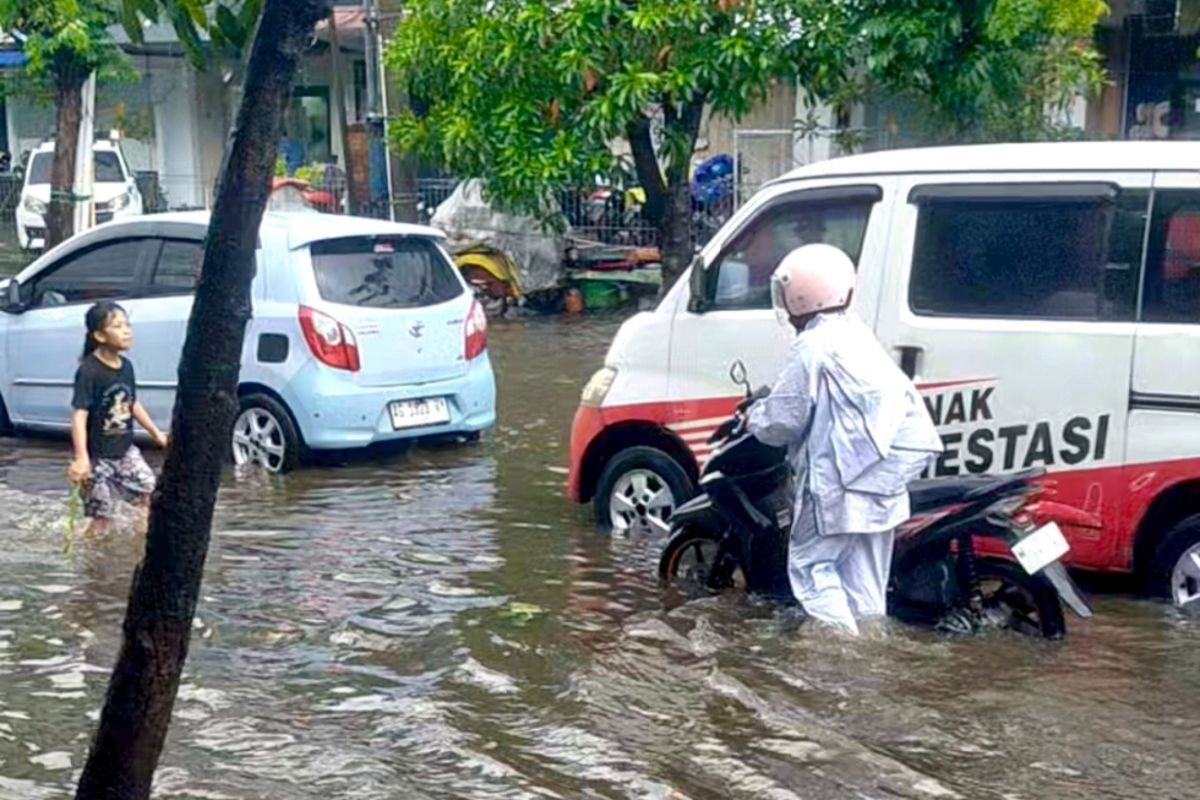
Heavy rain falling since dawn on Monday, 22 June 2026, transformed the rhythm of Surabaya, East Java, within hours. Roads meant to carry workers, students and logistics turned into waiting areas. Vehicles slowed, some broke down, while standing water appeared from the western to the eastern parts of the city.
The incident was not solely about excessively heavy rain. Surabaya was facing the convergence of three simultaneous forces: moderate to heavy local rainfall, runoff from higher ground, and a high tide that slowed the discharge of water downstream.
In a coastal city, drainage is not merely a matter of channels beneath the roads. It is a system connected from upstream areas, settlements, rivers, pump houses, to the sea. When the tide is high, water from the city often lacks room to exit immediately. Pumps continue to operate, but their thrust meets pressure from the opposite direction.
The Meteorology, Climatology and Geophysics Agency (BMKG) had issued a warning for potential moderate to heavy rain in several parts of Surabaya that morning. The alert showed that rainfall during the dry season is not impossible, particularly when local atmospheric conditions support the formation of rain clouds.
Standing water at a number of locations then served as a reminder that a modern city cannot simply build wide roads and fast-growing districts. The city must also ensure that water has a way home.
Surabaya possesses geographical characteristics that make water management a complex task. Certain areas receive runoff from higher ground in the west and south, then channel it to lower-lying areas before it reaches rivers and the sea. The Simo area, for instance, can receive flow from higher locations such as Dukuh Pakis and HR Muhammad. When rain falls simultaneously, water does not only pool where it lands but also moves along the city’s contours. Here, flooding must be understood as a matter of an entire catchment area, not merely a problem per sub-district or road segment.
At the same time, areas such as Tanjungsari, Tambak Mayor, Nginden, Ngagel and Bratang display different vulnerabilities. Some are constrained by channel capacity, some are affected by flows towards the Greges River, and others face obstacles because downstream water levels are already high.
The phenomenon of high tide creates a backwater effect. Water from city drains that should move towards the sea is held back because the receiving water level is higher. In such conditions, pump houses do not lose their function, but their effectiveness becomes limited. Pumping water without accounting for downstream conditions can result in water being retained within the same system.
For this reason, pump houses cannot be treated as a single answer. Pumps are an important part of the system, but they are no substitute for adequate channels, sufficient retention basins, clean rivers, and spatial planning that makes room for water.
The Surabaya Water Resources and Highways Agency (DSDABM) also reminded that rubbish and blocked drains can impede flow and disrupt pump operation. The problem appears simple, yet its impact is large. Waste entering drains not only slows the recession of floodwater but also increases the maintenance cost of public infrastructure.
Amid urban growth, every closure of open land, change in land use, and construction project must be ensured not to increase runoff risk. Rainwater that once infiltrated the soil now increasingly flows over impermeable surfaces. As a result, drains receive a larger volume of water in a shorter time.