
When the President's Right-Hand Man Clashed with a Four-Star TNI General
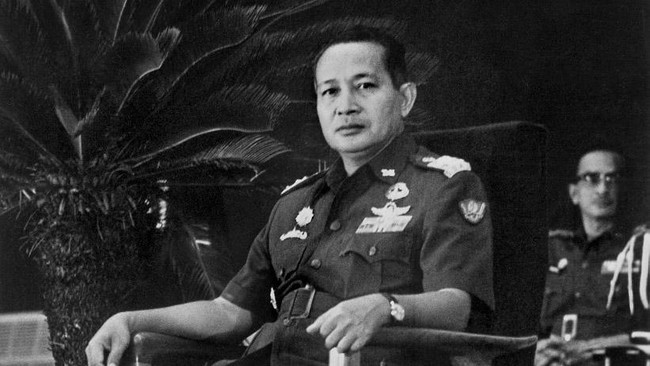
The inner circle of President Soeharto during the New Order era was not immune to internal political dynamics. Relationships between the President’s close associates were frequently marked by differing views on the execution of duties and authority.
Two influential figures within the ‘ring one’ of power at that time were the President’s Personal Assistant (Aspri), Ali Moertopo, and the Commander of the Command for the Restoration of Security and Order (Pangkopkamtib), General Soemitro. Although both enjoyed the trust of President Soeharto, they operated within different spheres of power.
Ali Moertopo had been managing various intelligence operations through Special Operations (Opsus) since 1968. Holding the rank of Major General, his influence was highly significant due to his direct access to the President. Meanwhile, General Soemitro, who served as Pangkopkamtib since 1971, held broad authority over national security, subversion prevention, and political stability.
The overlap of duties between the two became apparent starting in 1971. Soemitro believed that the existence of Opsus had the potential to cause overlaps with other official intelligence agencies, such as BAKIN or the Kopkamtib Intelligence unit.
“With the existence of Opsus, conflicts of interest between intelligence agencies could occur, for example, with Bakin or Kopkamtib Intelligence, leading to overlapping work areas. Occasionally, unnecessary tensions would arise,” Soemitro stated in his biography, Soemitro: From Panglima Mulawarman to Pangkopkamtib (1994).
On the other hand, Ali Moertopo’s inner circle believed that Soemitro frequently expanded his role beyond formal duties. Jusuf Wanandi, in his records Menyibak Tabir Orde Baru (2015), noted that in the early 1970s, Soemitro often took on a role in daily government coordination and would summon ministers to his office.
These differing approaches gradually triggered misunderstandings. Each side harboured suspicions that the other held too much dominant influence. The tension was further marked by security measures on the ground, including the deployment of troops and the regulation of coordination around Ali Moertopo’s residence, which was subsequently reported to President Soeharto.
Observing the situation, President Soeharto took steps to resolve the issue by convening the relevant high-ranking officers in late 1973. During this meeting, the President emphasised the importance of maintaining the succession process and the functioning of the government through constitutional channels.
A resolution to this rivalry was only reached following the Malari incident on 15 January 1974. According to Ken Conboy in Intel: Inside Indonesia’s Intelligence Service (2008), the riots, which began with student protests, led to an evaluation of national stability. As Pangkopkamtib, Soemitro subsequently decided to resign from his position.
Before ending his term, Soemitro held direct discussions with Ali Moertopo to discuss the developing situation.
Following these events, President Soeharto restructured the government and security apparatus. Figures from both sides were moved from strategic positions, the Aspri structure was disbanded, and Ali Moertopo was reassigned to BAKIN. From that point forward, the power-sharing pattern within the presidential circle was reorganised to prevent an excessive concentration of influence within a single party.
Source: jawawa.id (https://jawawa.id/newsitem/when-the-presidents-right-hand-man-clashed-with-a-four-star-tni-general-1788659572)
Originally published by CNBC Indonesia (https://www.cnbcindonesia.com/news/20260905210556-4-765372/ketika-tangan-kanan-presiden-ri-ribut-dengan-jenderal-tni-bintang-4), translated from Indonesian