
When the Indonesian President Was Forced to Cancel a Strategic Project to Save the Economy
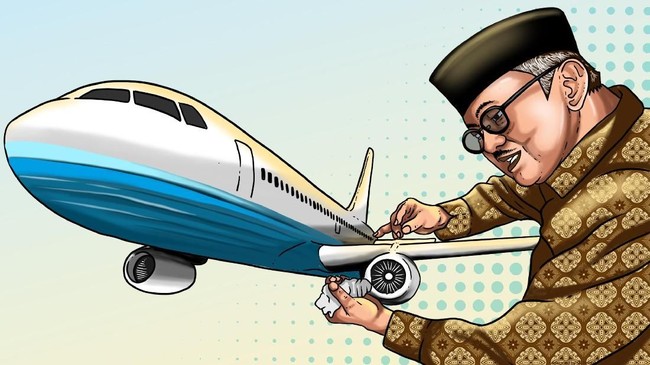
History records a heartbreaking moment when Indonesia’s third president, Bacharuddin Jusuf (B.J.) Habibie, was forced to halt the strategic national project he loved most. This bitter step had to be taken to save the Indonesian economy, which at the time was on the brink of collapse. Ironically, the project sacrificed was the fruit of Habibie’s decades-long struggle and dedication in the aerospace industry: the N250 aircraft. For the man born in Parepare, the N250 was not merely a flying sheet of metal. The project was a symbol, a quantum leap, and the embodiment of his ambition to transform Indonesia into a high-tech industrial nation. Habibie wanted to prove that the nation was capable of mastering advanced science and technology independently. History was written in gold when the N250 successfully took to the skies for the first time on 10 November 1995. Unfortunately, the euphoria did not last long. Not long after the Gatotkaca’s maiden flight, Indonesia was dragged into the vortex of the worst monetary crisis in its history in 1997-1998. The rupiah exchange rate collapsed to its deepest level, the national banking sector crumbled, and the state’s financial liquidity came under immense pressure. In order to secure international assistance to escape the abyss of the crisis, the Indonesian government was forced to sign a Letter of Intent (LoI) with the International Monetary Fund (IMF) in early 1998. This agreement on paper brought fatal consequences for the national aerospace industry: the total cessation of all subsidies and state funding support for strategic projects. The impact was instant. Projects requiring massive capital immediately lost their lifeline, and the N250, the project of national pride, became the primary casualty. This decision was extremely painful because the N250 was actually in the final phase of development. After its successful maiden flight in 1995, the advanced turboprop aircraft was undergoing an intensive flight test programme to obtain international airworthiness certification from the United States (FAA) and European (JAA) aviation authorities. In his memoir, ‘Detik-Detik yang Menentukan’ (2006), Habibie expressed his bewilderment and incomprehension at the IMF’s forceful demands. ‘I cannot understand, because it is completely without rational basis, why the IMF at the end of 1997 demanded that the government immediately stop assisting IPTN in completing the sophisticated N250 turboprop aircraft, whose maiden flight on 10 August 1995 was successful,’ Habibie recalled. Commercially, the N250 was designed with careful calculations. The aircraft was projected to be highly competitive in the global market, especially if world oil prices soared above US$35 per barrel. As a turboprop, the N250 was far more fuel-efficient than jet aircraft for serving short to medium-haul routes. More than just a trade commodity, Habibie viewed the N250 as a real solution for weaving connectivity and boosting the tourism sector across Indonesia’s vast archipelago. Ultimately, however, the complex economic reality forced the options to become extremely narrow. For the sake of macroeconomic stability and saving the livelihoods of the people, Habibie had to let Indonesia’s great aerospace ambitions freeze mid-flight.
Source: jawawa.id (https://jawawa.id/newsitem/when-the-indonesian-president-was-forced-to-cancel-a-strategic-project-to-save-the-economy-1783731031)
Originally published by CNBC Indonesia (https://www.cnbcindonesia.com/market/20260710235844-17-750002/saat-presiden-ri-rela-batalkan-proyek-strategis-demi-perbaiki-ekonomi), translated from Indonesian