
When the Economy Grows, Finding Jobs Remains Difficult
There is a question that has been increasingly heard in society lately: if Indonesia’s economy continues to grow at around five per cent, why does finding a job still feel so difficult? This question should not be answered merely by pointing to declining unemployment figures. Behind the relatively good macroeconomic indicators, a much more important structural change is underway; the relationship between economic growth, investment, and job creation is no longer as strong as it was in the past. The economy can grow, production can increase, investment can rise, and even productivity can soar, without generating as many formal jobs as we once imagined.
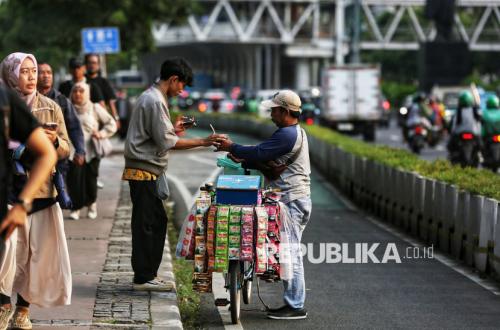
Recent data illustrates this paradox quite clearly. BPS (Statistics Indonesia) recorded that the Indonesian economy grew by 5.29 per cent year-on-year in the second quarter of 2026 and 5.45 per cent throughout the first half of 2026. In May 2026, 148.19 million people were recorded as employed, and the open unemployment rate stood at 4.65 per cent. Statistically, this is certainly not a picture of an economy losing jobs. However, about six out of ten Indonesian workers are still employed in the informal sector. Therefore, the issue is not simply whether jobs are available, but what kind of jobs are available.
This is the difference between having a job and having a good job. A person can be categorised as employed, but their income may be unstable, their productivity low, they may lack adequate social protection, have no career progression, and could lose their source of income at any time. Ride-hailing, micro-enterprises, small-scale trade, freelance work, and various informal economic activities have become vital social buffers. We must appreciate that function. However, a nation aspiring to be a developed country cannot allow informality to become a permanent condition for the majority of its workforce.
This problem becomes even more complex as we enter a productivity revolution. AI, robotics, automation, machine learning, and digitalisation allow companies to produce much greater output with fewer humans. An activity that once required dozens of people can now be performed by a few people with the aid of technology. Investment is also becoming more capital-intensive. Consequently, the old assumption that every increase in investment is automatically followed by a proportional increase in labour no longer holds true. Technology does not stop economic growth; rather, it can accelerate it. However, technology changes how that growth is translated into employment.
Therefore, we must not be trapped in a false choice between technology or labour. Rejecting robots and AI will only cause Indonesian industries to lose competitiveness. Conversely, leaving the entire transformation process to market mechanisms could concentrate the benefits of productivity among capital owners and high-skilled workers, while pushing other groups into low-productivity jobs. The World Bank has warned that job creation in Indonesia is still concentrated in low-value-added activities, while high-productivity, middle-class wage jobs are growing too slowly.
This is where economic policy orientation needs improvement. For a long time, we have been very proud when realised investment reaches certain figures. That is important, but not enough. Every major investment should also be tested against other questions: how many quality jobs are created, what wages are paid, how many local workers are trained, how many domestic suppliers grow, and how much technology transfer occurs? We need a sort of ‘Investment-to-Quality-Jobs Conversion Ratio’. With this metric, the success of investment is measured not just by the value of rupiah flowing in, but by the economic transformation it leaves behind.
Of course, not all investments must be labour-intensive. Data centres, modern smelters, chemical industries, semiconductors, and several strategic industries do require massive capital with relatively few workers. The nation still needs them. However, the national investment portfolio must be balanced. Indonesia also needs industries with a high employment multiplier: upgraded agro-industry, food and beverage, textiles and footwear, electronics, furniture, health products, creative industries, high-quality tourism, and various modern services. The strategy is not to choose between capital-intensive or labour-intensive, but to build a productivity-intensive economy that is also job-rich.
For this reason, reindustrialisation is vital. We should not view manufacturing merely as factories. A single manufacturing activity can sustain raw material suppliers, packaging, transport, warehousing, machine maintenance, design, information technology, financial services, and exports. The multiplier effect extends far beyond the factory gates. Indonesia requires a new generation of industrialisation, using modern technology while simultaneously building long domestic supply chains. The more value-added work is performed domestically, the greater the employment opportunities created.
However, industrial policy without human resource reform will only shift the problem. The competitors for Indonesian labour are no longer just workers from Vietnam, China, or India. The new competitors are humans using AI, automated machines, and robots. Even a university graduate no longer competes solely with other graduates. They may compete with someone without a high degree who learns continuously through digital platforms, masters AI, possesses a portfolio, and solves problems more quickly. The monopoly on knowledge by educational institutions has ended. Degrees remain important, but the ability to learn is far more decisive than before.
That is why investment in education must be expanded.