
When the Ecological Crisis Limits Freedom
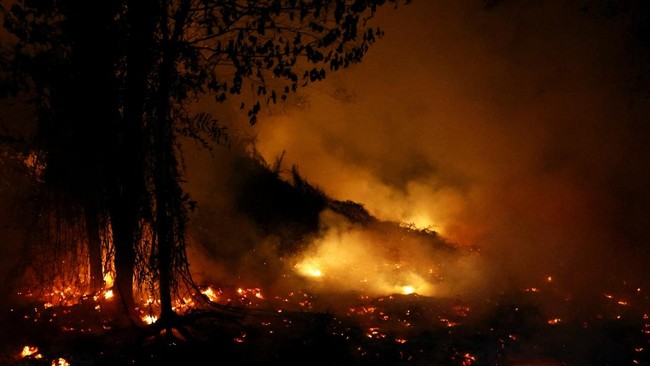
Indonesia has been celebrating 81 years of independence for more than a week. The red and white flag has been raised, ceremonies have taken place across the country, and we are once again reminded of the nation’s struggle to determine its own destiny. Yet on the same day, a number of areas in Kalimantan, one of Indonesia’s lungs, were again shrouded in haze from forest and land fires.
On Monday morning, 17 August 2026, the Ministry of Forestry’s forest and land fire monitoring system detected 93 high-confidence hotspots in West Kalimantan, 28 in Central Kalimantan, and two in South Kalimantan. Two days later, the number had risen to 518 points across the three provinces. The contrast raises a big question: after 81 years of independence, has the ideal of a sovereign, just, and prosperous Indonesia truly reached every space of our lives?
This question becomes important when we see that the challenges to independence today no longer always appear in the same form as eight decades ago. There are new problems that touch everyday life, affect living space, and test once again the extent to which the ideals of independence are truly felt.
On the morning when Indonesia celebrated its 81st anniversary, at exactly 07.00 WIB, the Ministry of Forestry’s forest and land fire monitoring system detected 93 high-confidence hotspots in West Kalimantan, 28 in Central Kalimantan, and two in South Kalimantan. Only two days later, the number had increased to 518 points in the three provinces. Cumulatively, during 17–19 August 2026, 750 high-confidence hotspots were detected, causing haze to enter people’s living areas.
Two days later, on 19 August, visibility at Supadio Airport in Pontianak was recorded at around 1.2 kilometres. In South Kalimantan, visibility at Syamsudin Noor Airport even briefly dropped to around 400 metres.
However, the haze problem does not stop at reduced visibility. It also narrows people’s space for movement, disrupts routines, and ultimately affects the fulfilment of citizens’ basic rights. One of the most obvious is the right of children to learn. The Ministry of Primary and Secondary Education recorded that 3,524 educational units had to implement distance learning. Around 571,338 students in West Kalimantan, Palangka Raya, and Banjarbaru continued to study from home due to deteriorating air conditions.
Indeed, these children have not completely lost their right to education. The right remains. But when haze prevents them from coming to school safely, their real ability to enjoy that right is diminished. This brings to mind Amartya Sen’s thinking in Development as Freedom (1999). For Sen, development is not only about rising incomes or growing infrastructure, but about the extent to which people have real freedom to live lives they consider valuable.
From this perspective, formal independence does not necessarily mean substantive independence. We may have the right to work, learn, and carry out activities. But when environmental conditions make those rights difficult to exercise, part of our freedom actually narrows.
Imagining how severe the haze is in robbing the freedom of communities in Kalimantan, I am also reminded of other lives that are affected yet have almost no space to speak. For wildlife, forest fires are not merely a disruption to daily life, but a threat to their homes and their survival.
When air quality deteriorates, we as humans can still complain. We can wear masks, close windows, move elsewhere, demand policies, or voice our concerns through various platforms. But Kalimantan’s forests are not only home to humans. Kalimantan is estimated to be home to around 57,350 orangutans.
In this year’s forest and land fires, hotspots were reported to be approaching orangutan population areas, including areas around Sebangau National Park. Haze can also disrupt the flowering and fruiting processes of forest plants, reducing food sources for orangutans. Several orangutans have even had to move habitat. A mother named Mama Yuni, along with her two children, Yuni and Pura, was evacuated from her original habitat in Ketapang Regency, West Kalimantan, and relocated to Gunung Palung National Park.
We can complain when our homes are filled with smoke. But wildlife does not have the same space to voice objections when their homes burn. At this point, the issue is no longer only about justice for humans, but also ecological justice. David Schlosberg (2007) reminds us that environmental justice does not stop at the distribution of benefits and burdens for humans, but also concerns the ability of living beings and ecosystems to sustain their lives. The loss of habitat, reduced food sources, and disrupted roaming space caused by forest and land fires show how a single event can alter the balance of life within the forest.
This points to a broader issue: how humans place themselves within the same ecosystem, while also determining the boundaries between freedom, interests, and responsibility towards other life.
Dry seasons and El Niño can indeed increase the risk of forest and land fires. Wind, humidity, land characteristics, and low rainfall also determine how quickly fire spreads. However, weather only creates the conditions.