
When the Chinese Communist Party Embraced Entrepreneurs
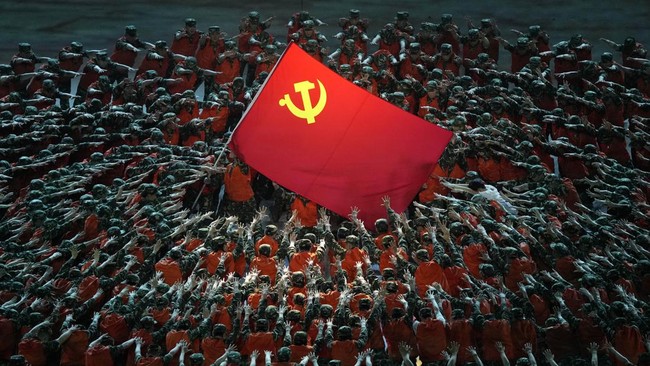
At the turn of the 21st century, the Chinese Communist Party (CCP) made a bold change that strengthened the People’s Republic of China’s (PRC) path towards becoming the advanced economy we know today.
At a celebration marking the party’s 80th anniversary in July 2001, CCP General Secretary Jiang Zemin explained the theory of the “Three Represents” as a development of Mao Zedong Thought and Deng Xiaoping’s theory of socialism with Chinese characteristics.
One of the theory’s calls was to support China’s productive forces. This opened up participation in national development to entrepreneurs, private businesses, technical professionals and others who had previously been excluded.
Deng Xiaoping’s economic reforms
At the turn of the 21st century, China was already very different from the country Mao had led out of the century of humiliation, through successive waves of civil war, war with Japan and then another civil war between the Communists and the Kuomintang nationalists.
Founded in 1949 on the ruins of the Kuomintang’s defeat under Chiang Kai-shek, China experienced the Great Leap Forward, the Cultural Revolution and other upheavals before Deng Xiaoping began economic reforms in the late 1970s.
Having seen the consequences of mismanagement caused by politically and ideologically driven policies, Deng quickly began reforms across several sectors. At the Third Plenum of the 11th Central Committee of the Chinese Communist Party in 1978, one of the reform proposals under discussion was a shift towards economic reform, to begin the following year. The party was expected to lead the effort.
Michael Wicaksono, in his 2017 book People’s Republic of China: From Mao Zedong to Xi Jinping, 1949–Present, describes how radical Deng’s reforms were, particularly from the perspective of communist ideology.
In early 1979, Deng summoned Rong Yiren, Hu Juewen, Hu Zi’ang, Gu Gengyu and Zhou Shutao. Known as the “Five Elders”, they were a group of former Chinese tycoons from before the founding of the PRC, whom Deng consulted on how to improve the country’s economy.
What distinguished the five from other former tycoons was their patriotism: they refused to turn their backs on their country when the revolution took place. That may also have saved Rong and his colleagues from being swept away by the Communist revolution.
Deng pursued his reformist economic policies until the end of his leadership in the late 1980s. In his essay “Economic Reform in China and the Soviet Union: A Comparison”, Rizal Mallarangeng examines the changes Deng introduced in detail.
In agriculture, Deng effectively allowed farmers to work their own land as they saw fit and to plant the seeds of their choice. He also relaxed controls that kept food prices low, enabling farmers to earn more from sales. This increased their incentive to work harder.
Deng next eased price controls on other commodities. By April 1979, policymakers were allowing the prices of many consumer goods to adjust to market conditions.
The prices of key industrial commodities such as steel and coal, however, remained under government control. The move gave the market more room to operate and made the Chinese economy more effective, as prices reflected actual market conditions rather than being set arbitrarily by bureaucrats.
In industry and trade, Deng gave state-owned enterprises greater authority to develop their own businesses through innovation, bonuses and other incentives designed to boost workers’ productivity.
The government also decided to encourage small private businesses in consumer goods and services. From just 100,000 private businesses in 1978, their number rose to 5.8 million by 1983. China’s rise towards becoming one of the world’s biggest economic powers was already taking shape.
In “Chinese Economic Reforms: Path, Progress, and Prospects” (1995), JC Sandesara presents statistics showing the success of Deng’s reforms. From 1979 to 1989, China recorded average gross national product growth of 9.1 per cent.
Per capita income growth rose from 5.53 per cent in the 1970s to 7.62 per cent in the 1980s. Imports’ contribution to GNP increased from 5.1 per cent to 6.7 per cent between 1978 and 1991, while exports’ share rose from 4.9 per cent to 10.2 per cent. In a more everyday measure, pork consumption increased by 94 per cent between 1978 and 1988, from 7.7kg to 14.9kg per person.
Economic change, ideological change
The changes brought about by Deng’s reforms in the second half of the 20th century took China into a new world, particularly in economic life. The Chinese Communist Party’s ideological outlook and position were among the aspects most affected.
Under Mao, the party had focused on developing Marxist-Leninist ideology. Deng’s rise to the top corrected Marxist-Leninist practices considered unsuited to China’s changing social, cultural and economic circumstances, which had led to costly mismanagement.
Initially, as noted above, Deng’s intention was simply to improve the country’s economic situation. But the reforms achieved far more than he had intended. The success of rebuilding China’s economy and turning it into an advanced economy brought back social groups that had been marginalised by the Communist revolution.
This first became evident in the return of former tycoons such as Rong Yiren, Hu Juewen and their colleagues, whom Deng gave important positions and roles in China’s economic development in the late 1970s. As the reforms progressed, they were joined not only by former tycoons but also by a new generation of private-sector workers, entrepreneurs, technical professionals, other professionals and more.
They now live alongside party cadres, the People’s Liberation Army and government bureaucrats, who had long been pillars of Chinese Communist society. As the economy changed, so too did the make-up of Chinese society.
This created a fundamental question for the CCP: how should the party respond to the emergence of these new groups in a social, political, cultural and economic life then dominated by workers, farmers, progressive intellectuals, party cadres, and officers and soldiers of the People’s Liberation Army?
Jiang Zemin’s Three Represents
It was here that Jiang Zemin, as CCP General Secretary, took a bold step. He responded to these developments by proposing the theory of the “Three Represents”, first put forward in 2000.
Jiang then returned to the theory and explained it at length in a speech marking the CCP’s 80th anniversary. The “Three Represents” strengthened the party’s role as a vanguard in building Chinese society, but rejected the narrow view that it represented only the traditional interests of workers and farmers.
The theory held that, amid these changes, the CCP should represent the development of China’s advanced productive forces. Second, it should represent the orientation of the country’s advanced culture.
Third, it should represent the fundamental interests of the majority of the Chinese people. In elaborating on the theory, Jiang said the development of China’s contemporary economy had brought forth new social groups: entrepreneurs, technical employees in the private sector, managers, private business owners and even freelance professionals.
Unlike party bureaucrats, workers’ and farmers’ cadres, and soldiers, these new groups tended to work professionally towards goals that were not necessarily ideological. Economic incentives and a meritocratic system that rewarded individual ability were therefore important to their development and their positive contribution to China’s national development.
The CCP now opened its doors to them. Jiang said that, as long as these new social groups worked honestly and conducted their activities in accordance with the law, they could join workers, farmers, progressive intellectuals, party cadres and People’s Liberation Army soldiers in building a socialist society with Chinese characteristics. The party called on citizens from all walks of life who were loyal to the country and socialism to work together to build the nation.
In line with this ideological development, the CCP reformed its party system, strengthened intra-party democracy, renewed its leadership, developed more scientific methods of leadership and introduced other changes.
Intra-party democracy was strengthened by listening to members’ views on major issues before the leadership made decisions. The party also encouraged younger, educated, professional and capable cadres.
In short, party management and operations became more systematic and professional, and more data-driven. In China, where the Communist Party is closely bound to the government, changes on one side affect the other.
The CCP’s reforms, which followed the changes in China’s economic order after Deng’s reforms, did more than make the party’s work more effective. By making it more conducive, responsive and accommodating to new social groups inclined towards professionalism, the party attracted entrepreneurs, business owners, professionals and others.
These groups, in turn, found a home in the CCP alongside farmers, workers and other traditional forces in Communist society. The party became their political vehicle for pursuing their interests in building a socialist society that made room for innovation and entrepreneurship, and valued individual initiative and achievement.
Source: jawawa.id (https://jawawa.id/newsitem/when-the-chinese-communist-party-embraced-entrepreneurs-1794329467)
Originally published by CNBC Indonesia (https://www.cnbcindonesia.com/opini/20261110225315-14-784068/ketika-partai-komunis-tiongkok-merangkul-kalangan-pengusaha), translated from Indonesian