
When Terrorists Seized the Grand Mosque: Hundreds Wounded on the Islamic New Year
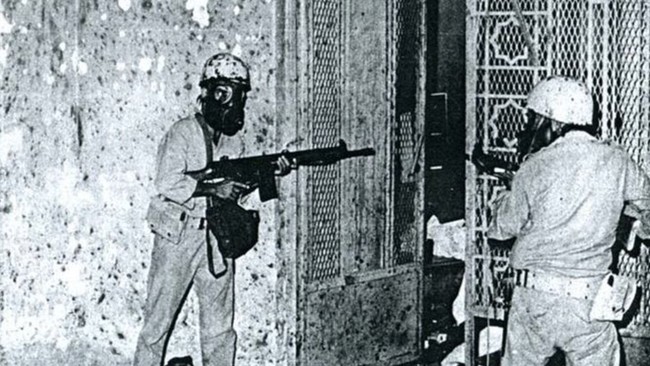
A dark event in Islamic history is remembered each Islamic New Year. On 20 November 1979, coinciding with 1 Muharram 1400 Hijri, terrorists seized the Grand Mosque in Makkah and held hundreds of worshippers hostage.
The incident occurred shortly after the dawn prayer. As worshippers still crowded the mosque area, an armed group suddenly took control and sealed off several access points.
According to M. E. McMillan’s ‘From the First World War to the Arab Spring’ (2016), the terrorist leader was Juhayman al-Otaybi, a former member of the Saudi Arabian National Guard. He and his followers accused the royal family of deviating from Islamic teachings and being too close to Western influence, thus justifying a coup.
The group also proclaimed that one of their followers, Mohammed Abdullah al-Qahtani, was the Imam Mahdi, a figure believed in Islam to appear at the end of times to establish justice.
The situation presented the Saudi government with a huge dilemma. On one hand, the Grand Mosque is the holiest site in Islam, requiring any military action to be extremely cautious. On the other, the rebels had taken hostages and were in control of the complex.
After obtaining a fatwa from religious scholars, the government launched a major operation to retake the mosque. Security forces laid siege to the complex for nearly two weeks, engaging in fierce battles with the militants who were entrenched inside the mosque and its network of underground tunnels.
To force the militants out, Saudi forces employed various strategies, including flooding the tunnels where they were hiding. The operation also received technical assistance from the French anti-terror unit, GIGN.
After almost two weeks, government forces successfully ended the occupation. Mohammed Abdullah al-Qahtani was killed in the fighting, while Juhayman al-Otaybi was captured alive and later executed in 1980 along with several of his followers.
The Grand Mosque seizure resulted in the deaths of 27 worshippers and left hundreds more injured. Many analysts view this tragedy, which occurred precisely at the start of the Hijri year 1400, as a turning point that prompted significant changes in the Kingdom of Saudi Arabia’s religious and social policies.