
When Science Immortalises a Name: A Lesson from Rote Island, NTT
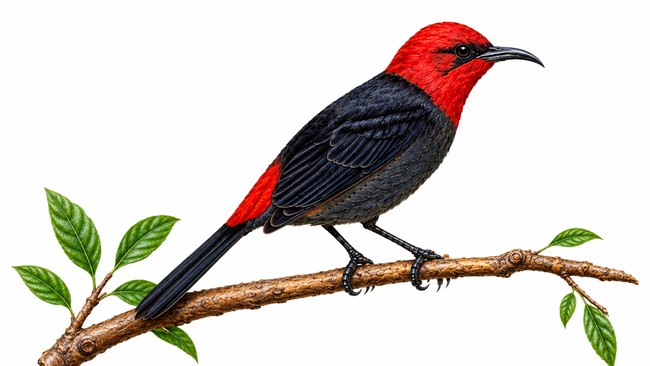
How does a person’s name become immortalised as a bird? That is what happened to Iriana Joko Widodo, whose name was given to the scientific designation Myzomela irianawidodoae, a bird endemic to Rote Island, East Nusa Tenggara. Officially recognised as a distinct species and introduced in 2017, the story of Myzomela irianawidodoae is not just about a name, but also about Indonesia’s rich biodiversity and the work of scientists in uncovering and documenting the archipelago’s natural wealth.
In science, every species found to be distinct from others is given a scientific name as its official identity, used by researchers worldwide. The name irianawidodoae is a tribute to Iriana Joko Widodo, who was the First Lady of Indonesia at the time. However, behind a scientific name lies a lengthy research process. Researchers observed the bird living on Rote Island and compared it with its close relatives. One of the researchers involved was Dr. Dewi Malia Prawiradilaga, a scientist from the Indonesian Institute of Sciences (LIPI), now part of the National Research and Innovation Agency (BRIN), along with fellow Indonesian researchers and partners from Singapore. Through observations of form, colour, sound, and other characteristics, the researchers found several differences indicating that the bird from Rote was a distinct species. The story of Myzomela irianawidodoae is therefore not just about a name. Behind it lies the tale of Rote Island’s biological richness, the dedication of researchers, and the importance of preserving scientific evidence of every discovery in scientific collections.
Pulau Rote, in East Nusa Tenggara, is one of Indonesia’s southernmost islands. It is known for its traditional Ti’i Langga hat, expanses of savanna, relatively dry landscape, and distinctive island environment. Behind its unique natural conditions, Rote harbours fascinating biodiversity, including various bird species with limited distribution. One of these is a bird from the genus Myzomela. Researchers found a population of Myzomela on Rote with characteristics different from its relatives in other regions. These differences prompted further investigation until the bird was finally designated as a separate species, Myzomela irianawidodoae.
At first glance, the Myzomela bird from Rote Island looks like its relative living on Sumba Island, Myzomela dammermani. Due to this similarity, the Rote bird was previously considered the same species. Its presence had even been observed since 1990. Researchers then examined the bird more closely, comparing the shape and colour of its feathers and its song with those of its Sumba relative. The results showed consistent differences, particularly in feather patterns and vocal characteristics. These findings formed the basis for the researchers to declare the Rote bird a different species. In 2017, the bird was introduced to the scientific world as Myzomela irianawidodoae, or the Rote Myzomela.
The discovery of a new species does not happen overnight. Behind Myzomela irianawidodoae is the collaborative work of Indonesian and Singaporean researchers who observed, collected data, and compared the bird from Rote Island with its close relatives. The research involved Dewi Malia Prawiradilaga, Pratibha Baveja, Suparno, Hidayat Ashari, Nathaniel Sheng Rong Ng, Chyi Yin Gwee, Philippe Verbelen, and Frank Erwin Rheindt. The Indonesian team was from LIPI, while the Singaporean team was from the National University of Singapore. This collaboration shows that biodiversity research requires more than just field observations. Researchers need to combine various information, compare findings with existing collections and data, and ensure that the differences found truly indicate a distinct species. The research results were published in 2017 in Treubia, a scientific journal published by LIPI. This publication was a crucial step in introducing Myzomela irianawidodoae as a new species to the scientific community. Behind a small bird from Rote Island lies a story of perseverance, cooperation, and a long scientific process. Discovering a species is not just about finding something new, but about presenting scientific evidence that enriches our knowledge of Indonesia’s biodiversity.
A small bird flying freely on Rote Island has ultimately left a trace that will not disappear. Several specimens are stored at the Museum Zoologicum Bogoriense (MZB), part of the Directorate of Scientific Collection Management at BRIN in Cibinong, as scientific proof that Myzomela irianawidodoae truly exists. One of these was designated as the holotype, the primary specimen that serves as the reference for identifying and naming a species, with the number MZB.Ornit.34.650. In the future, when the bird’s population may have changed, its habitat shrunk, or it may no longer be found in the wild, this specimen will remain as a witness to its existence. This is the power of scientific collections. They do not just preserve the body of a bird, but also a piece of Indonesia’s living history—a record that allows future generations of scientists to study what once lived in the Nusantara.
Discovering a new species is not merely about adding a name to the biodiversity list. Each species is a part of the ecosystem.