
When Rumours Inflate the Market: Lessons on the Price of Uncertainty
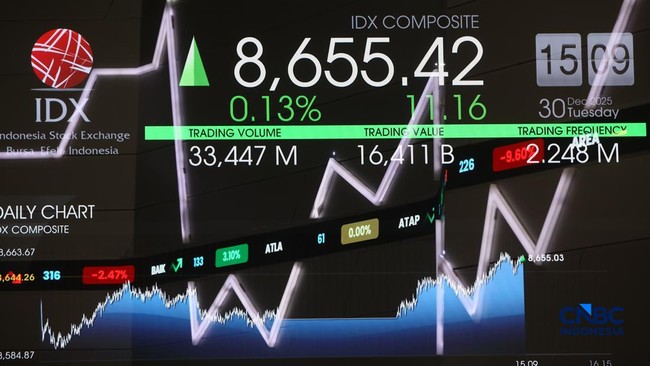
Financial markets often react not to what is happening, but to what might happen. In the world of investment, perception frequently moves faster than fact, while expectations often carry more weight than ongoing reality. Recently, the public sphere has been filled with rumours regarding the potential replacement of several key figures in national economic management, including fiscal and monetary authorities.
At almost the same time, the Rupiah exchange rate moved towards the Rp18,000 per US Dollar range, briefly touching historic lows. The stock market has also been under pressure following a deep correction from its peak several months ago. Meanwhile, foreign investors continue to adjust their portfolios and reduce exposure to several domestic financial instruments.
It is certainly unfair to attribute all this volatility solely to a single rumour. Global factors continue to play a major role. The strengthening of the US Dollar, high global interest rates, geopolitical uncertainty, the global economic slowdown, and increasing investor caution towards emerging market assets are all part of the landscape facing almost all emerging markets.
However, it is precisely within this fragile global environment that the market becomes far more sensitive to every domestic signal. In such conditions, a rumour that might only be momentary conversation in normal times can transform into a catalyst that amplifies market volatility. This event reminds us that in the modern economy, uncertainty carries a real price.
When Confidence Becomes Currency
In financial economic theory, there is a concept known as the ‘uncertainty premium’—the additional cost a country must bear when levels of uncertainty increase. When investors are unsure of the direction of policy, they demand higher yields, reduce investment, or move funds to assets considered safer.
The consequences can be seen across various economic indicators: weakening exchange rates, stock market corrections, rising funding costs, delayed investment, and slowing economic activity. Unmanaged uncertainty is ultimately translated by the market as risk, and every risk has a price to be paid.
Nobel Prize winner Robert Shiller, through the concept of ‘Narrative Economics’, explains that the economy is driven not only by data and policy but also by stories believed collectively by society and market participants. Narratives shape expectations. Expectations shape behaviour. And behaviour ultimately affects economic reality.
This is why rumours often possess an influence far beyond their substance. The market reacts not only to available facts but to possibilities perceived to be able to change the future.
Similar phenomena can be found in various countries. The United Kingdom experienced serious bond market turmoil in 2022 when investors questioned the credibility of the government’s fiscal policy direction. The United States has repeatedly demonstrated how changes in expectations regarding Federal Reserve policy can move trillions of dollars in market capitalisation in just hours.
The International Monetary Fund, through the World Uncertainty Index, shows that surges in uncertainty are almost always followed by a slowdown in investment, increased financial market volatility, and weakening economic activity.
Similar findings are seen in the Geopolitical Risk Index developed by Federal Reserve researchers. When uncertainty rises, investors tend to seek protection rather than opportunity. In other words, what the market truly seeks is not just profit, but certainty.
The Importance of Policy Signals
Therefore, various efforts to strengthen policy communication deserve appreciation. One such effort was seen when the Deputy Speaker of the House of Representatives and Chairman of the Gerindra Party, Sufmi Dasco Ahmad, brought together Finance Minister Purbaya Yudhi Sadewa and Bank Indonesia Governor Perry Warjiyo in a forum published amidst rising market speculation.
The presence of these two figures, who hold central roles in maintaining fiscal and monetary stability, was not merely a public communication agenda. For market participants, the meeting sent a much more important message: national economic policy coordination remains in progress, economic stability remains a priority, and both fiscal and monetary policy directions are being maintained consistently and sustainably.
From a modern economic perspective, this step is a form of ‘policy signalling’. Nobel laureate Michael Spence explains that when information is not entirely symmetrical, the market reads various signals provided by policymakers to assess future prospects.
The market does not always demand good news. The market values certainty more than ambiguity. Investors can accept heavy economic challenges as long as they understand the policy direction that will be taken to face them.
Institutions Stronger Than Rumours
The greatest lesson from this episode is not actually about who holds office or who is rumoured to change. The more important lesson is about how to build institutions that are stronger than rumours. A resilient nation must not depend on a single individual. A strong nation is built by credible institutions, consistent governance, and trustworthy policy coordination. When the market is confident that the system will continue to function well regardless of who is in it, the space for speculation is reduced.
Source: jawawa.id (https://jawawa.id/newsitem/when-rumours-inflate-the-market-lessons-on-the-price-of-uncertainty-1780810695)
Originally published by CNBC Indonesia (https://www.cnbcindonesia.com/opini/20260607104401-14-740745/ketika-rumor-menggoreng-pasar-pelajaran-tentang-harga-ketidakpastian), translated from Indonesian