
When Reservoirs Become Guardians of Rice Fields and Pillars of Hope for Residents
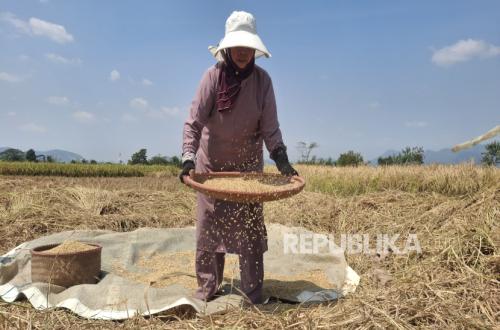
The scorching sun beat down as Nunung Sumarni (52) swung her sickle in the rice fields of Cangkorah Village, Batujajar District, West Bandung Regency (KBB), West Java. She was sorting which rice was ready to harvest. In the middle of this dry season, the farmer from Sapih Manggu Hamlet, RT 01, RW 11, Cangkorah Village, had to struggle extra hard so that the rice she planted about three months ago could still be harvested. Her field is a rain-fed area, agricultural land whose main water source depends heavily on rainfall.
There is no irrigation water from rivers to sustain the fields belonging to Nunung and other farmers. Her field is only flooded with water during the rainy season, and lacks water when faced with the threat of a prolonged drought due to the El Niño phenomenon. She was worried that not all of her rice would be harvested. “This is harvest time, it’s already due. But because of the dry season, some has ripened, some hasn’t,” said Nunung during a conversation with Republika on Tuesday (28/7/2026).
On the approximately 2,000 square metre field she works, rice still stretches across the land even though the drought threatens the harvest. Some has indeed turned yellow and is ready to harvest, while some is still green. Around her, rice is also still growing, and some has already been harvested, leaving only stubble on ground that is beginning to dry out due to the lack of water.
Farmers whose rice has not yet been planted are certainly anxious because this dry season is expected to last a long time. However, Nunung could still breathe a sigh of relief because the rice planted in the second period this year was still saved despite the absence of rain. Her agricultural area remains moist thanks to the presence of the Saguling Reservoir. “Actually, I was quite worried because of the weather. This could grow until it was ready to harvest because we used a hose, drawing water from the Saguling Reservoir. But now the water has started to recede too,” said Nunung.
She hopes that this year’s dry season harvest will still be satisfactory even without irrigation or rainwater. On the other hand, the water from the Saguling Reservoir, which is heavily relied upon for her rain-fed field, is beginning to recede. When conditions are good, the dry rice she obtains in one harvest season can reach 6 quintals. “When it’s good, I can get 5-6 quintals, but when it’s bad, at most 3-4 quintals. If the price is good, I can get Rp 600,000 per quintal,” said Nunung.
She and her family depend heavily on agricultural produce to keep their kitchen running. Besides being cooked at home, the harvest is usually also sold. “The money is for my children’s school allowance and so on,” said Nunung.
The dry season indeed brings challenges for people whose livelihoods depend on water availability. Amid the threat of reduced river flow and increased water demand, the existence of dams and reservoirs serves as the main buffer for life, from irrigating rice fields and providing clean water to supporting fish farming businesses.
In the Colo Timur Irrigation Area, Colo Weir in Central Java is not merely a structure for regulating river flow. The infrastructure supports food production on thousands of hectares of rice fields spread across Sukoharjo, Karanganyar, Sragen, and Ngawi.
The Chairman of the Main Association of Water User Farmers in the Colo Timur Irrigation Area, Sarjanto, said that water management this year had been prepared from the start, so farmers are optimistic that water needs can still be met until the end of the third planting season. “Alhamdulillah, this year it has been planned well. So even though there is El Niño, the water supply in the Colo Timur irrigation area should still be safe until the third planting season is complete,” said Sarjanto when met by Republika on Monday (27/7/2026).
According to him, the biggest challenge during the dry season actually comes from the increasingly hot weather. High temperatures cause greater water loss along irrigation channels than usual. He explained that the water flow from Colo Weir must be divided among four regencies, so irrigation officers have to work extra hard to ensure even distribution. “The water channelled is about 16 cubic metres per second and is divided among Sukoharjo, Karanganyar, Sragen, and Ngawi. Because almost all of them need water at the same time, the distribution is indeed not easy,” he said.
For Sarjanto, the existence of Colo Weir is very important for the agricultural sector. “Colo Dam is like the artery, the heart of agriculture. More than 20,000 hectares of rice fields depend on this dam. Therefore, management, maintenance, and water allocation planning are very important,” he said.
As an anticipatory measure in case of water distribution disruptions, the community has also begun building small reservoirs as backup storage. “We have built a small reservoir. It is not yet operating at maximum capacity, but it has been approved for dredging so that its storage capacity is larger. If there is a problem in the main channel, that water can be used for emergency purposes,” he said.
He hopes the government will continue to accelerate the rehabilitation of ageing irrigation networks. “Farmers hope that the old networks can be rehabilitated soon. Government programmes already exist, but we hope the repairs can be more comprehensive,” he said.
Unlike areas that enjoy irrigation supply from Colo Weir, some farmers in Selogiri District, Wonogiri, still depend on rainwater storage. When the dry season arrives, their fields dry out more quickly. Ibu Muki, one of the farmers, admitted that her harvest has begun to be affected by the lack of water. “This harvest is somewhat poor. Lack of water. We supplement it from a well, pumping from a well. The irrigation is lacking,” she said when met in the fields during a harvest break on Monday (3/8/2026).
According to her, her area has not yet received water supply from the Gajah Mungkur Reservoir because the land is at a higher elevation. “Here we only rely on rain-fed reservoirs. Not yet from Gajah Mungkur. They say it’s because…”
Source: jawawa.id (https://jawawa.id/newsitem/when-reservoirs-become-guardians-of-rice-fields-and-pillars-of-hope-for-residents-1786924245)
Originally published by Republika (https://news.republika.co.id/berita/tjjhk7487/ketika-waduk-menjadi-penjaga-sawah-dan-sandaran-pengharapan-warga), translated from Indonesian