
When Mother Earth Is Troubled Again
“I see Mother Earth, troubled and distressed.”
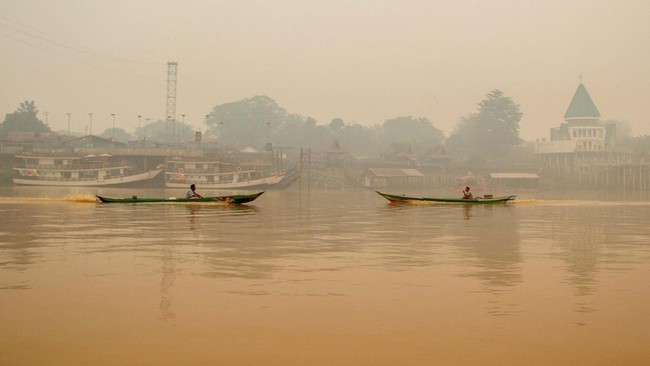
A line from Ismail Marzuki’s song Ibu Pertiwi feels different when sung by a nation facing a range of problems. Its sadness seems reflected in reality: burning forests, smoke-filled air, floods inundating residential areas and disruptions to people’s access to basic necessities.
It is hardly surprising that Ibu Pertiwi is often heard again when Indonesia faces difficulties. The song seems to express public unease, as people question the state of their country and its future.
That picture feels relevant to events throughout 2026. Indonesia has faced a series of problems, from forest and land fires to disruptions in fuel distribution and electricity supplies, as well as flooding. These events have occurred in different parts of the country, with varying causes and impacts, but all have affected people’s lives.
One issue currently attracting widespread attention is forest and land fires. Data from the Forestry Ministry’s SiPongi system recorded an indicative burned area of 202,004.30 hectares from January to July 2026.
By October, the Forestry Ministry had detected 1,359 hotspots with a high confidence level across Indonesia, based on monitoring up to 5 October 2026. The figure illustrates the scale of the challenge in controlling fires in the country.
Kalimantan is among the areas affected, with smoke crossing the border into neighbouring countries. This has prompted calls for Indonesia to take more serious steps to tackle fires and transboundary haze pollution.
On 12 October 2026, Malaysia’s Foreign Minister, Mohamad Hasan, said he would raise the haze issue at a meeting of ASEAN foreign ministers ahead of the ASEAN Summit in November.
Malaysia is seeking a more effective regional mechanism to address the problem. Singapore, meanwhile, has indicated that it may take legal action against companies responsible for fires that cause transboundary haze pollution.
Pressure from the two countries shows that the impact of forest and land fires is no longer confined to domestic environmental concerns. It also affects public health and international relations, and raises questions of accountability for those involved.
Another environmental problem was the flash flood that hit Solok Regency, West Sumatra, on 21 September 2026. According to the Meteorology, Climatology and Geophysics Agency (BMKG), heavy rain, with rainfall reaching 94 millimetres in a day, triggered the flood. Rising water flows, accompanied by landslides and rock, mud and sand, swept through residential areas and a government office complex.
The incident shows how intense rainfall can turn into a disaster that threatens residents’ safety and damages public facilities. The National Disaster Mitigation Agency (BNPB) reported two deaths after people who had been declared missing were found dead.
Beyond environmental problems and natural disasters, disruptions to public services have also affected people’s lives. On 13 October 2026, Indonesia’s Ombudsman received 25 initial reports concerning service and fuel-distribution disruptions in 11 provinces, including Bali.
Since 11 October, queues of vehicles have built up at several petrol stations because of delayed fuel deliveries, attributed to problems with transport vessels and bad weather. People have been queuing to obtain fuel, with lines of vehicles at some locations spilling onto the roads.
This situation warrants particular attention because disruptions to fuel distribution could hinder people’s mobility and economic activity, including tourism, a key pillar of Bali’s economy.
Energy-supply problems have also occurred in Batam, where a power-system disruption at 6.37am on 12 October caused outages in several areas. The disruption affected residents and businesses. PLN Batam restored supplies in stages, with service to affected customers returning by 13 October, a day after the problem began.
These incidents have different causes. But they all prompt a question that merits collective reflection: have prevention efforts been adequate, or do we too often act only after people have suffered the consequences?
Not every disaster is caused by human error. Climate change and extreme weather can increase risks, while environmental damage and weak oversight may worsen their impact. The technical causes and management of fuel-distribution problems and power disruptions also need to be examined.
It would be wrong to attribute every problem to the negligence of one party. Yet differences in cause should not prevent scrutiny of preparedness, prevention efforts and each party’s responsibilities in accordance with its role and authority.
These problems show that the challenges facing Indonesia are interconnected. Forest and land fires, flash floods, fuel-supply disruptions and power cuts each have distinct causes and characteristics.
But every incident leaves a fundamental question: who is responsible? Is it the companies proven to have damaged the environment, the public or the government? It would be wrong to blame every problem on the negligence of one party.
Each party has responsibilities according to its role and authority. Companies must answer for pollution or environmental damage proven to have been caused by their business activities, while the public also has a duty to protect and preserve the environment.
The government, however, has a different responsibility because its powers are broader: from drafting regulations and allocating budgets to carrying out oversight, enforcing the law, preparing for disasters and ensuring that public services function as they should.
The constitutional basis is set out in Article 28H(1) of the 1945 Constitution of the Republic of Indonesia, which guarantees everyone the right to a good and healthy environment. Article 33(3) also states that the earth, water and natural resources are controlled by the state for the greatest prosperity of the people.
Article 33(4), meanwhile, mandates an economy that is sustainable and environmentally conscious. These provisions underline the state’s important role in ensuring that the use of natural resources remains consistent with environmental protection and the public interest.
The government’s responsibility should therefore be judged by how far it fulfils this constitutional mandate through real policies and action. People need to see that the right to a good and healthy environment is a fundamental right they are entitled to as citizens.
The forest and land fires in Kalimantan illustrate why evaluation is important. When fires continue for months and smoke disrupts people’s lives and crosses national borders, the response cannot stop at extinguishing the flames.
The government must ensure that prevention continues, that land use is adequately monitored and that any proven violations are dealt with under the law.
Calls for the government to work transparently and provide information are increasingly relevant. With rapid and widespread access to information, the public can compare official statements with conditions on the ground.
People are now more active in scrutinising government policy and voicing criticism when they see something that does not match their expectations or the reality on the ground. Such critical engagement is part of democratic life and should be respected.
Criticism should not be viewed as a threat, but as an opportunity for the government to assess policies, address shortcomings and build public trust. The government should respond with data, open explanations and concrete, useful actions for which it can be held accountable.
When a problem remains unresolved, the public has the right to know its cause, what steps are being or will be taken, and how the response is progressing. Public trust does not grow simply from statements that a situation is under control, but from consistency between explanations and reality.
This reflection should not stop with the government and businesses. We should also ask ourselves, as Indonesian citizens: how have we treated the natural world that sustains our daily lives?
We are familiar with the principle of reciprocity, or reaping what we sow: what we plant is what we will eventually harvest. In the relationship between people and nature, this cause-and-effect principle can be understood in concrete terms.
Land clearing that disregards the environment’s capacity can make ecosystems more vulnerable. The loss of water catchment areas can increase flood risks, while damage that accumulates over many years may only become apparent when disaster strikes.
The principle of reaping what we sow must not, of course, be used to blame one another when disasters occur. Not every natural event is caused by human error, and those affected by disasters may have played no part in the damage.
Instead, the principle should prompt every party to reflect, act more carefully and avoid ignoring the consequences their actions may have for the environment and people’s lives. The song Ibu Pertiwi reminds us that love of country also means caring about the state of the nation and the lives of its people.
When forests burn, disasters strike and people’s access to necessities is disrupted, that concern must be translated into action. The government must fulfil its responsibilities, businesses must consider the impact of their activities, and the public must help protect the environment and scrutinise the implementation of policy.
If Mother Earth is troubled again today, we should not simply give way to sadness. We must learn from each problem, put right what has gone wrong and work to prevent the same mistakes from recurring.
Not all of us have the authority or ability to bring about major change. But being unable to do a great deal does not mean we can do nothing.
Protecting the environment through simple actions, using resources wisely and speaking up about our concerns are small but meaningful steps. Caring for Indonesia does not always have to begin with something grand; it can start with the smallest actions, taken with awareness and responsibility.