
When Migration Becomes a Weapon: The Geopolitical Calculus Behind the Ceuta Crisis
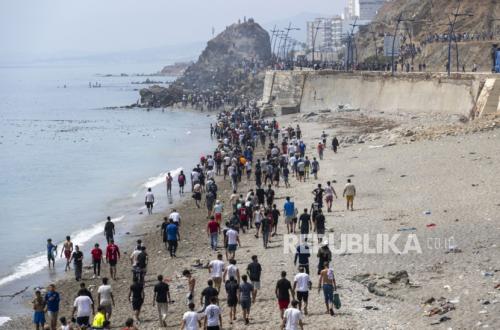
The world was once again presented with dramatic images from North Africa’s border at the end of July 2026, as thousands of migrants breached fences and swam across shallow waters from Morocco into Ceuta, a Spanish exclave on the African continent. At least 67 people died, reception centres collapsed, and Madrid was forced to deploy the military to secure the border. What makes this event analytically peculiar is a simple fact: some of the migrants attempting to enter Ceuta were not from countries experiencing major wars, but were using Morocco as a transit state. The question, therefore, is not only why they migrate, but why Moroccan border surveillance appears to weaken at specific moments.
The temptation to link this crisis to Spain’s foreign policy stance is strong. Madrid is known as one of the most vocal European voices condemning Israeli violence against Palestinians, and in March 2026, Pedro Sánchez’s government refused a United States request to use the Rota and Morón bases to support strikes against Iran, even closing its airspace to US aircraft involved in the operation—a move that triggered trade severance threats from Washington. Using simple logic, it is easy to speculate that Rabat, as a close US ally in the region, deliberately ‘punished’ Spain by opening the migration tap.
However, this speculation falters when confronted with contradictory facts. Morocco itself normalised diplomatic relations with Israel in 2020 as part of the Abraham Accords, in exchange for US recognition of Moroccan sovereignty over Western Sahara. This means that in terms of geopolitical orientation, Rabat is actually closer to the Washington-Tel Aviv axis, not opposed to it. Connecting the Palestinian issue or the military base rejection directly to the loosening of border controls risks becoming a narratively appealing but empirically weak conclusion.
A more accountable explanation comes from the narrower realm of law and bilateral diplomacy. On 29 June 2026, the Spanish Supreme Court issued a ruling prohibiting authorities from carrying out summary returns of migrants caught at sea while attempting to enter Ceuta and Melilla without due legal process. The Spanish Interior Ministry stated that human smuggling networks quickly exploited this legal gap to push more people to cross, especially via sea routes where deportation was previously immediate. This is a classic pattern: changes in the legal framework of migration are often exploited by transnational criminal networks far faster than bureaucracies can respond.
Yet, there is a precedent that cannot be ignored: the pattern of Spain-Morocco relations on migration has always been closely tied to the Western Sahara dispute, not Middle Eastern issues. A similar crisis in May 2021, when around ten thousand migrants crossed into Ceuta in a matter of days, occurred right after Spain allowed Polisario Front leader Brahim Ghali to be treated for Covid-19 in a Spanish hospital—a move Rabat considered indirect support for the Western Sahara independence movement. This time, although the Sánchez government tried to separate the migration issue from diplomatic tensions and claimed communication with Rabat was ‘running smoothly’, this historical pattern remains noteworthy. Migration has repeatedly been used as an instrument of pressure by Morocco against Spain, specifically concerning the status of Ceuta, Melilla, and Western Sahara—not Palestine or Iran.
For Indonesia, this case offers an important lesson on how forced migration is increasingly used as an instrument of geopolitical pressure between states. This phenomenon, known in international relations studies as the weaponisation of migration, involves using migration flows as a political pressure tool against another country. This pattern was also seen in the cases of Belarus-EU (2021) or Turkey-EU (2016 onwards), where transit states deliberately loosened border controls as a diplomatic bargaining chip. What distinguishes the Morocco-Spain case is that the motive is highly local and territorial, related to claims over two exclaves and Western Sahara—not part of a broader geopolitical bloc alignment concerning Palestine-Israel or Iran-US.
The temptation to read every global crisis through the lens of the Middle East conflict is understandable amid ongoing regional escalation. However, careful analysis demands we refrain from such generalisations. The Ceuta crisis is more accurately read as a reminder that behind almost every ‘sudden’ migration wave, there is almost always a very specific and local political calculation, one that is often missed when we rush to find a common thread with larger global issues. The Ceuta case demonstrates that in the 21st century, borders are no longer guarded only by fences or patrol boats. Human flows themselves can turn into instruments of coercive diplomacy. Therefore, reading migration solely as a humanitarian crisis often causes us to miss the political dimension that actually drives the crisis.