
When Leadership Must Learn to See
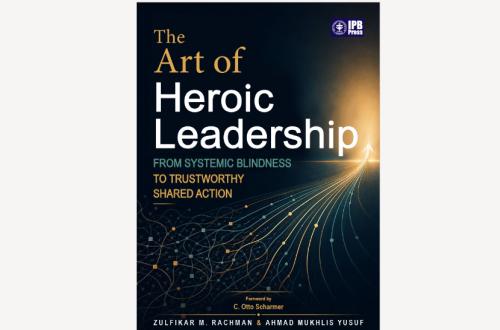
A review of the book ‘The Art of Heroic Leadership’ by Zulfikar M. Rachman and Ahmad Mukhlis Yusuf offers a unique perspective on leadership. Rather than focusing on how to become a great leader, this three-hundred-page volume begins with something leaders often avoid: blindness to themselves and the systems in which they operate. The full title, ‘The Art of Heroic Leadership: From Systemic Blindness to Trustworthy Shared Action’, sets the authors’ direction. Leadership is not primarily understood as the ability to command, make decisions, or produce performance, but as a journey from an inability to see towards trustworthy collective action.
This idea is vital because the modern organisational world faces interconnected challenges. Economic decisions can impact social trust, technological shifts can alter both labour and human identity, and political conflicts can evolve into economic and humanitarian crises. Within an organisation, a decision that appears successful in one department may create problems in another. The book views this not merely as a matter of complexity, but as a leadership issue. The problem is not simply whether a leader is capable of acting, but whether they are capable of seeing what is actually happening and understanding the consequences of their actions.
This is where the concept of ‘systemic blindness’ serves as a crucial entry point. A leader operates within a system that possesses its own history, power structures, incentives, habits, expectations, and relationships between actors. Because they are part of that system, structural issues often appear to be individual problems. Consequently, leaders tend to fix visible symptoms while the underlying patterns that generate the problems continue to persist. The book even demonstrates that actions taken with good intentions can still produce undesirable results when the perception of the system remains partial.
Such a view serves as a critique of a management culture that relies too heavily on execution. For decades, organisations have built increasingly sophisticated execution capabilities. Strategies are more measurable, incentive systems are more structured, data is more available, and performance is easier to monitor. However, the ability to execute well does not inherently make an organisation healthier. In fact, according to the book, highly disciplined execution can magnify errors when the underlying framework of thinking is flawed. Execution does not correct perception; in certain circumstances, execution may actually accelerate and expand the limitations of that perception.
At this point, the book poses a more fundamental question: what must leadership become before its actions can be trusted? This question shifts leadership from the realm of competence to the realm of responsibility. A leader is not only responsible for what they intend, but also for what their actions produce. Thus, good intentions are no longer a sufficient measure of leadership morality. What must also be considered are the consequences that follow once a decision is made. Leadership becomes a form of accountability toward the lives touched by those decisions.
The book’s narrative is built through three major movements: Descent, Re-Formation, and Widening. ‘Descent’ brings the leader down from potentially premature self-confidence toward a willingness to see both the system and themselves. ‘Re-Formation’ is the process of rebuilding the foundation from which one acts. Finally, ‘Widening’ moves this transformation from the individual to the collective space. Thus, leadership transformation does not stop at personal change; individual awareness must find a social form to become shared, actionable practice.
Here, the concept of ‘self blindspot’ acts as a partner to ‘system blindspot’. Humans never view a system from the outside; they view it through themselves. Therefore, the limitations of the system and the limitations of the self reinforce one another. A leader unable to recognise their own internal state may misread the system. Conversely, an invisible system can reinforce the reactions and limitations within the individual. The book serves as a reminder that leadership is ultimately exercised by humans, not by titles, strategic frameworks, or management tools.