
When hope grows from thirsty soil
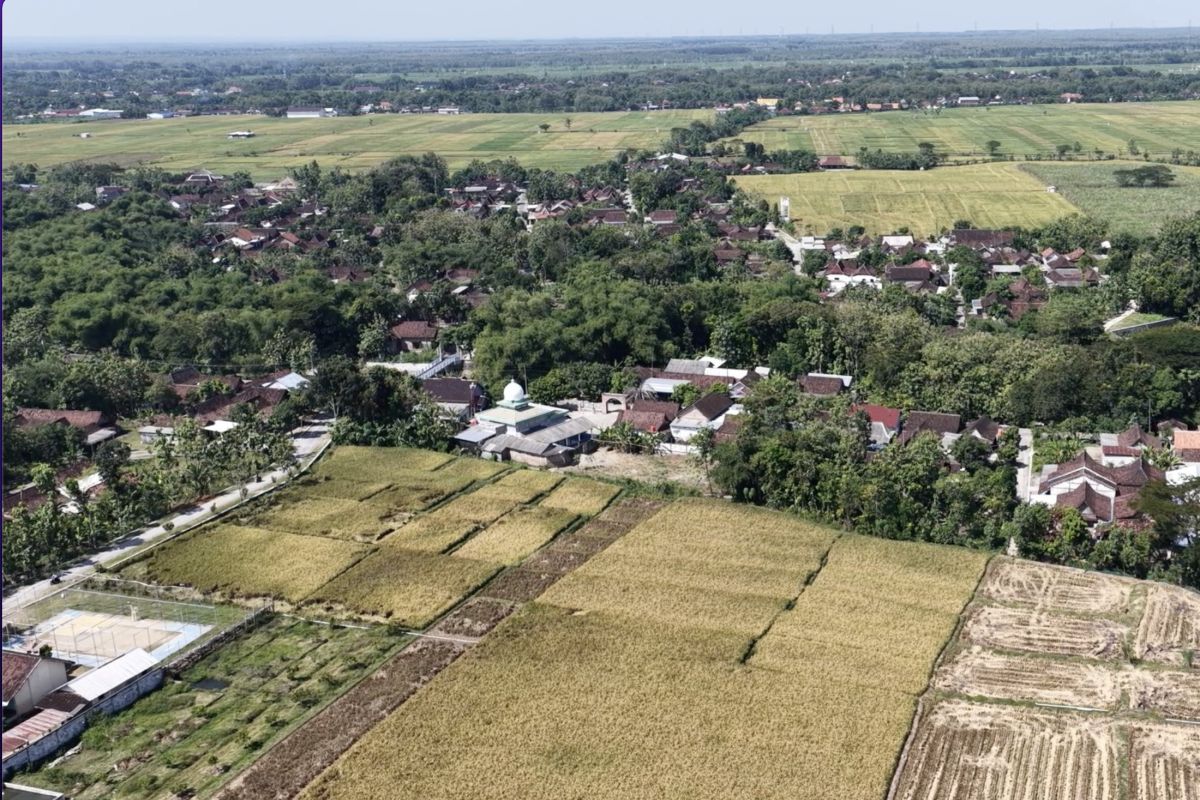
Beneath the scorching sun, amid stretches of golden paddy fields, a pair of wrinkled hands ties up a sack of grain. His face is glistening with sweat, but his eyes reflect gratitude. This harvest, his six-patok plot—about two hectares—has produced more than 15 tonnes.
Sutarno, a middle-aged man, has been a farmer for more than a decade, continuing his parents’ legacy. His fields are highly productive, allowing him to harvest three times a year.
In a trembling voice, Sutarno told ANTARA that before his fields became as productive as they are today, he went through very difficult times, when the land he worked was rain-fed and could be harvested only once a year.
“In the past, we were really short of everything, both clothing and food. It was very difficult because, you could say, we harvested once a year, and sometimes the crop failed altogether,” Sutarno said.
Kaliwedi, where Sutarno lives, is now one of the biggest food-producing villages in Sragen Regency. Sragen is one of Central Java’s strongest regions for food security, ranking third in the province for rice production. Statistics Indonesia’s Central Java office recorded rice production in the “Bumi Sukowati” region at 397,014 tonnes in 2025.
Yet Kaliwedi, now classified as an Independent Village, was once designated an Underdeveloped Village, a status it held until 2018. It had faced serious restrictions on access to water, preventing its agricultural sector from reaching its potential. Some 90 per cent of residents depend on farming for their livelihoods.
Kaliwedi’s turning point
The Kaliwedi village administration did not stand still. After taking office in December 2013, village head Daryono began looking for ways to address the fundamental obstacle to farming: water availability.
The village administration took inspiration from neighbouring Ngawi Regency, where deep wells are used to irrigate farmland. Work to develop deep wells began in 2015.
There was, however, another challenge. Each deep well cost a substantial amount—about Rp70 million. But after discussions with residents and calculations showed that a well could irrigate four to five hectares, the project went ahead. The funding came from the People’s Business Credit (KUR) programme.
Kaliwedi now has 108 deep wells, irrigating about 250 hectares of farmland. The land has become fertile and agricultural productivity has risen significantly. Before the wells were built, farmers harvested once a year, producing an average of 7.5 tonnes. By 2025, they were harvesting three times a year, with average annual production reaching 22.5 tonnes per hectare.