
When Fire Destroys the Wildlife Habitats of Kalimantan
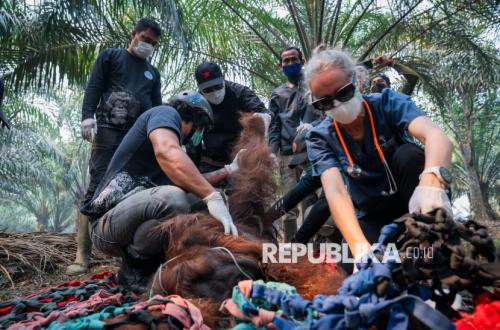
Every time forest and land fires (karhutla) occur in Kalimantan, public attention usually focuses on the total area burned, the number of hotspots, haze, and economic losses. However, there is one loss that is rarely seriously calculated: the destruction of wildlife habitats. Fire knows no conservation boundaries; it can move from cleared land into shrubs, secondary forests, and swamp and peat forests.
When fires occur repeatedly, the issue is no longer just about how many hectares of forest are burned, but how much wildlife living space is lost and how long ecosystems require to recover.
Kalimantan is one of the world’s bastions of biodiversity. The island’s forests serve as habitats for the Bornean elephant, rhinoceros, orangutan, sun bear, clouded leopard, golden cat, marbled cat, proboscis monkey, hornbill, and various types of mammals, birds, reptiles, amphibians, and other small organisms. Each species has different ecological needs, but all depend on one common thing: a functioning habitat.
Therefore, when forests burn, it is not just trees that are lost. What is burning is the chain of life. The Borneable elephant (Elephas maximus borneensis) is one of the species that most requires space. Elephants need large amounts of forage vegetation, water, and movement corridors that allow their groups to migrate according to habitat conditions. Their population is already very limited. The IUCN estimates that only about 1,000 Bornean elephants remain in the wild, with approximately 400 reproductive adults, while about 60 per cent of their forest habitat has been lost in the last four decades (IUCN, 2024).
In such conditions, fire becomes a multi-layered threat. Fire eliminates grass, shrubs, undergrowth, and tree saplings. Once food sources diminish, elephants will seek alternative forage. In an already fragmented landscape, these choices can lead elephants into plantations, farms, and human settlements.
This is where forest fires can escalate into human-elephant conflict. The conflicts that emerge following fires are not isolated incidents; they are an ecological consequence of habitat loss.
The condition of the Sumatran rhinoceros (Dicerorhinus sumatrensis) in Kalimantan is even more sensitive. The rhino population in Kalimantan is so small that the existence of every individual and its habitat holds extraordinary conservation significance. For rhinos, fire can eliminate food plants, cover vegetation, movement corridors, and the microhabitat conditions necessary for survival.
Source: jawawa.id (https://jawawa.id/newsitem/when-fire-destroys-the-wildlife-habitats-of-kalimantan-1788652380)
Originally published by Republika (https://analisis.republika.co.id/berita/tkwah9483/ketika-api-membakar-rumah-satwa-kalimantan), translated from Indonesian