
When Campus Science Helps Farmers Break Free from Weather Dependency
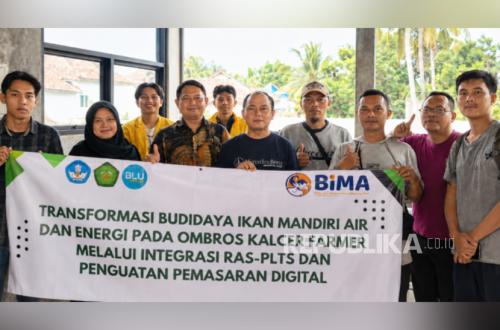
REPUBLIKA.CO.ID, JAKARTA — Citengan Hamlet in Sukamulya Village, Cihaurbeuti District, Ciamis Regency, West Java, has borne witness to how academic innovation can leap beyond the physical limitations of rural areas. Amid global challenges concerning the water crisis and demands for a transition to clean energy, genuine collaboration has taken shape.
The Ombros Kalcer Farmer fish cultivation group is no longer merely resigned to seasonal cycles or ever-shrinking land. Through appropriate technology, they are beginning to walk the path towards sustainable food and energy self-sufficiency.
This change was initiated by the Community Service Team of Siliwangi University. They applied the Recirculating Aquaculture System, better known as RAS, a cultivation system carefully integrated with a Solar Power Plant (PLTS).
The programme, titled “Water and Energy Independent Fish Cultivation Transformation for Ombros Kalcer Farmers through RAS–PLTS Integration and Digital Marketing Strengthening”, was introduced as an answer to the longstanding anxieties faced by local cultivators, ranging from limited land and unstable water supply to high operational energy costs. The activity forms part of the Community Partnership Programme under the Community-Based Empowerment scheme.
The entire programme is funded by the Directorate of Research and Community Service, Directorate General of Research and Development, Ministry of Higher Education, Science and Technology for 2026. At the cultivation site in Citengan Hamlet, RT 002/RW 002, an air of optimism was palpable as the head of Ombros Kalcer Farmer, Hasbi Ash Shiddieqy Kosasih, gathered with his group members. They welcomed the Siliwangi University team led by Ir. Andri Ulus Rahayu, S.Pd., M.T., with members Visi Tinta Manik, S.Si., M.Si., and Ir. Cecep Muhamad Sidik, S.T., M.T., along with the active involvement of a number of students bringing fresh energy to this social-technology project.
The programme’s chief implementer, Andri Ulus Rahayu, said the programme is part of the implementation of the Three Pillars of Higher Education (Tri Dharma Perguruan Tinggi), particularly in applying research outputs so they deliver direct benefits to society. The core value of academic research lies in how great its benefits are when they touch the daily lives of ordinary communities. Without proper downstream application, innovation merely becomes a pile of dead documents in the campus library.
“As lecturers at Siliwangi University, we have three main duties: education, research, and community service. This activity is a form of implementing the research of lecturers and students so it can be used directly by the community,” Andri said in a written statement received by Republika on Sunday (19/7/2026).
According to Andri, the programme began with discussions between the Siliwangi University team and the managers of Ombros Kalcer Farmer regarding plans to develop fish ponds using the RAS system. During the process, the partner faced various obstacles, from limited land to dependence on water source conditions. Rural areas once considered ideal for fish cultivation are now confronting serious ecological challenges due to climate change and land conversion.
To date, cultivators in Sukamulya Village have often been trapped in a weather dilemma. During the rainy season, water from irrigation channels risks declining in quality due to mixing with domestic waste.
Turbidity and pollutants carried by surface water currents frequently trigger mass deaths of fish fry. Conversely, during the dry season, water discharge falls so cultivation activities cannot run optimally. These conditions mean fish production remains dependent on seasonal changes, a conventional pattern that leaves farmers’ incomes uncertain and difficult to predict.