
When books have not yet become a habit
A children’s book can sit on a shelf for a long time without ever really being touched. Its cover is attractive, its pictures are colourful, and it was even bought with good intentions. Yet interest in reading does not grow from book ownership. It grows from habits that are repeated over time.
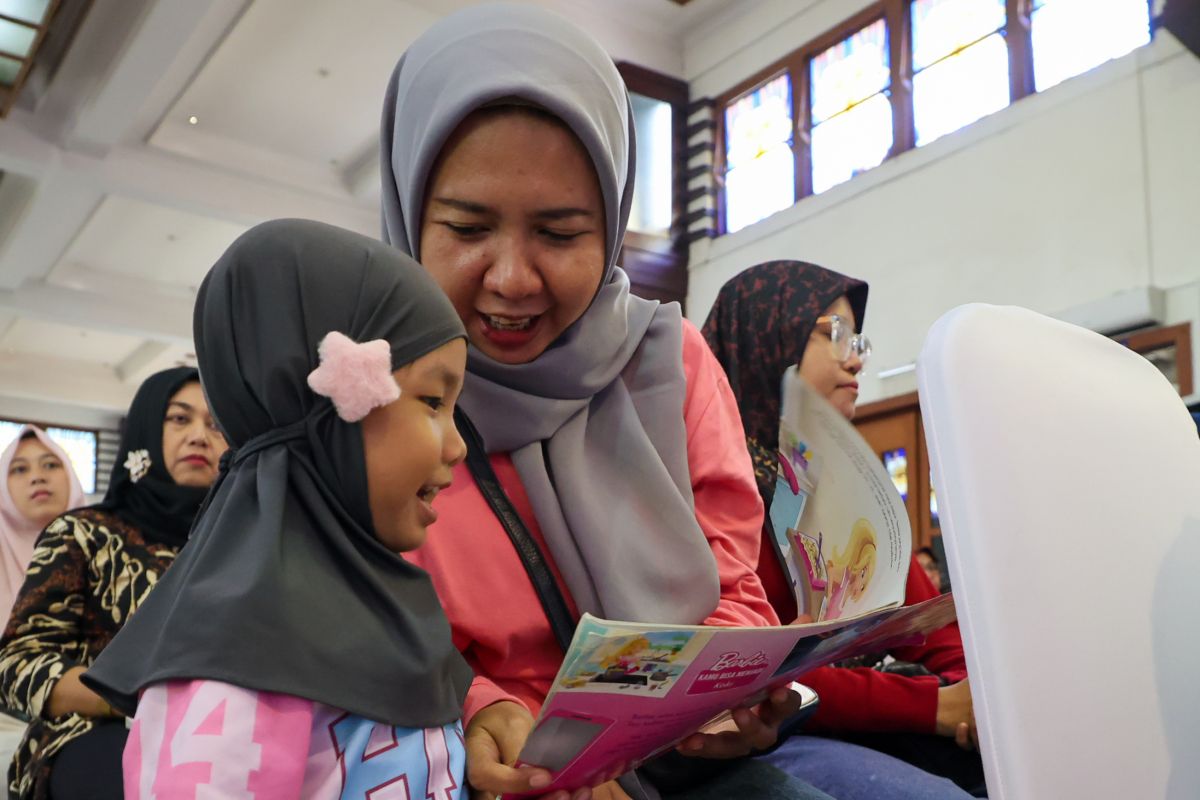
In the city of Surabaya, East Java, efforts to build that habit are being expanded from the classroom to the family. The Surabaya city government, through the Library and Archives Service (Dispusip) together with Literacy Ambassador Rini Indriyani, is encouraging parents to introduce reading culture through storytelling and the programme ‘Cerita Ayah Eri dan Bunda Rini Itu Asyik’ or Ceria.
The move is important because the problem of children’s reading cannot be answered simply by increasing the number of books. The real challenge is making books present in everyday life, such as in conversations, games, or bedtime routines.
Surabaya actually has substantial literacy assets. Dispusip recorded 527 community reading garden points (TBM), 571,883 book collection copies as of August 2025, nine mobile library cars, and one library motorcycle. Average library visits were recorded at 65,026 visitors.
In education, the Surabaya City Regional Government Work Plan 2026 recorded that 83.36 percent of primary school education units in 2025 achieved the minimum literacy competency standard. At lower secondary level, the achievement reached 93.58 percent.
These figures show a relatively strong school literacy foundation. Reading ability and the love of reading are not the same thing. A child may be able to understand a text because of learning demands, but may not necessarily choose to read when there is no assignment.
Reading is not a burden
The national picture shows that building a reading culture still faces challenges. The National Library recorded a national Reading Interest Level of 54.80 in 2025, while the Community Literacy Development Index in March 2026 stood at 40.6 and fell into the low category.
The data shows that the growth of facilities does not automatically produce reading habits. Libraries can provide books, but habits require time, role models, comfort, and reading materials that match readers’ interests.
Surabaya once recorded a Reading Interest Level of 80.3 in 2023, the highest in East Java. That achievement is an important asset, but it should not be seen as the final result. Reading habits can change according to the environment and the lifestyle of each generation.
Another challenge comes from gadgets. Children now obtain stories, videos, games, and information on a single device. Books do not only compete with other books, but also with a much faster flow of digital attention.
For that reason, books and gadgets should not be pitted against each other as two mutually exclusive choices. What is more needed is family guidance so that technology is used healthily while still providing space for reading.
The read-aloud programme developed by the Surabaya city government since February 2026 is directed at that need. Reading aloud makes the voices of parents, teachers, and companions a bridge for children before they are able to read independently.
Families hold a position that libraries cannot replace. Schools teach reading skills and libraries provide reading materials, but the home determines whether reading becomes a normal habit or is instead regarded as additional work.
A child who sees their parents reading has a different experience from a child who is merely told to read. Reading together, discussing the content of stories, and allowing children to choose reading materials according to their interests are simple habits that can build closeness with books.