
When 14 Ministers Abandoned the Indonesian President, the Government's Fate Was Sealed
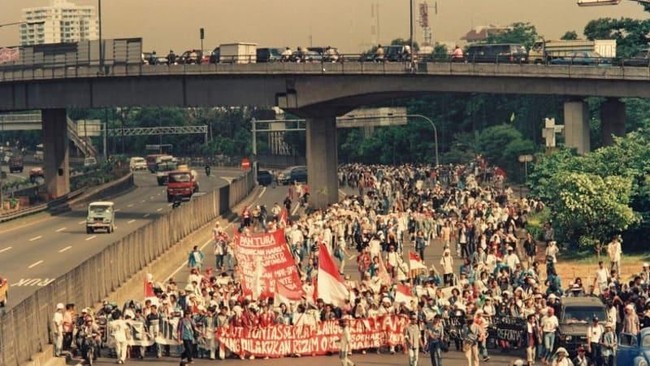
A total of 14 ministers simultaneously resigned from the Seventh Development Cabinet on 20 May 1998, amidst a monetary crisis and political upheaval that rocked Indonesia. The move became one of the turning points that accelerated the end of President Soeharto’s government.
The Coordinating Minister for Economic, Financial, and Industrial Affairs at the time, Ginandjar Kartasasmita, revealed that the decision was reached after the ministers concluded that Indonesia’s economic condition was on the brink of collapse. In his book Managing Indonesia’s Transformation (2013), Ginandjar recounted that discussions held since morning with ministers, journalists, and business figures converged on one conclusion: Indonesia was heading towards an economic and political crisis with no clear way out.
The crucial meeting took place at the Bappenas Building in Jakarta. During the meeting, Ginandjar openly presented the national economic condition and warned that Indonesia could potentially collapse if the situation was left unchecked. The majority of ministers present agreed with this assessment, with only State Minister of Agrarian Affairs/Head of the National Land Agency, Ary Mardjono, expressing a differing view.
Following the forum, Ginandjar declared his intention to resign from the cabinet, which had only been inaugurated by President Soeharto four days earlier. The decision was subsequently followed by other ministers one by one, until 14 cabinet members declared their resignation simultaneously. Those who resigned were Akbar Tandjung, A.M. Hendropriyono, Giri Suseno Hadihardjono, Haryanto Dhanutirto, Ginandjar Kartasasmita, Kuntoro Mangkusubroto, Justika Baharsjah, Rachmadil Bambang Sumadhijo, Rahardi Ramelan, Subiakto Tjarawerdaya, Sanyoto Sastrowardoyo, Sumahadi, Theo L. Sambuaga, and Tanri Abeng.
In a joint statement, the 14 ministers assessed that the formation of a new cabinet would not resolve the root problems of the crisis. This stance served as a strong signal that the economic elite’s confidence in Soeharto’s leadership had evaporated. Historian Robert Edward Elson, in his book Soeharto: A Political Biography (2017), noted that Soeharto was shocked by the collective action of his ministers. According to Elson, the mass resignation was outside of Soeharto’s political calculations, as he was still planning to announce a Reform Cabinet on 21 May 1998 to maintain his legitimacy.
Efforts to prevent the resignations were reportedly made. In his book Detik-detik yang Menentukan (2006), Vice President B.J. Habibie revealed that he had asked the ministers to remain in the cabinet, but their decision was final and unchanged. The loss of support from key ministers and the political elite ultimately made Soeharto’s position untenable. A day after the mass resignation, on 21 May 1998, Soeharto announced his resignation as President of the Republic of Indonesia, ending more than three decades of his rule.