
What's Happening in Indonesia: 239 Dead, 203 Missing in Shipping Accidents
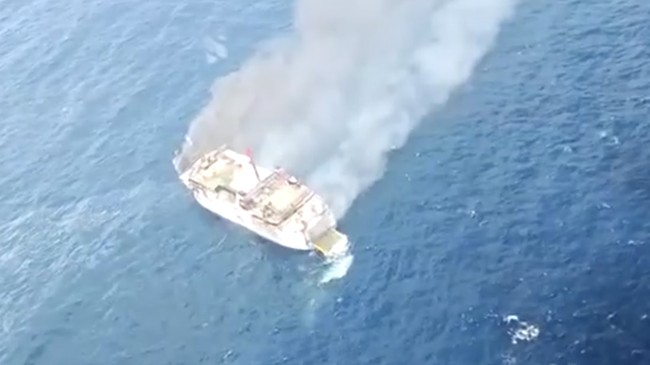
Jakarta, CNBC Indonesia — The National Search and Rescue Agency (Basarnas) recorded 601 shipping accidents in Indonesian waters between January and 15 August 2026, resulting in a total of 3,607 victims, of whom 3,404 people were evacuated, both survivors and the deceased.
Of that figure, 3,165 people survived and 239 died. Tragically, across the hundreds of search and rescue (SAR) operations mounted in response to these accidents, 203 victims remain listed as missing.
It should be noted that these figures do not yet include the KM Virgo Transport 8 accident in the Java Sea in the early hours of Sunday (13/9/2026). According to the manifest, the KM Virgo was carrying 240 people, and the search for missing victims is still ongoing. As of Monday (14/9/2026), 114 victims had been evacuated, six of whom had died.
This is according to Djoko Setijowarno, an academic from the Civil Engineering Programme at Unika Soegijapranata and Adviser to the Indonesian Transport Society (MTI), citing Basarnas data.
“Between January and 15 August 2026, 203 people went missing due to accidents in Indonesian waters — the impact of non-transparent manifests,” Djoko told CNBC Indonesia on Tuesday (15/9/2026).
Previously, the National Transportation Safety Committee (KNKT) also highlighted the problem of passenger manifest data on ships, stressing that the manifest is the foundation of rescue operations during an emergency.
Quoting ferizy.com, ship manifests are divided into three types: passenger manifests, cargo manifests, and vehicle manifests. This means the document must officially contain the list of passengers and the ship’s load, including cargo and vehicles carried on board.
“The manifest list is the single reference for the SAR team and Harbourmaster to carry out evacuations, count survivors and missing persons, and identify the deceased in order to expedite official notification to families,” the KNKT wrote on its official website.
Furthermore, the KNKT noted, from an administrative and legal standpoint, the validity of manifest data is an absolute requirement for the Harbourmaster before issuing a Sailing Approval Letter (SPB), as stipulated in Article 207 of Law Number 17 of 2008 on Shipping.
“A valid manifest is also needed to cross-check tickets to prevent revenue leakage and unregistered passengers, and serves as valid legal evidence in the processing of insurance compensation, banking matters, and victims’ inheritance rights,” the KNKT asserted.
So, is the manifest the primary and sole determinant of safety in transport, in this case shipping? Not yet. There is another crucial factor that must not be overlooked: shipworthiness testing.
Djoko explained that Law Number 17 of 2008 on Shipping, as most recently amended by Law Number 66 of 2024, gives a clear mandate to the Harbourmaster as the party responsible for shipping safety and security.
“Under Article 207, the Harbourmaster performs shipping safety and security functions, carries out supervision, enforces shipping law, and assists in the execution of search and rescue at ports,” he explained.
“Meanwhile, Article 208 governs the Harbourmaster’s duties, which include supervising ship seaworthiness, port safety and security, vessel traffic, passenger embarkation and disembarkation, loading and unloading activities, the transport of dangerous goods, and pollution control and firefighting at ports,” he added.
Then there is Article 209, which authorises the Harbourmaster to inspect ships, examine ship documents, issue SPBs, delay the departure of vessels that fail to meet requirements, and conduct investigations within its authority.
However, he noted, the implementation of these rules is not fully reflected in Minister of Transportation Regulation (Permenhub) No 28/2022 on Procedures for Issuing Sailing Approval Letters.
“The current SPB issuance mechanism is still far too oriented towards administrative checks rather than technical inspection of a ship’s physical condition,” Djoko said.
Djoko highlighted weaknesses in the regulation. One of these, he said, concerns physical ship inspections, which are generally only carried out when there is a report or indication that a vessel is unseaworthy.
“In addition, the Harbourmaster is only required to verify documents without bearing responsibility for the validity of the contents of the documents submitted,” he revealed.
“The SPB issuance system still relies heavily on the Master’s Sailing Declaration — a statement made by the ship’s captain — so the scope for substantive oversight is limited,” he said.
Furthermore, he continued, Permenhub No 28/2022 does not firmly regulate the conduct of random inspections before ships depart, nor periodic safety audits of shipping fleets.
Djoko therefore urged the government to promptly amend Permenhub No 28/2022 so that it aligns with the spirit of the Shipping Law.
He asked that SPB issuance no longer rest solely on administrative verification.
“But be accompanied by physical ship inspections before departure, periodic safety audits, risk-based inspections, and greater accountability in the SPB issuance process,” he asserted.
Proper Shipworthiness Testing Minimises Accidents
Djoko also highlighted that shipworthiness testing (ship seaworthiness inspection) aims to ensure vessels can sail safely, do not pollute the environment, and meet maritime occupational safety standards.
“Once the entire testing process is declared to meet requirements by the Harbourmaster/Port Authority and the classification society (such as the Indonesian Classification Bureau, BKI), the ship will be issued a Ship Safety Certificate and a Pollution Prevention Certificate as the legal requirement to sail,” Djoko asserted.
He outlined the main aspects and stages of shipworthiness testing:
Ship Safety (Construction & Stability)
Strength of the hull, rudder, and ship structure
Ship stability and draft (hatch fittings and covers)
Machinery, piping, and electrical systems
Navigation equipment (radar, GPS, AIS) and communications (VHF/MF/HF radio)
Life-Saving & Rescue Equipment
Lifeboats, life rafts, lifebuoys, and lifejackets
Distress signalling equipment (flares, smoke flares)
Environmental Pollution Prevention
Oil Water Separator (OWS) equipment
Sewage treatment plants and ship waste handling
Measurement of ship exhaust gas emissions
Load Line
- Inspection of load line marks (Plimsoll mark) on the hull to prevent overloading
Manning & Seafarers’ Welfare
Completeness of crew certification and competence (Safe Manning Certificate)
Suitability of accommodation spaces and crew health facilities
- Types/Stages of Inspection (Periodic Testing)
Initial Survey: conducted when a ship is newly built or when it changes national flag
Annual Survey: routine inspection every 12 months to ensure key equipment and safety systems are functioning properly
Intermediate Survey: a more thorough inspection carried out in the second or third year within the five-year cycle
Renewal/Special Survey (Docking): an in-depth inspection every five years, in which the ship must be dry docked for testing of hull plate thickness, propellers, and rudder stock.