
What Were the Universe's First Stars Like? NASA Explains
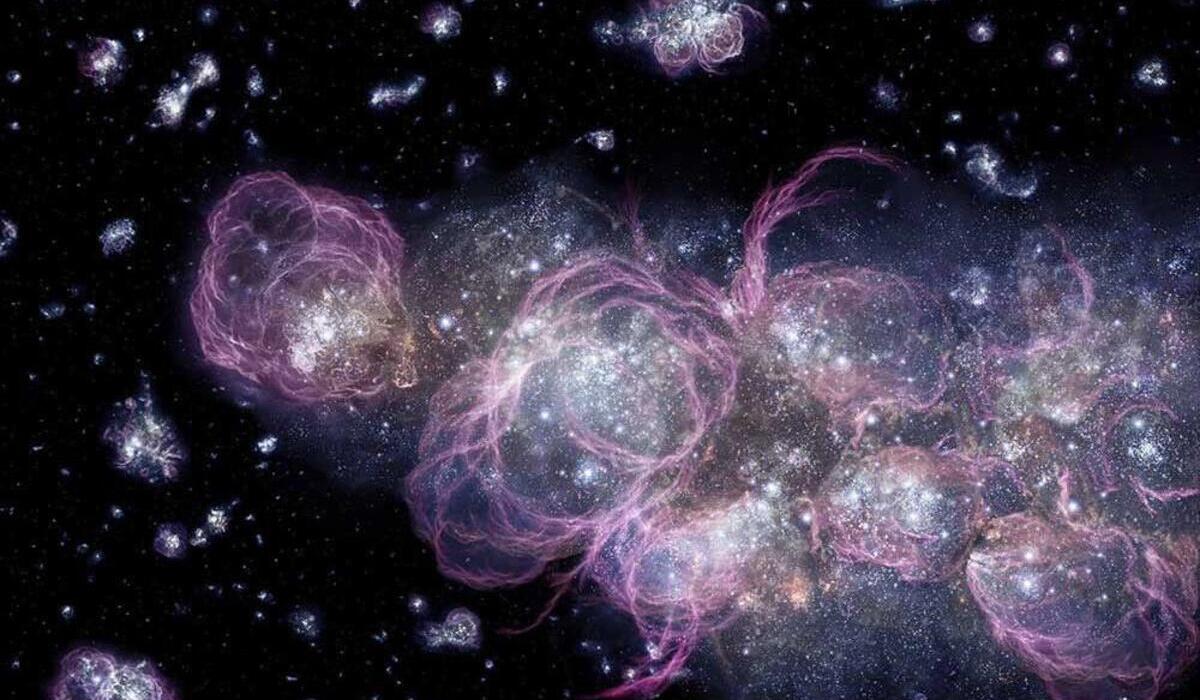
The universe was not always filled with stars, planets, and galaxies as we see it today. In the early period following the Big Bang, the cosmos contained only simple elements: hydrogen, helium, and a trace of lithium. From these basic ingredients, the first stars, known as Population III, were born. Although they have never been directly observed, astronomers are convinced of their existence based on various observations, physical calculations, and computer simulations.
According to NASA, this first generation of stars was very different from the stars we see today. They were composed almost entirely of hydrogen and helium, lacking heavier elements such as carbon, nitrogen, oxygen, or iron. In astronomy, all elements heavier than helium are referred to as ‘metals’. Since these elements had not yet been formed in the early universe, Population III stars are believed to have been metal-free.
Scientists know that only hydrogen, helium, and a little lithium were created in the aftermath of the Big Bang. Heavier elements could only appear later through the process of nuclear fusion inside stellar cores. This means that before the first generation of stars formed and began producing these heavier elements, the universe contained no carbon, oxygen, or iron. Astronomers therefore conclude that the first stars must have formed from very simple material, namely pure hydrogen and helium.
While their composition is fairly well understood, the size of the first stars remains a subject of research. One clue comes from the fact that no metal-free stars have been found to this day. If many Population III stars were small, some should have survived until the present era, as low-mass stars can shine for billions of years. Since none have been discovered, many astronomers suspect that most of the first stars were extremely massive. Computer simulations studying star formation in the early universe support this idea, showing that creating a star without metals requires a much larger clump of matter compared to modern star formation. As a result, Population III stars are estimated to have had masses between 10 and 300 times that of the Sun.
Their enormous size meant the first stars likely had extraordinary temperatures and brightness. The greater a star’s mass, the higher its temperature and energy output. For example, a star with a mass around 100 times that of the Sun could have a surface temperature reaching 100,000 kelvin. For comparison, the surface temperature of the Sun is only about 5,500 degrees Celsius. Such a massive star could also radiate energy equivalent to one million Suns, with most of that energy emitted as high-energy ultraviolet light rather than the visible light that dominates our Sun’s output. Astronomers believe that ultraviolet radiation from these first stars helped end the cosmic ‘Dark Ages’ by ionising the hydrogen gas that filled the young universe.
The fate of the first stars depended on their mass. Stars with masses between 10 and 140 times that of the Sun are thought to have ended their lives in supernova explosions. These explosions scattered the heavy elements forged in their cores throughout the universe. The resulting material then became the raw ingredients for the next generation of stars, planets, and ultimately, life. Meanwhile, stars with masses up to around 300 times that of the Sun may have experienced a type of supernova so powerful that it completely destroyed the star, leaving no remnant behind. Even larger stars are suspected to have collapsed directly into black holes without exploding. Some scientists even theorise that black holes formed from these ancient stars became the seeds of the supermassive black holes now found at the centres of many galaxies.
To date, no Population III star has been directly observed. Evidence for their existence is only seen through the traces they left behind, such as the heavy elements found in later generations of stars, the influence of their radiation on the universe’s primordial gas, and the possible existence of black holes as remnants of their deaths.