
What makes a signature legally valid?
Jakarta (ANTARA) - A signature may appear simple. It might consist of just a name, a few lines, or scribbles that are sometimes even difficult to read. However, when applied to certain documents, a signature can have significant legal consequences.
This is why a signature is not merely about its form or how aesthetically pleasing it is. In a legal context, other factors are far more important, such as who is signing, whether that person has the authority to do so, the contents of the document, and how the signature can be proven.
So, what actually makes a signature considered legally valid?
It is not about the beauty or ugliness of the signature
There is no requirement for a signature to look complex, be legible, or have a specific shape to be considered valid. The primary focus is the connection between the signature, the person signing it, and the agreed-upon document.
In civil law practice, a signature on a document can serve as evidence that an individual has provided consent to the contents of that document. Therefore, the issue is not whether the signature looks beautiful, but whether it can truly be linked to the party involved. This also explains why a person does not need to have an identical signature every time they sign a document; human signatures naturally possess slight variations.
Who signs becomes important
One fundamental aspect is the identity of the person affixing the signature. For instance, if someone signs an agreement on behalf of a company, the issue is not just whether the signature resembles that person’s signature, but whether they actually possess the authority to represent the company.
In other words, a signature does not stand alone. The context of the document and the capacity of the signatory are also crucial. This becomes increasingly relevant for documents with specific legal consequences, such as agreements, powers of attorney, corporate documents, or documents created by officials with specific authorities.
What about electronic signatures?
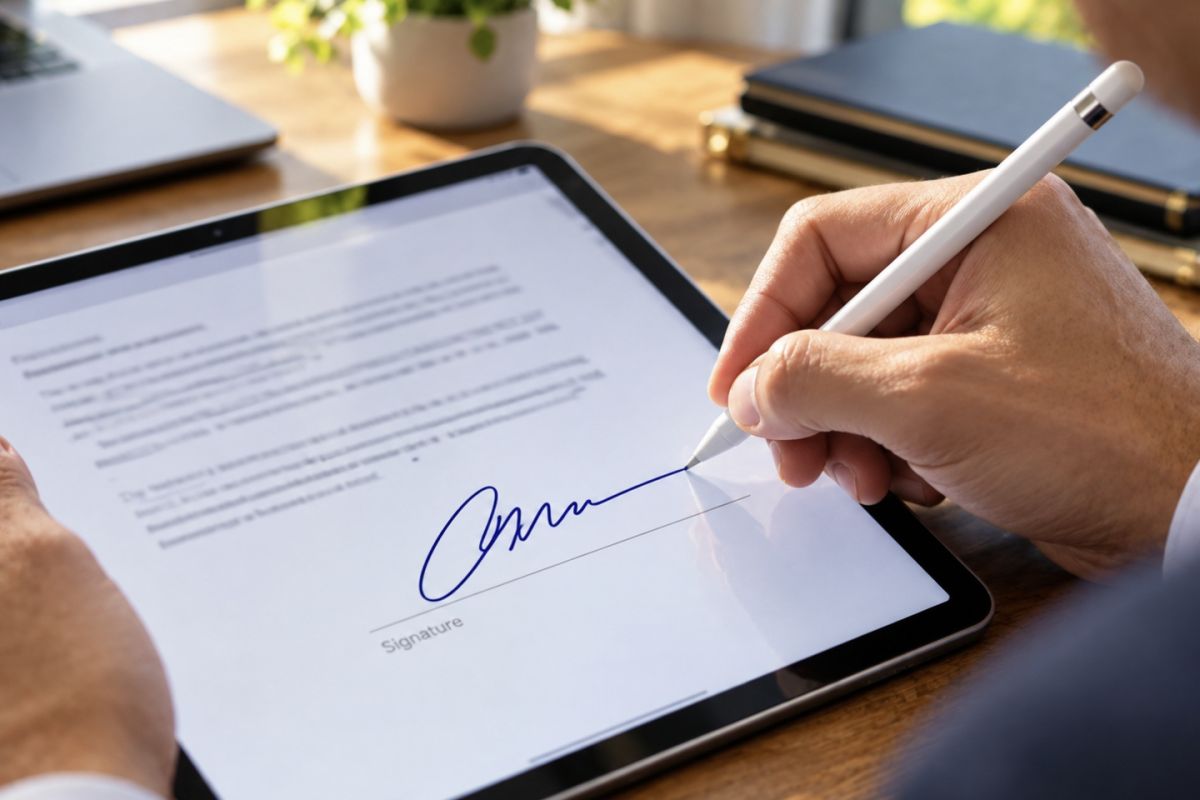
In the digital era, signatures are no longer always ink on paper. Indonesia recognises electronic signatures as a form of signature that can hold legal weight. Provisions regarding this are regulated, among others, in the Electronic Information and Transactions Law and Government Regulation Number 71 of 2019.
Under these regulations, an electronic signature has valid legal force and consequences if it meets several requirements. These include the fact that the data used to create the electronic signature must be linked to the signatory, must be under the signatory’s control during the signing process, and must allow for the detection of any changes to the signature or electronic information after the signing has occurred.
Therefore, an electronic signature is not merely pasting an image of someone’s signature into a PDF document. A key difference between an electronic signature and a mere signature image is the mechanism used to ensure the identity and integrity of the document. In certain electronic signature systems, electronic certificates are used to assist in the identification and authentication process.
Consequently, electronic signatures that meet legal requirements can be used to provide consent to electronic documents, even if the process is not performed by applying ink directly to paper. Law Number 1 of 2024, which amends the ITE Law, also continues to recognise electronic information and electronic documents as valid evidence to provide legal certainty in the implementation of electronic systems and electronic transactions.
Is a scanned signature pasted onto a document automatically valid?
This is a common point of confusion. A signature that is scanned and then pasted as an image onto an electronic document does not automatically possess the same characteristics as an electronic signature that meets the requirements of the prevailing laws and regulations.
A signature image is essentially just a visual representation. Meanwhile, an electronic signature within a legal framework has requirements related to the identity of the signatory, control over the signature creation data, consent, and the ability to detect changes after signing.
Therefore, the method by which a document is signed needs to be adjusted to the needs and the applicable rules for that specific document.
It does not have to be exactly the same. A person may produce a slightly different signature due to writing position, speed, hand condition, or habit. Small differences such as these do not automatically render a signature invalid. In dispute situations, the issue may evolve into a matter of evidence. If one party denies ever signing a document, for example, the authenticity of the signature and other evidence related to the document may be examined.
Thus, a signature is not the only thing to consider when assessing a document. So, what makes a signature valid?
Simply put, it is not the shape of the scribble that determines it. What matters is the existence of a provable link between the signature, the person signing, the consent to the contents of the document, and the authority of that person if they are acting on behalf of another party.
For electronic signatures, there are specific requirements as regulated by legislation. Therefore, a signature consisting of only a single line is not automatically less valid than one full of loops. Conversely, a signature that looks very convincing does not automatically prove that a document is valid if it was actually applied by an unauthorised person or without consent.