
What is the State of Disability-Inclusive Pesantren?
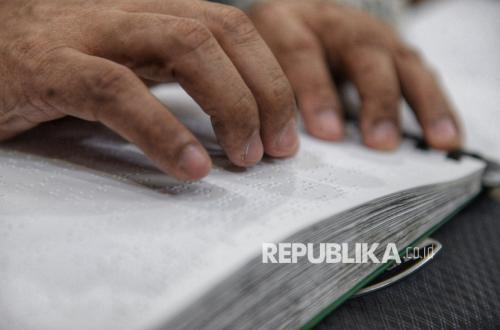
The sound was faint from a study room. It was not the rustle of turning pages of a classical text, as is common in pesantren (Islamic boarding school) recitations. Nor was it the dance of a pen on paper. What could be heard was the slow friction of fingertips moving over raised dots. A visually impaired santri (student) was reading Ta’lim al-Muta’allim in Braille. Beside him, another student was repeating memorisation of the Al-Arba’in al-Nawawiyah. In another corner, several students were studying the Matan of al-Jurumiyah and Al-Amtsilah al-Tashrifiyah.
This scene is likely unknown to much of the public. Yet behind these quiet study rooms, a significant effort is underway to bring knowledge to everyone without exception. This raises the question: what is the state of disability-inclusive pesantren?
In the perspective of the Ministry of Religious Affairs, pesantren have a responsibility to serve all levels of society. This view aligns with the mandate of Law Number 18 of 2019 on Pesantren, which affirms the institution’s functions in education, dakwah (religious outreach), and community empowerment. Simultaneously, Law Number 8 of 2016 on Persons with Disabilities guarantees the right of every disabled person to quality education on an equal basis, free from discrimination.
Traces of inclusivity are not foreign to the Islamic scholarly tradition. The Quran immortalises the story of Abdullah bin Ummi Maktum, a blind companion whose situation became part of the reason for the revelation of Surah ’Abasa. In Islamic history, Abdullah bin Ummi Maktum was not marginalised due to his visual impairment. The Prophet Muhammad entrusted him to call the azan and carry out various important duties in Medina.
The value of respect for persons with disabilities can also be found in the classical texts (kitab kuning) that have been the source of learning in pesantren for centuries. In works such as Al-Majmu’ Syarh al-Muhadzdzab by Imam al-Nawawi, Mughni al-Muhtaj by al-Khatib al-Syarbini, Tuhfah al-Muhtaj by Ibn Hajar al-Haitami, and Nihayah al-Muhtaj by al-Ramli, there are discussions regarding the blind (al-a’ma), the deaf (al-ashamm), the mute (al-akhras), and those with walking impediments (al-a’raj) in various aspects of worship, transactions, testimony, and social life.
Although classical scholars were not familiar with the modern term ‘disability’, their attention to the needs and rights of these groups shows that issues of accessibility and humanity have long been part of Islamic legal discourse. In more recent developments, this perspective has been strengthened by the Fikih Penguatan Penyandang Disabilitas (Jurisprudence for the Empowerment of Persons with Disabilities) compiled by the Bahtsul Masail Institute of PBNU (2021), which positions persons with disabilities as subjects with full rights in religious, educational, social, economic, and political life.
The commitment to inclusivity has been reinforced by the state through Law Number 8 of 2016 on Persons with Disabilities, Law Number 18 of 2019 on Pesantren, and Government Regulation Number 13 of 2020 on Reasonable Accommodation for Students with Disabilities. Within the Ministry of Religious Affairs, this spirit is translated through Minister of Religious Affairs Regulation Number 1 of 2024 on Reasonable Accommodation for Students with Disabilities in Educational Units under the Ministry of Religious Affairs, Decree of the Director General of Islamic Education Number 1262 of 2024 on Technical Guidelines for Child-Friendly Care in Pesantren, and Decree of the Minister of Religious Affairs Number 91 of 2025 on the Roadmap for the Child-Friendly Pesantren Development Programme. All these regulations aim to ensure that pesantren become a shared home that is safe, friendly, and accessible to all children of the nation, including those with disabilities.
However, regulations will remain mere documents if they do not manifest in the study room. Therefore, the Ministry of Religious Affairs has not stopped at policy formulation. In recent years, various classical texts (kitab kuning) in Braille, the Quran in Braille, and the Quran in Sign Language have been published to expand access to Islamic knowledge. Texts such as Ta’lim al-Muta’allim, Matan Safinatun Najah, Al-Arba’in al-Nawawiyah, Akhlaq lil Banin, Matan al-Jurumiyah, Al-Lughah al-’Arabiyah, and Al-Amtsilah al-Tashrifiyah can now be studied by visually impaired students through Braille. Meanwhile, the Quran in Sign Language opens a new path for deaf students to understand the messages of the Quran.
Beyond being mere publishing products, the Braille classical texts, Braille Quran, and Sign Language Quran are symbols of a civilisation that refuses to leave anyone behind. They are a statement that the path to knowledge must be paved for all, not just for those who are physically complete. The question ‘What is the state of disability-inclusive pesantren?’ is not only about the number of institutions or student statistics. It touches the very heart of pesantren civilisation. Has the pesantren become a home that is open to all children of the nation? Do persons with disabilities have the same opportunity to recite, memorise the Quran, and tread the path of knowledge as other students?
Pesantren must move beyond a charity-based approach and adopt a rights-based approach. Disability inclusion is not an act of mercy or social generosity. It is a constitutional mandate and the fulfilment of basic rights. The state, through the Ministry of Religious Affairs, must ensure that every pesantren receiving state recognition and support provides reasonable accommodation for students with disabilities. This accommodation includes physical accessibility, inclusive learning methods, disability-friendly teaching materials, and the availability of educators and education personnel who understand the principles of inclusive education.
Pesantren must be a place where a blind santri can memorise the Quran with his fingers, a deaf santri can understand the meaning of the Quran through sign language, and a santri with a physical disability can access all learning and worship facilities without hindrance. The question ‘What is the state of disability-inclusive pesantren?’ must be answered not only with words but with real action. The state must be present to ensure that no child of the nation is left behind in accessing religious education. Because in the perspective of the pesantren, every individual is a servant of God who has the same right to draw closer to Him through knowledge.