
What Is the Source of PVC Resin Linked to the Fire Terror at Fia's House?
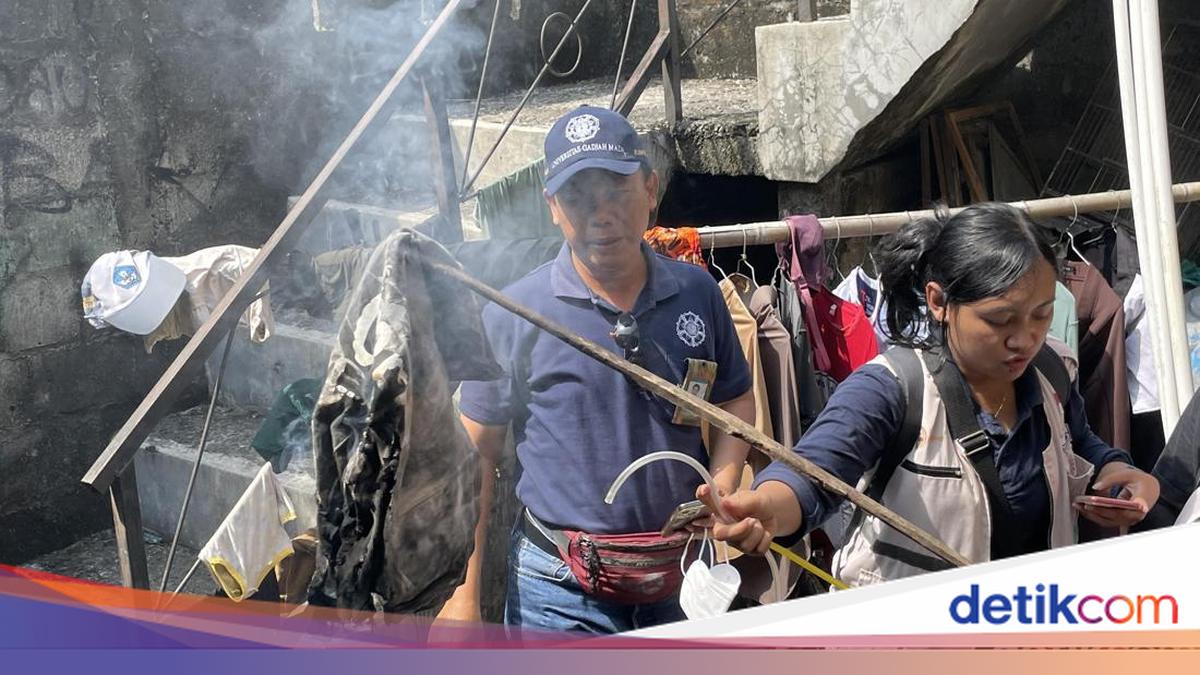
The Centre for Entropy Deceleration Studies (PKPE) at the Faculty of Engineering, Universitas Gadjah Mada (UGM), has concluded that the mysterious fire case at Mutfia, or Fia’s, house in Margomulyo, Seyegan District, Sleman Regency, is not related to natural gas. The appearance of the fire is suspected to be linked to polyvinyl chloride (PVC) resin. So, where did the PVC resin come from?
“In principle, we have finished at the stage of finding the source of the fire. Once again, it is not natural gas, but there is one substantial material found as residue at the burnt site, namely residue from polyvinyl chloride or PVC. So, there is that substance and according to us, that is the source of the fire, which is not natural,” said Sarju Winardi, a lecturer in the Geological Engineering Department at UGM, when contacted by journalists on Monday (15/6/2026).
Sarju explained that this PVC residue is suspected to originate from a flammable material. He said the material was likely already in a liquid state from the beginning and was a mixture. Sarju stated that the substance was found on several burnt objects.
“So, the residue from this polyvinyl is suspected to come from a substance that was originally a mixture; the residue is the remainder of the solid material, and the source of the fire was the solvent mixture,” he said.
“So, it appears this material was originally something mixed with a solvent. This solvent then escaped as the producer of the fire, leaving its residue behind. This substance is present on several materials, and the BPBD will follow up on this,” he continued.
The residue was found by researchers at several points that had been on fire, such as on walls and plywood. Meanwhile, on objects that were burnt, like sofas, chairs, and cables, the residue was not found because they were completely consumed by the fire.
“The traces we found were on the walls at the burnt site; from the nails downwards, the substance was visible. But on burnt items like sofas, chairs, and cables, we did not find it because they were completely burnt,” he said.
Sarju noted that, outside of this case, many materials contain PVC resin.
“Various types of glue, paint, and solvents—it is possible that if all the solvent burns, it produces that residue. But it cannot self-ignite, no. We have not found that; it must be ignited by something with a self-ignition property, it must be sparked,” he said.
Regarding the possibility of human intervention, Sarju declined to answer. He mentioned that there is a more authorised agency to provide information.
“At that level, the BPBD will follow up. So, we are conveying the findings from our colleagues, which are evidence that such residue exists,” he explained.
Sarju continued that the PVC resin cannot ignite on its own and requires an igniter. As for the igniter, Sarju said his team is not authorised to disclose it.
“There must have been an igniter because without being sparked, it would not burn. So, what was the igniter? This will be further investigated by another team at BPBD. We will report for the igniter to be investigated. We are not at the stage of investigating further,” he stressed.
Therefore, he affirmed that UGM’s final conclusion is that the source of the fire was not natural gas.
“So, we only conclude that the source of the fire was not natural gas,” he concluded.