
What is the Financial Note Prabowo Will Deliver and Why It Matters for Indonesia
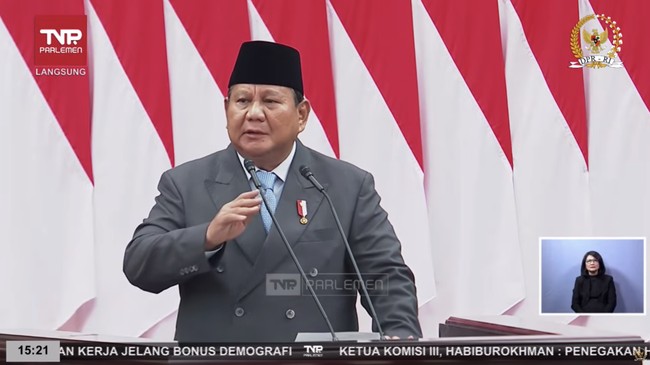
President Prabowo Subianto will deliver the government’s statement on the 2027 Draft State Budget (RAPBN) and its accompanying Financial Note during a Plenary Session of the House of Representatives (DPR) today, Friday (14/8/2026). This marks the second time Prabowo has presented the Financial Note since his inauguration on 20 October 2024. The RAPBN 2027 will provide a picture of the budget direction for the third year of his administration.
The Financial Note is an official government document that explains the RAPBN submitted to the DPR. It serves as a roadmap detailing how the government plans to collect revenue, allocate spending, and finance the budget. The document contains several key components. The first is the Basic Macroeconomic Assumptions, which include projections for economic growth, inflation, the rupiah exchange rate, the 10-year Government Securities (SBN) interest rate, the Indonesian Crude Price (ICP), and oil and gas lifting volumes. Accurate macro projections are essential to keep fiscal risks under control, as overly optimistic or pessimistic assumptions can affect the realism of revenue targets and the scope of government programs.
The Financial Note also details State Revenue, which consists of tax revenues, non-tax state revenues (PNBP), and grants. Tax revenues include income tax, value-added tax, land and building tax, as well as customs and excise. PNBP comes from sources such as oil and gas, mining, and dividends from state assets. The size of the revenue target determines the government’s capacity to fund priority programmes. On the spending side, the document breaks down State Expenditure into Central Government Spending and Transfers to Regions (TKD). Central Government Spending covers ministry and institutional budgets, interest payments on debt, subsidies, social assistance, and capital expenditure, while TKD includes various funds for regional governments and villages.
Another critical section covers the Deficit and Budget Financing. When spending exceeds revenue, the government must cover the deficit through financing, such as issuing government bonds or utilising loans. By law, the budget deficit is capped at 3% of Gross Domestic Product (GDP), a limit that was temporarily relaxed during the COVID-19 pandemic but has since been reinstated. For the 2027 budget, the government has designed a deficit range of 1.8% to 2.4% of GDP. The Financial Note will also explain the fiscal policy direction for the year, which for 2027 is themed ‘Grow Higher, Prosper Faster’, focusing on national priorities including food sovereignty, energy and water independence, education, health, and downstream industrialisation.
Source: jawawa.id (https://jawawa.id/newsitem/what-is-the-financial-note-prabowo-will-deliver-and-why-it-matters-for-indonesia-1786690327)
Originally published by CNBC Indonesia (https://www.cnbcindonesia.com/research/20260813141956-128-758970/akan-disampaikan-prabowo-apa-itu-nota-keuangan-pentingnya-buat-ri), translated from Indonesian