
What is the difference between Sumatran and Javan rhinos? Learn their characteristics
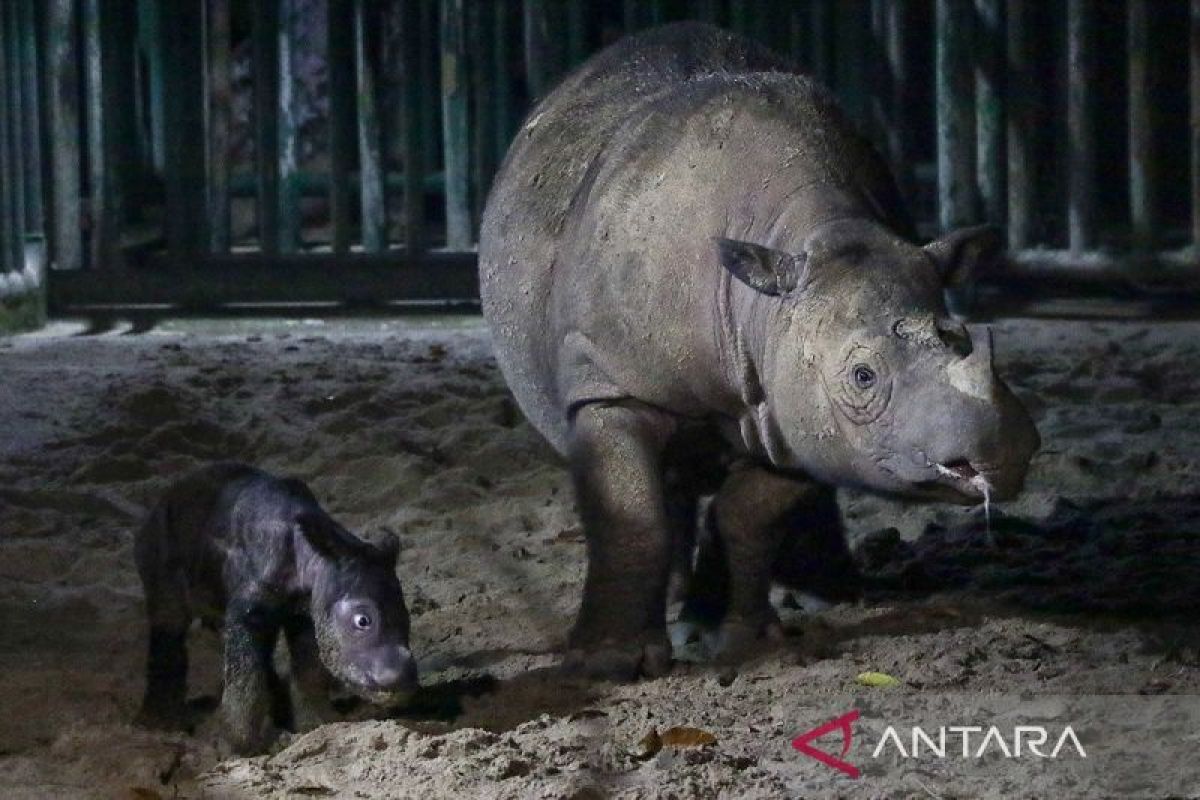
Jakarta (ANTARA) – Indonesia is home to two surviving rhino species: the Sumatran rhino (Dicerorhinus sumatrensis) and the Javan rhino (Rhinoceros sondaicus). Both are rare animals facing the threat of extinction, but they differ in body shape, number of horns, skin characteristics and habitat range.
The most readily identifiable difference is the number of horns. The Sumatran rhino has two, while the Javan rhino generally has only one. The Sumatran rhino is also known for its thicker coat, whereas the Javan rhino has grey skin with folds resembling protective armour.
Both species play an important role in maintaining the balance of forest ecosystems. However, their extremely small populations make protection and conservation efforts increasingly important.
So, what are the differences between Sumatran and Javan rhinos? Here are some of the characteristics to know.
- Number of horns
The most striking difference between the two species is the number of horns on the front of the head.
The Sumatran rhino is the only Asian rhino species with two horns. Its front horn is usually longer, while the rear horn is shorter and sometimes appears only as a small stub.
The Javan rhino, by contrast, generally has just one horn at the front of its head. It is usually relatively short. In female Javan rhinos, the horn is often very small or not visible at all.
Rhino horns are made of keratin, the protein that also forms human hair and nails. They are therefore not bones, as some people might imagine.
- Body size
The Sumatran rhino is known as the smallest of the world’s five surviving rhino species. It stands about 1 to 1.5 metres at the shoulder and generally weighs between 600 and 950 kilograms.
The Javan rhino has a larger body. Its shoulder height can reach about 1.4 to 1.7 metres, while its weight is estimated at between 900 and 2,300 kilograms.
These measurements can vary according to the individual, sex and physical condition. In general, however, the Javan rhino is larger than the Sumatran rhino.
- Skin and hair
The condition of their skin and coats provides another way to distinguish the two animals.
The Sumatran rhino has coarse, reddish-brown hair that is quite visible, particularly in young animals. As it ages, its hair tends to become sparser, coarser and darker.
This characteristic has led to the Sumatran rhino often being called the ‘hairy rhinoceros’.
By contrast, an adult Javan rhino has almost no visible hair on its body. Its skin ranges from grey to greyish-brown, with folds that give it the appearance of an animal wearing protective armour.
The folds are particularly visible around the neck and shoulders, although they are less pronounced than those of the Indian rhino.
- Head and lips
The shape of the head and lips also distinguishes the two rhino species.
The Sumatran rhino has a relatively small head and a muzzle suited to reaching different kinds of plants in the forest. The Javan rhino, meanwhile, has a long, pointed upper lip resembling a finger.
This lip helps the Javan rhino grasp and pull leaves, shoots and young branches, which make up its diet.
Both species are herbivores and tend to forage in densely vegetated forest areas.
- Habitat and distribution
Another difference is where the two species survive today.
The Sumatran rhino persists in several forest areas on the Indonesian islands of Sumatra and Kalimantan. It favours dense tropical forests, including lowland and mountain areas.
The Javan rhino, by contrast, is now found only in Ujung Kulon National Park in Banten. Its entire natural population is concentrated in this one area, making the species highly vulnerable to threats that could affect its habitat.
According to the IUCN SSC Asian Rhino Specialist Group, both species are classified as Critically Endangered. Sumatran rhino populations are spread across small, isolated groups, while the Javan rhino faces a major risk because it has only one natural population.
Protecting habitat and monitoring illegal hunting are therefore important parts of conservation efforts for both species.
- Behaviour and breeding
Sumatran and Javan rhinos both tend to live alone, except when mating or when a mother is caring for her young. Both also like to wallow, which helps maintain the condition of their skin and bodies.
The Sumatran rhino is known to be more vocal, making a range of sounds such as whistles and groans. These sounds are thought to help animals communicate when living far apart in dense forest.
The Javan rhino, meanwhile, is exceptionally difficult to observe directly. Research into its behaviour and population relies heavily on camera traps, tracks and indirect observation in its natural habitat.
Both species have long gestation periods, estimated at around 15 to 16 months, and generally give birth to one calf at a time. Their slow reproductive cycle means population recovery takes a long time, especially when so few individuals remain.
- Both face extinction
Despite their differences, the Sumatran and Javan rhinos face the same problem: the threat of extinction.
The Sumatran rhino faces habitat loss, illegal hunting and the difficulty of individuals finding mates because its population is fragmented.
The Javan rhino, on the other hand, is at great risk because its entire natural population lives in a single area. Major disruptions, such as an outbreak of disease or a natural disaster, could affect the survival of the whole species.
Conserving both animals requires habitat protection, anti-poaching patrols, population monitoring and ongoing research. Public support is also needed, including by avoiding products derived from protected animals and supporting reputable conservation organisations.
The Sumatran and Javan rhinos are irreplaceable parts of Indonesia’s natural heritage. Learning how they differ not only increases knowledge of wildlife, but also helps raise awareness of the importance of preserving forests and protecting endangered species.