
What Is Embun Upas? How the Ice Phenomenon Forms in Dieng
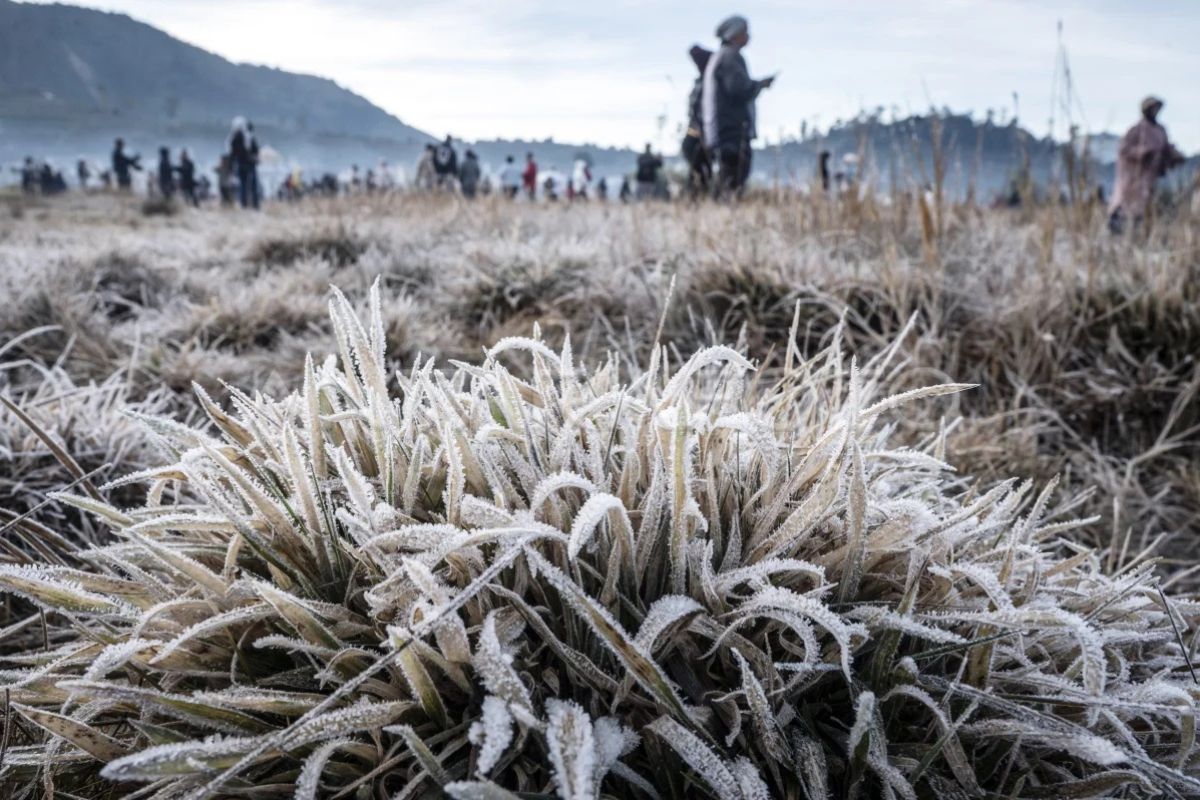
Jakarta (ANTARA) - Grass and leaves covered in a layer of ice crystals are among the natural sights that attract attention in the mountains. In Indonesia, this phenomenon is known as embun upas, or frost, and is commonly associated with the Dieng Highlands in Central Java.
Its appearance can make mountainous areas seem to be covered in a thin layer of snow. However, embun upas is not snow, but ice that forms directly on the ground, grass, leaves and other objects as a result of very low temperatures.
The phenomenon generally occurs from night until morning, particularly during the dry season. How, then, does embun upas form in mountainous areas?
What is embun upas, or frost?
Embun upas is a phenomenon in which ice crystals form on the surface of an object when its surface temperature reaches freezing point or below. In meteorological terms, it is called frost.
In Dieng, local people call it embun upas, meaning ‘poisonous dew’. The name arose because ice that clings to plants can cause their leaves to wilt, dry out or even die when the phenomenon occurs.
Although it looks like snow, the formation process is different. Snow forms from ice crystals in the atmosphere that then fall to the ground, whereas embun upas forms on the surface of objects that cool to freezing point.
The formation of embun upas begins as air and ground-surface temperatures fall at night.
When the sky is clear and cloud cover is very limited, the Earth’s surface releases heat stored during the day into the atmosphere. As a result, the soil, grass and leaves cool rapidly.
If surface temperatures fall to 0 degrees Celsius or below, water vapour in the air can form ice crystals on the cold surface.
Under certain conditions, water vapour first condenses into droplets of dew. As temperatures continue to fall below freezing, the water then freezes, forming a thin layer of ice.
Water vapour can also turn directly into ice crystals without passing through a liquid phase. This process is known as deposition.
Both processes can produce a layer of ice crystals that looks like a thin covering of snow on plants and the ground.
The dry season is one period conducive to the formation of embun upas, particularly in mountainous areas of Java.
One contributing factor is the Australian monsoon, which carries relatively dry, cold air masses towards Indonesia.
In addition, sparse cloud cover allows heat from the Earth’s surface to escape more readily at night. This can cause temperatures in highland areas to drop sharply, sometimes reaching freezing point.
Topography also plays a role. Cold air tends to flow down slopes and collect in valleys or mountain depressions. As a result, some areas can experience lower temperatures than their surroundings.
These conditions mean embun upas may appear in areas such as the Dieng Plateau, particularly towards morning.
Is embun upas dangerous for hikers?
Embun upas is not a poisonous substance and is not dangerous to people who touch it. However, its appearance indicates that temperatures are very low, so hikers should remain alert to the risks of exposure to cold.
Extreme cold can increase the risk of hypothermia, especially if someone is exposed to wind, wearing wet clothing or is not adequately protected.
In addition, ice on the ground and rocks can make paths more slippery.
Hikers should therefore wear warm layers, keep themselves dry and take care when crossing surfaces covered with frost.
Embun upas is an unusual sight in Indonesia’s mountainous regions. Behind its beauty, however, the phenomenon is the result of meteorological processes influenced by temperature, humidity, wind and the condition of the Earth’s surface, according to information from the Meteorology, Climatology and Geophysics Agency (BMKG) and other sources.
Source: jawawa.id (https://jawawa.id/newsitem/what-is-embun-upas-how-the-ice-phenomenon-forms-in-dieng-1794189095)
Originally published by Antara (Indonesian) (https://www.antaranews.com/berita/5840507/apa-itu-embun-upas-proses-terbentuknya-fenomena-es-di-dieng), translated from Indonesian