
What Is Behind the Chaos in Europe as France and Italy See Mass Unrest?
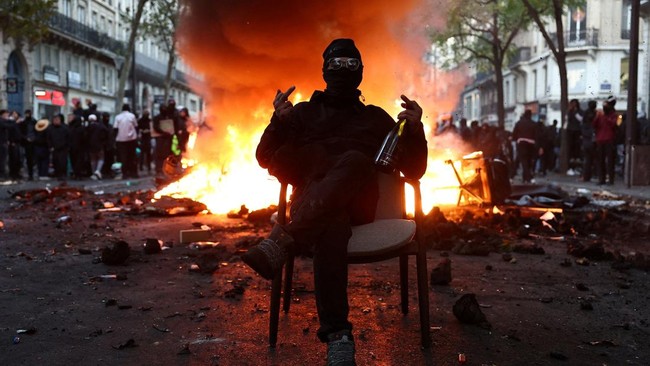
Anger over the cost of living and pressure on public services have driven hundreds of thousands of demonstrators on to the streets in several European countries. Their grievances range from high housing costs to poor conditions in schools and universities.
France saw the biggest demonstrations last weekend, with more than 500,000 people taking to the streets. Most of the protests were peaceful, but some people looted and vandalised shops, set fire to town halls and attacked police officers.
Separate demonstrations also took place in Italy, Spain, Portugal and Albania on Saturday and Sunday. The immediate causes varied, although high fuel and energy costs were among the underlying issues in several countries.
What triggered the demonstrations?
According to CNBC International on Tuesday (20 October 2026), the protests in France began last month, when secondary-school pupils criticised poor educational conditions, including inadequate facilities and teacher shortages. The action subsequently grew into broader demonstrations over living standards and the decline in the quality of public services.
In Spain, housing protests began in September after an 87-year-old woman, Maricarmen Abascal, was evicted from her home following a 230% rent increase imposed by an investment fund. She died two weeks later. Thousands of demonstrators also took to the streets in Portugal on Saturday to protest against surging housing and living costs.
“People are clearly protesting about the cost of living, including the price of diesel and fuel. But above all, they are protesting about housing costs, which have risen significantly across Europe, particularly in Portugal,” said Portugal’s Minister of State and Finance, Miranda Sarmento.
In Albania, demonstrators were angered by poor university conditions and high tuition fees, and called for Prime Minister Edi Rama to resign. Some protesters threw petrol bombs and other objects at police, and set fire to cars and rubbish bins.
In Italy, a cost-of-living demonstration in central Milan on Saturday also turned violent. Rioters attacked police with stones and chunks of paving, and set fire to barricades.
“The underlying problem is that politicians are unable to offer many Europeans the hope of a better life. The economy is growing only slowly and governments have accumulated large amounts of debt, leaving them very limited scope to increase public spending or cut taxes,” said Andrew Kenningham, chief European economist at Capital Economics.
Why is this happening now?
Douglas Yates, a professor at the American Graduate School in Paris, said the escalation of violence, particularly in France, was the result of several factors converging. It was, he said, a storm that had turned into a superstorm.
Inflation had prompted protests by people dissatisfied with the cost of living, Yates said. That discontent was already present, even without any additional trigger.
Another factor, he said, was France’s 2027 presidential election. Opposition parties are seeking to capitalise on growing public dissatisfaction with President Emmanuel Macron.
Prime Minister Sebastien Lecornu has proposed a 2027 budget intended to narrow France’s deficit, which is projected to reach 5.4% of gross domestic product (GDP) this year. Proposed measures include freezing public-sector pay indexation and tightening reimbursement for sick leave.
“Finally, there are the students, particularly those from disadvantaged families, who began this movement with reasonable demands: to repair their dilapidated school facilities and perhaps install air conditioning in classrooms. These three factors eventually came together and created an uncontrollable storm,” Yates added.
France’s economic situation is also deteriorating. In the second quarter of 2026, the unemployment rate rose to 8.3%, covering 2.7 million people, according to the French national statistics agency, Insee.
Unemployment among 15- to 24-year-olds rose to 21.6%. Final Insee data showed consumer prices in September were 3.1% higher than a year earlier, up from 2.4% in August.
Energy prices surged by 21.3%. Meanwhile, Le Monde reported, citing Insee data, that purchasing power per consumption unit is projected to fall by 0.7% over 2026.
Calculations by the French Economic Institute for Le Monde estimate that the decline in purchasing power since 2024 is equivalent to an annual loss of €1,200 (Rp24.2 million) for a household with two adults and two children. For a single adult, the estimated loss is €600 a year.
Portugal’s Finance Minister Sarmento said conditions differed from one European country to another. Portugal had a stronger fiscal position and much lower debt than France, he said.
“Countries with higher public debt have much less fiscal room to act. But the main issue is that we need to address productivity and competitiveness at European level,” he said.
“The European economy is not growing as fast as the United States. Without economic growth, it is impossible to raise wages or provide the resources for better public services and social support,” Sarmento added.
According to Eurostat, Portugal recorded the European Union’s highest annual house-price increase in the second quarter of 2026, at 16.5%. Sarmento said the Portuguese government was working to increase housing supply in order to bring down the cost of buying and renting homes.
France’s fiscal pressures
French government bond yields rose and the euro weakened on Monday. The unrest has added to investor concerns about the country’s debt and budget.
“It will be difficult to bring down the budget deficit without taking painful measures,” said Sharon Bell, a senior European equity strategist at Goldman Sachs.
“Taxes on French companies are very likely to rise. I think taxes in general could also increase in France. Fiscal consolidation means the government must cut spending or raise taxes. Both are very difficult to do,” she explained.
Mike Bell, head of market strategy at RBC BlueBay Asset Management, said France faced a “very real risk” of a sovereign debt crisis.
“What France needs is to put its fiscal position in order. It needs to raise the retirement age. You cannot retire at 62 when the average person lives to 84,” he said.
“But if things are already like this before they even start discussing that policy, imagine what would happen on the streets of France if the government tried to raise the retirement age. In the UK, the retirement age is 68,” Bell added.
Source: jawawa.id (https://jawawa.id/newsitem/what-is-behind-the-chaos-in-europe-as-france-and-italy-see-mass-unrest-1792489876)
Originally published by CNBC Indonesia (https://www.cnbcindonesia.com/news/20261020152300-4-777885/apa-yang-membuat-eropa-chaos-prancis-italia-rusuh-besar-besaran), translated from Indonesian