
What is a skyquake, the phenomenon linked to loud booms in Bandung?
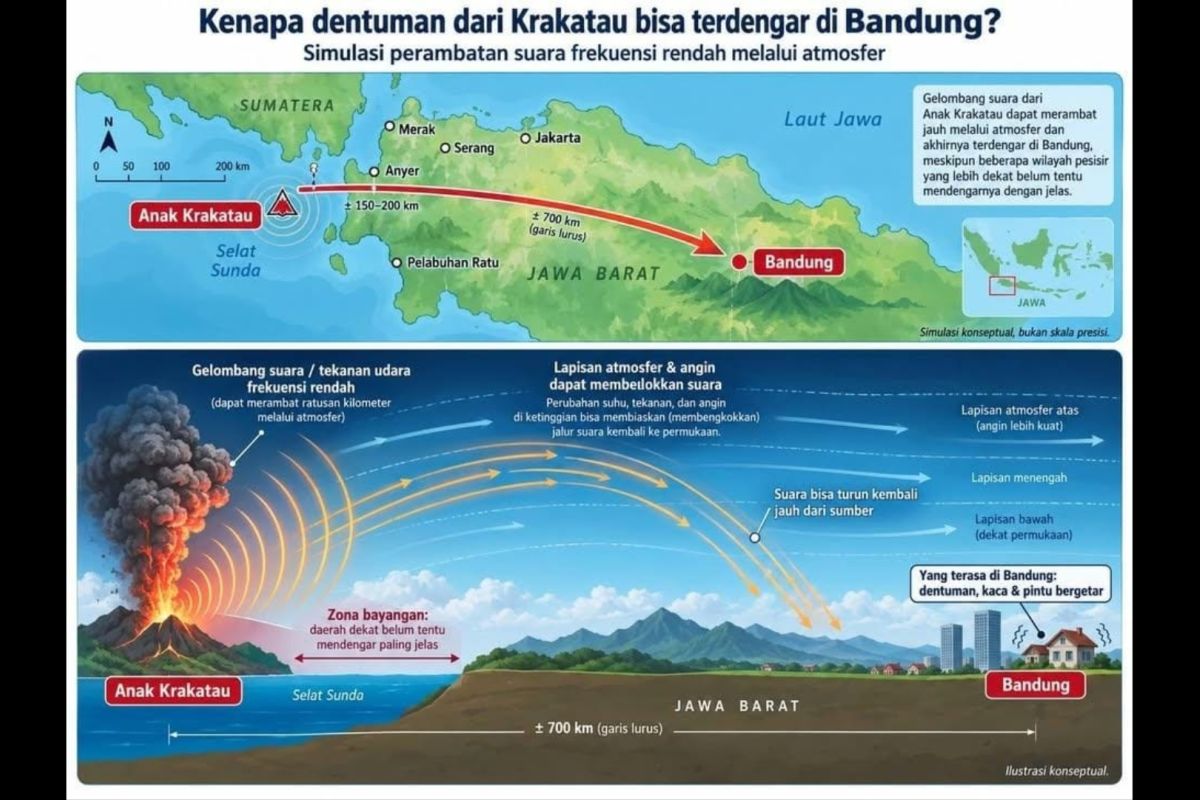
Residents of Greater Bandung were left puzzled by a loud booming sound heard repeatedly from Friday evening (4/9) until the early hours of Saturday (5/9). The sound was reported across several areas of West Java, with some residents even claiming to have felt windows or parts of their homes vibrate.
The phenomenon was widely linked to the ongoing eruption of Mount Anak Krakatau in the Sunda Strait. However, the Meteorology, Climatology and Geophysics Agency (BMKG) confirmed that there was no seismic activity connected to the booms. The BMKG also stated that the sound was unrelated to the eruption of Mount Anak Krakatau.
Amid various speculations, the term skyquake, or ‘sky boom’, has become a popular topic of discussion. So what exactly is a skyquake?
A skyquake is a term used to describe a loud booming sound heard from the sky or atmosphere, but whose source is not easily identified.
This phenomenon does not mean an actual ‘earthquake in the sky’ has occurred. The term skyquake is more commonly used to describe the character of a sound that resembles an explosion or boom, while the exact cause can vary.
In the Bandung case, the Head of the Bandung Class I Geophysics Station, Suaidi Ahadi, mentioned skyquake as one of the possibilities being considered. The BMKG had previously examined seismic data, lightning activity, weather conditions and the Earth’s magnetic field.
Why can a skyquake sound like an explosion?
One of the things that makes this phenomenon confusing is that the sound can be heard very clearly even though its source is not visible.
In general, sound can travel through the atmosphere and under certain conditions can be heard far from its source. Therefore, the booming sound heard by the public does not necessarily originate from the nearest visible location.
However, the exact mechanism of a skyquake is not always easy to explain. In the Bandung case, the BMKG stated that the phenomenon still requires further research by scientists in the fields of earth science, geophysics and meteorology.
This is the important part.
On Saturday (5/9), the BMKG Bandung Geophysics Station stated that the booms heard in Greater Bandung were unrelated to the activity of Mount Anak Krakatau. According to the BMKG, the distance between Bandung and Mount Anak Krakatau means that a direct link between the eruption sound and the booms heard in Bandung needs to be questioned.
On the other hand, the Geological Agency, through its Head Lana Saria, had previously put forward a different hypothesis. He said that reports of booms and vibrations from West Java, Banten and Lampung occurred at a time coinciding with the continuous eruption of Mount Anak Krakatau from 23.07 to 04.40 WIB. For this reason, the Geological Agency at that time suspected a connection.
The differing findings show that the cause of the booms cannot simply be concluded as either an eruption or a skyquake.
The BMKG found no earthquake
From the BMKG’s monitoring, no seismic activity was found in Bandung and its surroundings when the booming sounds were reported by the public.
The BMKG also examined lightning activity. The monitoring results did find lightning, but its intensity was not significant enough to be directly linked as the cause of the booming sounds.
This means that, up to the point of those monitoring results, earthquakes and lightning activity had not provided a sufficient explanation for the source of the sounds.
Not necessarily.
Skyquake itself is a term used to describe a sound phenomenon, not the name of a specific disaster. What needs to be considered is the source of the sound.
If the boom is caused by geological activity, extreme weather, human activity or a particular atmospheric phenomenon, the impacts will certainly differ.
For this reason, the public does not need to panic immediately when hearing a mysterious booming sound. However, if it is accompanied by strong vibrations, building damage, falling objects or other danger signs, the public should follow information from the authorities.
Why are phenomena like this difficult to explain?
Booming sounds can be difficult to trace because the source of the sound is not always located exactly where the person hearing it is. Atmospheric conditions, wind direction, air layers and the characteristics of the sound source can all affect how sound travels.
In addition, if there is no instrument recording that directly captures the source, researchers must compare various data to find the possible cause.
That is what happened with the Bandung booms. The BMKG still says the phenomenon requires further study and has not concluded that the sound was truly a skyquake.
So, the term skyquake, which has been widely linked to the Bandung booms, should be understood as a hypothesis or possibility, not a final answer. Amid the viral spread of various theories on social media, the public should still wait for the results of official agency studies so as not to incorrectly link the phenomenon to earthquakes, weather or the eruption of Mount Anak Krakatau.