
What is a Lava Fountain? The Phenomenon During the Anak Krakatau Eruption
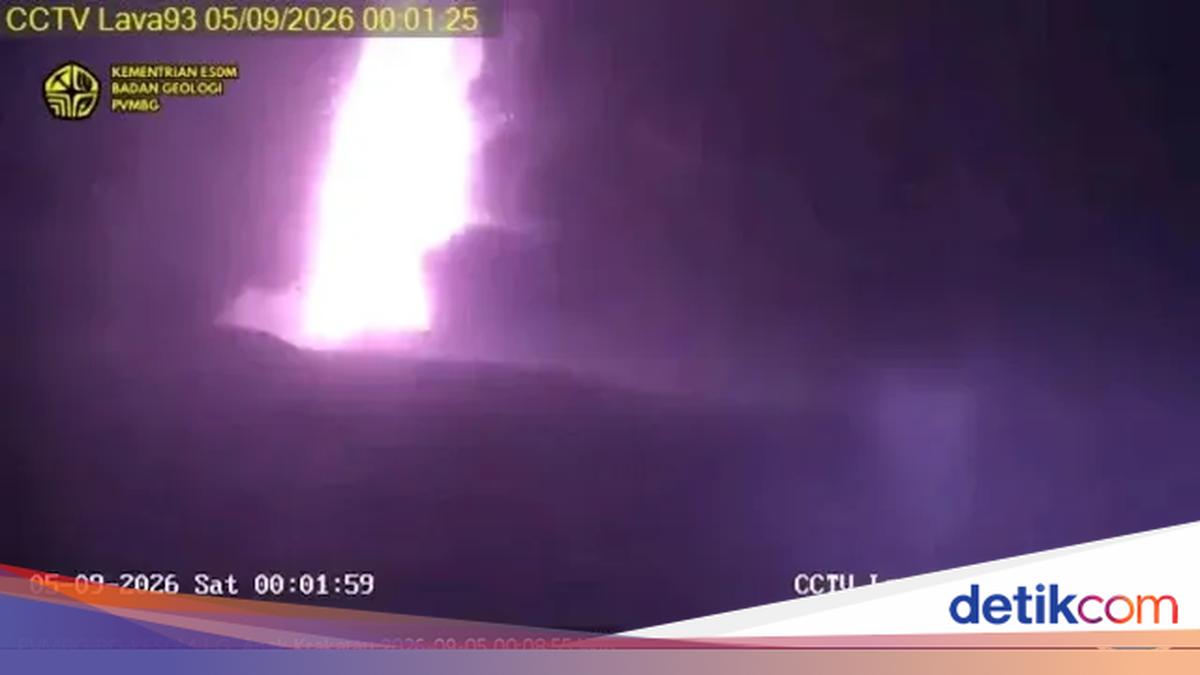
Mount Anak Krakatau in the Sunda Strait region has erupted, producing rumbles and a ‘lava fountain’. The Geological Agency revealed that this eruption, resembling a lava fountain, produces lava flows with bright red bursts.
“The height of the eruption column could not be observed, but the bright red colour of the eruption bursts was clearly visible continuously. This eruption phenomenon resembles a ‘lava fountain’ that produces lava flows. Continuous eruptions lasting several hours associated with lava fountain eruptions are a common phenomenon that frequently occurs,” said the Head of the Geological Agency, Lana Saria, in a statement on Saturday (5/9/2026).
What is a lava fountain? According to the official website of the Ministry of Energy and Mineral Resources (ESDM) Geological Agency, a lava fountain is a fountain of lava that produces lava flows. Continuous eruptions lasting several hours associated with lava fountain eruptions are a common phenomenon.
According to the United States Geological Survey, lava fountains are sometimes referred to as Hawaiian explosive activity, named after the type location for this kind of eruption—Kīlauea Volcano, Hawaii. This phenomenon often occurs in other basaltic centres in different tectonic settings, such as Mount Etna, Sicily.
Lava fountains form when the gas contained within magma cannot escape quickly enough as the magma rises to the surface, resulting in a mixture of lava and gas that sprays into the air. The magma erupts due to the gas contained within it.
According to Britannica, a lava fountain is a volcanic phenomenon where molten rock, or lava, erupts from a vent in a continuous flow, resembling a fountain. This occurs when magma, which is molten rock beneath the Earth’s surface, rises and erupts as lava. Lava fountains are often associated with basaltic lava, which is less viscous and allows for more fluid eruptions.
Impact of the Anak Krakatau Eruption
Mount Anak Krakatau in the Sunda Strait region experienced an eruption that produced rumbles and vibrations. The vibrations were felt strongly by local residents, causing doors and windows to shake.
In video footage shared by the Banten Regional Disaster Management Agency (BPBD) on Saturday (5/9/2026), the eruption of Anak Krakatau caused residents’ doors to rattle. The strong vibrations caused doors to make loud, creaking noises.
Other videos showed residents’ windows vibrating. The tremors were strong enough to cause window curtains to move on their own.
BPBD Banten reported that the vibrations occurred several times starting from 01:00 WIB early this morning. At 07:00 WIB, residents also reported strong tremors due to the Anak Krakatau eruption.
A resident named Rizqi shared his testimony during the eruption. Residents heard loud booms and felt strong vibrations since the early hours of the morning.
“The vibration of the windows and these occasional loud booms have been felt since 2 am today,” Rizqi told reporters.
“We initially thought it was only happening in our house, but this morning it turns out all our neighbours experienced the same thing,” he added.
Source: jawawa.id (https://jawawa.id/newsitem/what-is-a-lava-fountain-the-phenomenon-during-the-anak-krakatau-eruption-1788602309)
Originally published by detikcom (https://news.detik.com/berita/d-8649798/apa-itu-lava-fountain-fenomena-saat-gunung-anak-krakatau-erupsi), translated from Indonesian