
What do orangutans do in their daily lives in the forests of Kalimantan?
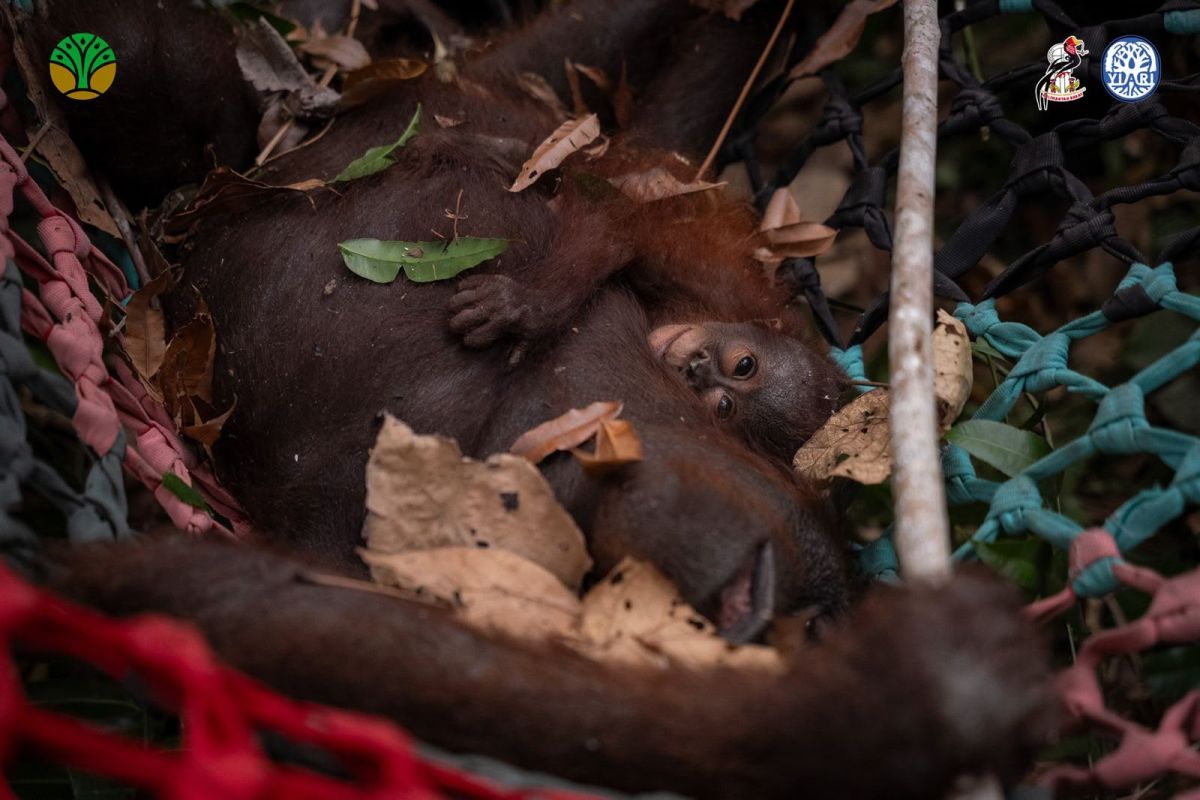
Jakarta (ANTARA) – When imagining a Bornean orangutan, one probably pictures a reddish-brown ape swinging through the trees. Yet life in the forest for orangutans is far more complex than simply moving from one tree to another.
Beneath their seemingly calm demeanour, orangutans lead rather busy routines. They must forage for food, travel from one place to another, build nests, care for their young, and avoid the various threats present in their habitat.
The Bornean orangutan, or Pongo pygmaeus, is an endemic species of the island of Kalimantan. Its habitat is spread across several forest areas on the island, particularly lowland tropical forests and peat swamp forests, including peatland ecosystems.
Unfortunately, this habitat continues to face multiple pressures. Changes in land use, forest fragmentation, and forest and land fires are increasingly limiting the living space available to orangutans.
So what is life really like for orangutans in the forest?
Most of their time is spent in the trees
Orangutans are known as arboreal animals, meaning they carry out most of their activities in the trees.
Trees are an essential part of their lives. From the canopy, orangutans can forage for food, travel, rest, and build nests.
Life in the trees also gives orangutans a way of moving that differs from many other animals. With their long arms and strong bodies, they can move from branch to branch to reach food sources or safer locations.
For this reason, the presence of large trees and interconnected forests is vital for their survival.
A varied diet
One of the orangutan’s main daily activities is searching for food.
Fruit is an important part of their diet, but they do not rely on fruit alone. Orangutans also eat leaves, bark, flowers, and other parts of plants.
Food availability is strongly influenced by forest conditions and the seasons. When fruit is abundant, orangutans can spend a great deal of time foraging and eating it.
Conversely, when certain food sources are hard to find, they must travel further in search of other options.
Observations by the Borneo Orangutan Survival (BOS) Foundation of orangutans released back into the wild show that feeding can take up a large share of an orangutan’s active time. In observations of an orangutan named Alba in Bukit Baka Bukit Raya National Park, for example, an average of 56.5 per cent of her active time was spent feeding.
This means a healthy forest provides not only shelter, but also a natural “kitchen” for orangutans.
Life on the move
Orangutan life does not always unfold in one place.
They need to move in line with the availability of food. If a fruiting tree lies some distance away, orangutans will travel towards it.
This movement makes the size and condition of their habitat important. Fragmented or disjointed forests can make these journeys more difficult.
According to the BOS Foundation, Bornean orangutans now live in fragmented populations and are found only in certain forest areas. Human activity and development are among the factors squeezing their natural habitat.
In other words, for orangutans, having a sufficiently large forest is not necessarily enough. They also need forests that remain connected so they can move about and find food sources.
Orangutans build nests to sleep in
As rest time approaches, orangutans engage in an intriguing activity that humans do not perform daily: building nests.
Nests are usually built in the trees using twigs and leaves, resembling a simple bed used for resting.
The location of the nest is not chosen at random. The height of the tree, the condition of the branches, and the surrounding environment all factor into the orangutan’s decision.
BOS Foundation observations of a mother orangutan named Manggo and her infant Melki in the Bukit Batikap Protected Forest in Central Kalimantan found their nest some 16 to 20 metres above the ground. Melki, being still young, also slept alongside his mother.
This shows that a nest is not merely a place to sleep, but part of an orangutan family’s life.
A long learning process
For young orangutans, life in the forest is also a lengthy learning process.
Infant orangutans do not instinctively know all the skills needed to live independently. They learn from their mothers, from identifying food and moving through the trees, to finding safe places and building nests.
The bond between mother and infant is crucial during the growth period.
Observations of Manggo and Melki show how infant orangutans remain dependent on their mothers whilst learning the skills they will later need to survive on their own.
This process makes the presence of the mother and a safe habitat extremely important. If the habitat is disturbed, the infant’s learning process can also be affected.
Orangutans are not always social animals
Unlike some primates often seen in large groups, orangutans lead relatively solitary lives.
Adult orangutans generally go about their activities alone. Encounters with other individuals do occur, particularly in certain circumstances such as when food is abundant, or in the relationship between mother and infant.
Therefore, spotting a single orangutan in the forest does not mean only one individual lives in that area.
They may each have their own home ranges and use the same forest area at different times.
A forest of many functions
For orangutans, a forest serves many functions at once.
The forest provides food, a place to sleep, shelter, and space to move. The variety of trees and plants within it also forms an ecosystem that supports many other animals.
The BOS Foundation records that Bornean orangutans can be found in various habitat types, from mangrove forests to karst forests, although they are most commonly found in lowland tropical forests. Dipterocarp forests and peat swamp forests are also important habitats for the species.
This is why, when a forest is damaged, what is lost is not simply a collection of trees.
For orangutans, forest degradation means fewer places to forage, rest, breed, and raise their young.
When life in the forest is disrupted
Their dependence on forests makes orangutans highly vulnerable to environmental change.
Forest and land fires, for instance, can destroy vegetation and fill the air with smoke. Meanwhile, forest clearance and habitat fragmentation reduce the space orangutans can use to move around.
These conditions can even drive orangutans out of their natural habitat and towards plantations or settlements in search of food.
This is why orangutan conservation cannot be judged solely by the number of animals rescued. The condition of their home must also be a priority.
The BOS Foundation says orangutan protection must go hand in hand with the protection and restoration of forest ecosystems. These efforts include fire prevention, patrols, mitigation of human-orangutan conflict, and rehabilitation of damaged forest areas.
Life in the forest is essential
The lives of orangutans in Kalimantan offer a simple illustration of just how important forests are for wildlife.
There, every tree has a function. Some provide fruit, others serve as pathways, resting places, or the spot where a mother raises her young.
That is why protecting orangutans cannot be achieved merely by rescuing injured individuals or moving animals out of dangerous areas.
A safe habitat remains the primary requirement.
The stories of orangutans that have successfully returned to the forest show that when habitat is available and conditions are favourable, they can resume their natural lives: foraging, moving from tree to tree, building nests, and raising the next generation.
In the end, life for orangutans in the forests of Kalimantan is not a simple affair. Every day they must read the condition of the forest, search for food, choose places to rest, and protect their young so they can survive.
And all of it depends on one common factor: a forest that can still serve as their home.
As long as the forests remain intact, orangutans will still have the chance to live as they should – far from the encirclement of smoke, habitat loss, and conflict with humans.
Source: jawawa.id (https://jawawa.id/newsitem/what-do-orangutans-do-in-their-daily-lives-in-the-forests-of-kalimantan-1788828807)
Originally published by Antara (Indonesian) (https://www.antaranews.com/berita/5730665/apa-yang-dilakukan-orangutan-kesehariannya-di-hutan-kalimantan), translated from Indonesian