
What Caused the Nepal Flash Flood That Struck Without Rain?
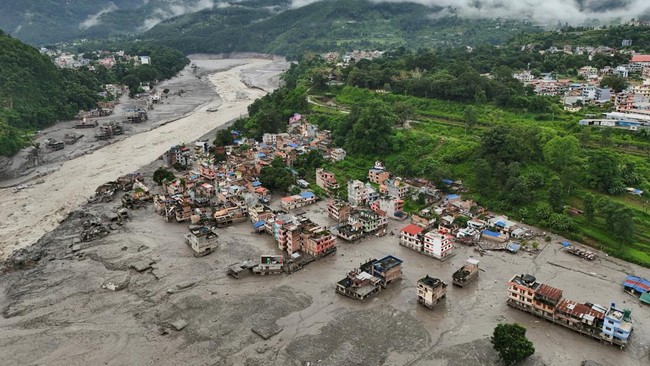
A glacier in the high Himalayas collapsed on Wednesday morning, triggering a massive flood along the Nepal-Tibet border.
Citing an Al-Jazeera update on Thursday (27/8/2026), at least 160 people have been confirmed dead, while nearly 1,500 people remain missing in Nepal and Tibet, China.
In Nepal, 826 people were reported missing, including nearly 600 foreign tourists, according to police and tourism officials. Across the border, Chinese state media reported 558 people missing in Gyirong County, Tibet, including 260 foreign nationals.
The incident occurred at around 08:40 local time or 02:55 GMT on Wednesday. Flash floods and landslides suddenly struck the mountainous region along the Nepal-Tibet border.
The massive flood carrying water, mud, and rocks swept through the Lhende Khola river valley, submerging villages and destroying homes and critical infrastructure.
At least 19 bridges and around 40 kilometres of road were washed away by the flood. The Nepalese army and rescue teams have been deployed using helicopters, drones, and sniffer dogs.
However, high river water levels, damaged roads, and thick mud are hampering efforts to reach some of the worst-affected areas. Across the border in Tibet, extremely thick mud deposits are also hindering Chinese rescue teams from reaching the border area.
This actually took officials by surprise, as the flood occurred when no rain was falling.
So what actually caused the Nepal flash flood? Why did the flood come when there was no rain?
The disaster appears to have originated in the high Himalayas when part of a glacier collapsed. This triggered a chain of events that produced a powerful wave of water and debris downstream.
Satellite imagery shows a substantial portion of the lower end of the glacier broke off at an altitude of about 5,200 metres above sea level. The material then fell approximately 1,200 metres to the valley floor, carrying rocks and sediment.
The resulting avalanche of ice and rock struck the Lhende River in Tibet, about 20 kilometres northeast of the Nepal-China border crossing. The landslide material temporarily dammed the river before the natural dam eventually burst, releasing a massive flood wave downstream.
Was there really an earthquake?
Earlier initial reports cited a 4.4 magnitude earthquake as the trigger for the glacier collapse. However, the US Geological Survey (USGS) issued a revised report.
The USGS stated that the seismic signal actually originated from the landslide itself and not an earthquake. The landslide ultimately produced a seismic event recorded as equivalent to a 5.2 magnitude earthquake.
Where exactly did the flood occur?
The flash flood struck the mountainous region on the Nepal-Tibet border. One of the worst-affected areas is Rasuwa District in Nepal, just south of the Chinese border.
The initial wave entered the Lhende Khola river, which then flows into the Bhote Koshi river and subsequently the Trishuli river. The flood flow then moved south through Nepal.
The water level of the Trishuli river was reported to have risen by up to 9 metres in just 30 minutes. In Rasuwa District, the settlements of Timure and Syapru Besi were among those affected.
Further downstream, the flood reached parts of Nuwakot and Dhading districts, damaging homes, roads, and other infrastructure. Across the border in Tibet, mud and debris struck Gyirong Port in the Shigatse region.
The Trishuli river then joins the Narayani river, which flows into the state of Bihar, India, where it is known as the Gandak river. This caused a major impact on surrounding areas.
“My brother-in-law has a liquor shop here. I received a phone call from him this morning. They were crying and saying their entire house was swept away by the flood,” said Raju Bhadel, a local businessman in Nepal.
“I saw about nine trucks swept away by the flood, including people. This was a very heartbreaking incident,” said Manoj Mishra, a teacher, who said he saw vehicles and people being carried away by the flood current in Nepal.
Source: jawawa.id (https://jawawa.id/newsitem/what-caused-the-nepal-flash-flood-that-struck-without-rain-1787827905)
Originally published by CNBC Indonesia (https://www.cnbcindonesia.com/news/20260827162940-4-762838/apa-penyebab-banjir-bandang-nepal-hantam-warga-meski-tak-ada-hujan), translated from Indonesian