
What ASEAN Sees in Russia That the West Does Not
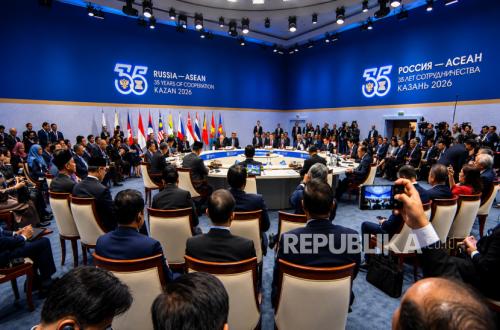
While the West has isolated Russia since the outbreak of the war in Ukraine, a different scene has emerged in the city of Kazan. Leaders and high-ranking officials from Southeast Asia have been arriving in succession to attend meetings with Moscow.
There are no empty seats and no signs of ostracisation. Instead, what is visible is a keen interest in expanding cooperation. This raises a significant question: If Russia is truly as isolated as often depicted in the West, why are ASEAN nations still actively building relations with it?
This question becomes even more compelling because the meeting in Kazan is more than just an ordinary diplomatic celebration. Russia and ASEAN are commemorating 35 years of partnership, a relationship that is now evolving amidst major shifts in the global geopolitical landscape.
However, what is actually happening in Kazan is not just about Russia; it is also about ASEAN.
For decades, many have regarded the European Union as the primary model for regional integration. Brussels is seen as the most successful example of how sovereign nations can cede part of their authority to a shared institution to create a larger market and political power.
But now, a different model is emerging. ASEAN does not possess a supranational parliament like the EU. It lacks a commission capable of regulating its member states, nor does it have a political structure that forces members to follow a single policy line.
Nevertheless, this organisation continues to grow. Its economy is developing into one of the most dynamic in the world, its population is approaching 700 million, global trade routes traverse its territory, and investment continues to flow.
Why is this much looser model actually succeeding?
Aleksandr Bobrov, a professor of international relations at Russia’s MGIMO, suggests that ASEAN has demonstrated that regional integration does not have to be built by transferring primary power to supranational institutions.
“ASEAN proves that countries can work closely together without losing their respective strategic maneuverability,” said Bobrov, as reported by Russia Today on Friday (19/06/2026).
Yet, that is only the first layer of the story. For Moscow, ASEAN is not merely a regional organisation.
ASEAN serves as a gateway to one of the largest economic growth centres of the 21st century. The region connects the Indian and Pacific Oceans, controls trade routes that serve as the lifeblood of the global economy, and is home to several of the world’s fastest-growing economies.
As the West showers Russia with sanctions and economic restrictions, access to regions such as ASEAN is becoming increasingly vital for Russia.