
Whale Sharks Repeatedly Stranded on Java's Coast Amid Worsening Environmental Conditions
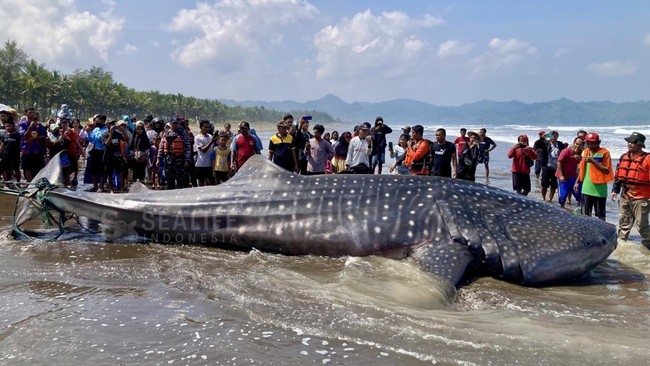
A research team from Jenderal Soedirman University (Unsoed) is investigating a series of whale shark strandings along the southern coast of Cilacap Regency, Central Java. The latest incident occurred when an adult male whale shark, measuring 8.36 metres, was found stranded on Banjarsari Beach, Nusawungu District, Cilacap, on Saturday morning, 23 May 2026. This was the second such event within a week, following the stranding of a 4-metre whale shark along the same coastline, merely 6 kilometres away.
Responding to the incidents, a research team from Unsoed’s Faculty of Fisheries and Marine Science (FPIK) collaborated with the Cilacap Marine Biota Stranding Handling Network, the Fisheries Service, the Agriculture Service, and the Sealife Indonesia Foundation. Unsoed researcher and marine science lecturer Mukti Trenggono confirmed that oceanographic analysis points to strong ecological factors drawing the large animals close to shore. Based on MODIS Aqua satellite imagery from May 2026, the coastal waters from Cilacap to Kebumen currently exhibit relatively high chlorophyll-a concentrations of around 1-3 mg/m³, combined with warm sea surface temperatures ranging between 29-30°C.
‘These oceanographic conditions indicate increased water productivity and potential aggregation of plankton and small nekton,’ Mukti stated in a release quoted from Unsoed’s official website on Tuesday, 9 June 2026. This is believed to be the ecological driver attracting whale sharks to the shallow waters of Cilacap to hunt their primary food sources, such as rebon shrimp and anchovies. The phenomenon was further evidenced by a necropsy conducted by the joint team, which found the shark’s stomach completely full of undigested anchovies.
However, beyond these natural factors, the research team also highlighted a serious anthropogenic threat. In addition to lacerations caused by ship propellers, plastic waste was discovered inside the digestive tract of the protected animal. Another Unsoed researcher, Nuning Vita Hidayati, emphasised that the declining quality of the marine environment is strongly suspected to be a fatal trigger causing these giant creatures to experience disorientation and become stranded.
‘The decline in water quality due to pollution, including the accumulation of heavy metals, can affect the physiological condition, immune system, and navigational ability of sharks,’ she explained. Such disturbances potentially increase the risk of disorientation and environmental stress, and can even cause acute poisoning that directly contributes to the stranding of sharks. To ascertain the exact cause of death and the successive strandings, Unsoed is currently conducting further sample testing. The FPIK research team has secured water and biological samples from the incident site for comprehensive analysis in the university laboratory. Laboratory tests at Unsoed will include in-depth analysis of water quality, genetic analysis, and supporting oceanographic studies. This scientific research is expected to provide academic recommendations for local government and relevant agencies in formulating a sustainable protection policy for the whale shark migratory area on the southern coast of Java.