
West Sumatra Rehabilitation and Reconstruction Accelerated, Rp17.9 Trillion Prepared to Face Flood Threat
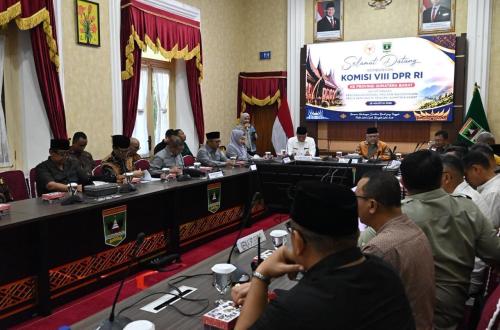
West Sumatra Governor Mahyeldi Ansharullah has called for the acceleration of rehabilitation and reconstruction following floods, flash floods and landslides that struck several areas of the province. The urgency is heightened by the continuing threat of hydrometeorological disasters, while sedimentation in a number of rivers has not yet been fully addressed.
Mahyeldi made the remarks while receiving the Specific Working Visit Team of House of Representatives Commission VIII at the West Sumatra Governor’s Palace on Friday (28/8/2026). The visit was conducted to observe first-hand the progress of post-disaster handling and to carry out the DPR’s oversight function.
Mahyeldi explained that total losses and damage from the disaster reached approximately Rp33.4 trillion, according to a press release received on Saturday (29/8/2026). The regional government has proposed a requirement of Rp21.4 trillion through the Post-Disaster Rehabilitation and Reconstruction Plan (R3P), of which around Rp17.9 trillion has been approved for infrastructure handling.
The budget is planned to be implemented on a multi-year basis over three years, from 2026 to 2028. A number of works have already commenced, but Mahyeldi cautioned that some works still need to be accelerated because the threat of disaster has not fully passed.
One issue receiving attention is sedimentation in several rivers that has not been entirely addressed. The condition is feared to increase the risk of flooding when high-intensity rainfall occurs again.
Mahyeldi stressed that accelerating rehabilitation and reconstruction requires joint work through three nodes: central government ministries and agencies, the West Sumatra Provincial Government, and district and city governments according to their respective authorities.
He expressed hope that all works can proceed in accordance with the R3P that has been prepared together with the National Disaster Management Agency (BNPB), so that handling not only repairs damage from previous disasters but also reduces the risk of recurring disasters.
The head of the Specific Working Visit Team of House Commission VIII, Ansory Siregar, said the visit was part of the DPR’s oversight function. Therefore, Commission VIII requires a factual picture of the conditions and various problems still faced in the implementation of rehabilitation and reconstruction in West Sumatra.
Ansory asked the West Sumatra Provincial Government to convey conditions on the ground openly to Commission VIII. Various problems identified during the visit will subsequently be brought forward and voiced in discussions at the central level.
Ansory also paid attention to the use of the Rp17.9 trillion budget planned over three years. In his view, acceleration needs to be considered so that the development process does not take too long, especially as infrastructure that has not fully recovered could be affected again if another disaster occurs.
Commission VIII member from the PDI Perjuangan faction, H. Wibowo Prasetyo, agreed that acceleration is key to West Sumatra’s recovery process. According to him, with the very large scale of damage and losses, all works cannot possibly be completed at once, so clear prioritisation is needed.
“With losses and damage reaching Rp33.4 trillion, we understand that recovery will certainly take time. Therefore, there must be a scale of priorities. Those that are most urgent and potentially endanger the public if not addressed immediately must be prioritised,” Wibowo said.
Wibowo paid particular attention to the river sedimentation issue raised by the Governor. In his view, sedimentation is not merely a matter of post-disaster infrastructure recovery but is directly related to mitigation of the next disaster threat.
“We are racing against the rainy season. We must not allow unaddressed sedimentation to reduce river capacity, then high-intensity rainfall arrives and the public faces flooding again. We certainly do not want people who are trying to recover to become victims once more,” he said.
Therefore, Wibowo supported strengthening coordination between the central government, the West Sumatra Provincial Government and district and city governments as conveyed by Mahyeldi. According to him, the scale of the disaster indeed requires joint work across levels of government.
“It is impossible for a problem of this magnitude to be borne by the regional government alone. The central government, province and districts/cities must move together according to their authority. If there are obstacles in the implementation of rehabilitation and reconstruction, we identify them together and find solutions,” he said.
Wibowo assessed that the Commission VIII visit must produce concrete follow-up actions. The various needs and problems conveyed by the West Sumatra Provincial Government can serve as material for Commission VIII in carrying out its oversight function and in discussions with BNPB and relevant ministries and agencies at the central level.
According to him, acceleration does not mean all works must be carried out simultaneously. The government can determine priorities based on the level of urgency and risk to public safety.
“Those that, if not addressed now, could potentially cause another disaster and endanger the public when the rainy season arrives, those must be prioritised. For high-risk points, time is indeed limited,” Wibowo stressed.
He appreciated the West Sumatra Provincial Government for preparing the R3P and openly conveying the region’s conditions and needs to Commission VIII. In his view, the DPR needs to take a role in overseeing the recovery plan so that it can be realised and its benefits can be felt by the public immediately.
“The spirit is to work together to accelerate recovery. We want the people of West Sumatra to recover soon, but recovery must also make this region more resilient and the public better protected when facing disasters,” he said.