
West Sumatra Provincial Government and BNPT Join Forces to Strengthen Teachers’ Role in Preventing School Violence
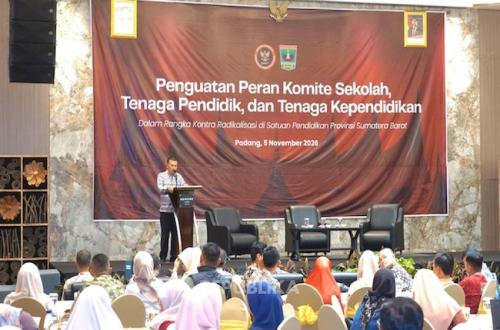
PADANG — Educational institutions face challenges not only in shaping character and improving the quality of learning, but also in protecting pupils from exposure to intolerance, radicalism and violent content.
In response, the National Counter-Terrorism Agency (BNPT) is strengthening cooperation with the West Sumatra provincial government and educators to build resilience in schools.
The joint commitment was marked by a declaration involving experts and educators at the Mercure Hotel ballroom in Padang, West Sumatra, on Thursday (5 November 2026). The collaboration aims to strengthen prevention efforts and increase schools’ capacity to address potential intolerance, radicalism, terrorism and other forms of violence involving young people.
In his remarks, Mursalim, head of West Sumatra’s National Unity and Politics Agency (Kesbangpol), highlighted the growing phenomenon of True Crime Communities (TCC) among children and young people. The trend is considered to be linked to an interest in content containing violence and anarchism.
Mursalim said children exposed to these ideas should not be immediately given a negative stigma. Instead, they should receive support to help them return to normal lives appropriate to their stage of development.
“Those involved should not be excessively stigmatised, but guided so they can live like children their own age again. West Sumatra’s Kesbangpol and its officials have also carried out mitigation and provided support to children exposed to TCC ideas,” Mursalim said.
BNPT’s acting director of counter-radicalisation, Colonel Hendro Wicaksono, said developments in information technology were making efforts to tackle violence, intolerance, radicalism and terrorism increasingly complex. The open flow of information means harmful content can reach people of all ages, including children in educational settings.
“The threat of violence can emerge in places we consider safe, even in schools, which are commonly seen as places to learn and shape character,” he said.
Hendro stressed the importance of educators in building children’s resilience to negative influences. Teachers, he said, are among the adults closest to pupils after their parents, placing them in a strategic position to provide guidance and help children interpret digital content appropriately.
“We hope this declaration will not merely be a forum for exchanging information, but also an opportunity to make a lasting joint commitment and take sustained action to create a tolerant younger generation opposed to violent ideologies,” Hendro said.
After the joint declaration, the event continued with a presentation on “Strengthening National Insight and Multi-Stakeholder Collaboration in Counter-Radicalisation”, led by Dr Adil Mubarak, chair of the West Sumatra Terrorism Prevention Coordination Forum (FKPT).
Adil explained that schools are a strategic setting for counter-radicalisation because they are among the first environments in which children encounter the values of tolerance, diversity and national identity. For this reason, strengthening national awareness must be an ongoing effort involving multiple parties.
The next session, “The Role of Former Terrorism Convicts as Agents of Peace and Radicalism Prevention”, was delivered by Yahya, a BNPT deradicalisation partner. He urged the public not to judge someone’s involvement in a terrorist group solely by their appearance or way of interacting with others.
Yahya said terrorist groups can change their members’ appearance and interaction patterns, meaning that identification based only on physical characteristics risks leading to mistaken judgements.
“Such views can increase the risk of errors in the early identification of people suspected of holding intolerant or radical beliefs,” Yahya said.
The programme then continued with training for teachers on preventing and addressing intolerance and violence in schools. Psychologist Dra Reni Kusumowardhani, M.Psi., who led a session, emphasised the importance of effective communication between teachers, parents and children.
She explained that two-way communication requires more effort than one-way communication, but is important for building trust, understanding children’s problems and finding solutions together.
“Parents or teachers should identify the problems or shortcomings that may be preventing a child from feeling close to them,” Reni said.
The next training session examined ways to reduce violence and intolerance in educational settings. Speakers included BNPT expert on counter-narratives Prof (HC) M. Suaib Tahir and Muhammad Abdullah Darraz, a lecturer at the University of Muhammadiyah Prof Dr HAMKA (Uhamka).
Suaib Tahir said violent behaviour by children or pupils often does not occur in isolation. Problems at home can affect a child’s development and carry over into school. Responses to violence should therefore take account of the underlying issues and the child’s social environment.
Muhammad Abdullah Darraz said teachers and pupils are often exposed to radicalism and terrorism from outside school. Those affected, he said, should be viewed as victims of broader influences and networks, and should receive protection, support and rehabilitation.
Through the declaration and training programme, BNPT and the West Sumatra provincial government hope schools will be better prepared to take preventive action against violence involving pupils. Strengthening educators’ capacities is also expected to help schools identify potential problems, mitigate risks and respond appropriately when incidents require specialised support.
The collaboration also underscores that preventing intolerance, radicalism and violence among young people is not the responsibility of schools alone. Families, government, communities and other stakeholders all have a role in creating a safe, inclusive environment that supports children’s development.
Source: jawawa.id (https://jawawa.id/newsitem/west-sumatra-provincial-government-and-bnpt-join-forces-to-strengthen-teachers-role-in-preventing-school-1794372767)
Originally published by Republika (https://daerah.republika.co.id/berita/tobi2m291/pemprov-sumbar-dan-bnpt-sinergi-perkuat-peran-guru-cegah-kekerasan-di-sekolah), translated from Indonesian