
West Sumatra Continues Push for Modern Agriculture to Achieve Food Self-Sufficiency
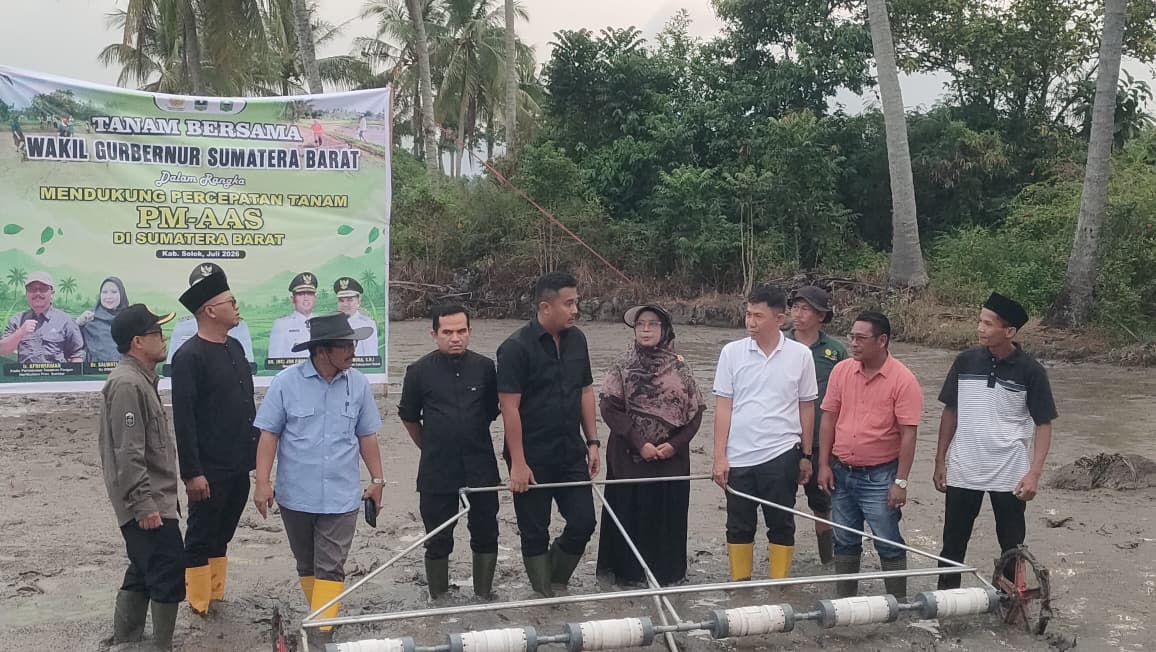
The Provincial Government of West Sumatra is continuing to accelerate the transformation of the agricultural sector towards a more modern, efficient, and technology-based cultivation system as a strategy to increase productivity while strengthening regional food security. This commitment was realised through the inaugural planting of rice seeds using the Modern Agriculture–Advanced Agriculture System (PM-AAS) pattern on land belonging to the Rawang Sari Farmers Group in Nagari Salayo, Kubung District, Solok Regency, on Saturday (25/7).
West Sumatra Deputy Governor Vasko Ruseimy asserted that agricultural modernisation is an important step to address the sector’s challenges amidst increasingly limited paddy fields and rising public food needs. “This is an excellent activity to support the government’s programme,” he said. He noted that increasing food production can no longer rely solely on expanding agricultural land. Therefore, the government is encouraging various innovations and the use of technology so that the productivity of each hectare of land can be continuously improved. Vasko assessed that the implementation of modern agriculture must be accompanied by sustainable mentoring for farmers, ensuring that the innovations introduced do not stop at the demonstration stage but are widely applied and provide real benefits for increasing harvests and farmer welfare. “We want this technology to be truly adopted by farmers so that productivity increases and their welfare is lifted,” he stated.
The activity was also attended by Solok Deputy Regent Chandra; Head of the West Sumatra Plantation, Food Crops, and Horticulture Office, Afniwirman; Head of the Solok Regency Agriculture Office, Deslirizaldi; the Head of BRMP West Sumatra; agricultural extension workers; farmer groups; and the local community. Head of the West Sumatra Plantation, Food Crops, and Horticulture Office, Afniwirman, explained that PM-AAS is a modern agricultural programme initiated by the Minister of Agriculture to increase land productivity through mechanisation and more precise planting mechanisms. Unlike conventional patterns that use seedlings from nurseries, the PM-AAS system plants seeds directly using a special planting tool. This method makes the planting process faster and more efficient, reduces labour requirements, and allows for more optimal plant population management.
According to Afniwirman, the seed requirement in the PM-AAS system is indeed higher, around 70–80 kilogrammes per hectare compared to the conventional pattern which averages about 25 kilogrammes per hectare. Fertiliser needs are also adjusted to support the denser plant population so that the potential yield can increase significantly. “With this system, productivity is targeted to reach around 10 to 12 tonnes of grain per hectare. If the area of paddy fields is increasingly limited, then what we must do is increase the productivity of each existing hectare of land,” he said. He added that the planting in Nagari Salayo is the first application of PM-AAS in West Sumatra after previously being in the trial stage.
To accelerate the programme’s implementation, the government will optimise the role of agricultural extension workers as the frontline for field mentoring. Each extension worker is targeted to assist with the implementation of PM-AAS on approximately 50 hectares of land, ensuring that modern cultivation technology can be applied correctly according to the conditions of each region. With more than a thousand extension workers in West Sumatra, the potential mentoring coverage is estimated to reach around 50,000 hectares of agricultural land. The West Sumatra Provincial Government hopes that the successful implementation of PM-AAS in Solok Regency can serve as a model for developing modern agriculture in other rice production centres. Through mechanisation, technology application, and sustainable mentoring, agricultural productivity is expected to continue increasing, thereby strengthening regional food security while supporting the national food self-sufficiency target.