
West Nusa Tenggara Targets Rp6.22 Trillion in Revenue in 2027, with Spending Up 5.7%
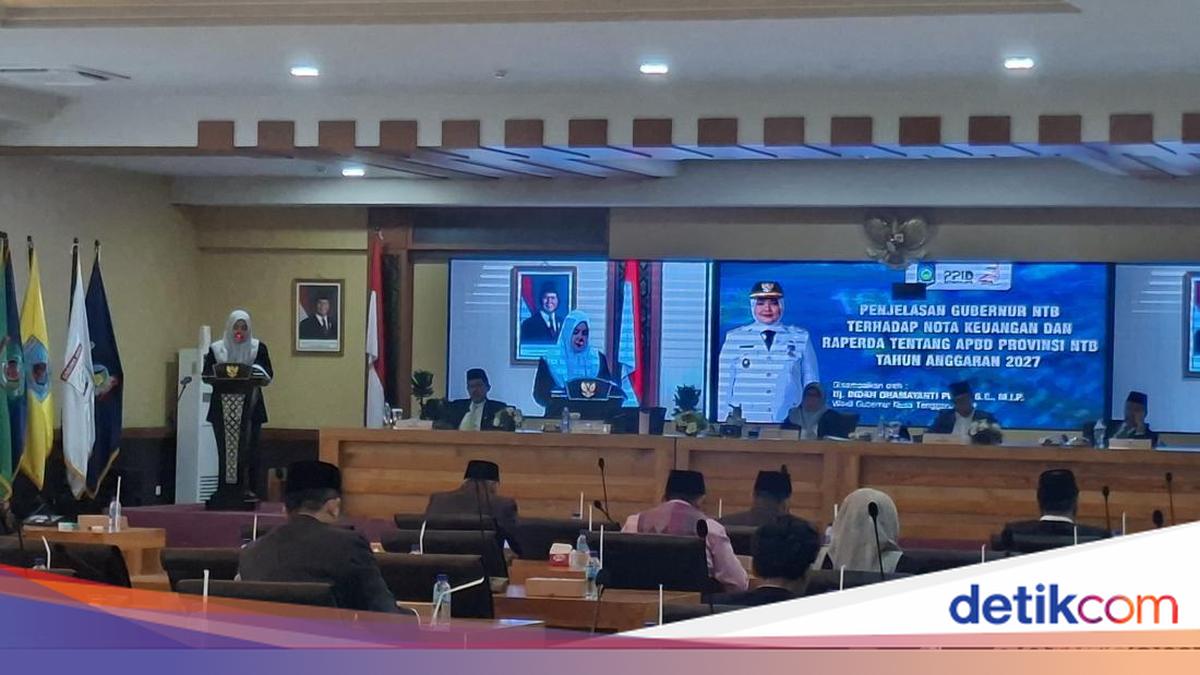
The West Nusa Tenggara (NTB) provincial government has set its revenue target for the 2027 fiscal year at Rp6.22 trillion. Deputy Governor Indah Dhamayanti Putri announced the figure while presenting the financial statement and draft regional regulation on the 2027 regional budget (APBD) at a plenary meeting of the NTB Provincial Council (DPRD) in Mataram on Monday (9 November 2026).
Dinda, as Indah is known, said regional revenue in 2027 was planned at Rp6.22 trillion, an increase of about 10.69% from the original 2026 budget of Rp5.62 trillion.
The revenue comprises Rp3.128 trillion in own-source regional revenue (PAD), up 3.44% from Rp3.02 trillion in 2026; Rp2.98 trillion in transfers from the central government, an increase of 20.01%; and Rp114.21 billion from other legitimate regional revenue sources.
Although PAD is growing, Dinda acknowledged that regional revenue still relies predominantly on central government transfers. “Going forward, revenue policy will focus on digitising tax and levy collection, expanding the tourism and agro-maritime sectors, optimising regional assets, and strengthening the performance of region-owned enterprises such as Bank NTB Syariah,” she said.
On the spending side, the NTB provincial government has set 2027 regional expenditure at Rp6.06 trillion, around 5.7% higher than in the 2026 budget. This comprises Rp4.61 trillion in operating expenditure, Rp397.20 billion in capital expenditure, Rp38 billion in unexpected expenditure, and Rp1.01 trillion in transfers to regencies, cities and villages.
Capital expenditure is set to increase from Rp193.48 billion in 2026 to Rp203.72 billion in the original allocation under the General Budget Policy and Provisional Budget Ceiling (KUA-PPAS).
“This demonstrates the government’s commitment to creating assets and long-term benefits for the region,” she said.
Dinda said the 2027 fiscal policy would be guided by the principles of realism, results, effective targeting and sustainability. The budget is intended to address three priority issues and support ten flagship programmes.
Poverty alleviation has been allocated Rp745.25 billion, with a focus on village-based interventions, particularly in 106 villages with pockets of extreme poverty, strengthening productive economic activity, and protecting vulnerable groups and people with disabilities, said Dinda, a former two-term Bima regent.
The provincial government has also allocated Rp487.88 billion to high-quality, sustainable tourism. The funding will support destination development, the creative economy, national and international events, and digital connectivity in areas without reliable coverage.
“Food and energy security, as well as downstream development in the agro-maritime sector, have been allocated Rp110.38 billion. This includes food security, irrigation, Rp89.49 billion for Meninting Dam, and the downstream processing of agricultural, livestock, fisheries and marine products,” she added.
Dinda said Rp69.27 billion had been allocated to human resource development, including vocational training to prepare NTB’s young people to compete in local and international labour markets.
Good governance and smart governance receive the largest allocation, at Rp1.05 trillion, to advance merit-based bureaucratic reform and the digitisation of public services.
A key feature of the 2027 draft budget is the shift from a deficit of around Rp111.2 billion in the 2026 budget to a surplus of Rp162.7 billion in 2027. The budget surplus (SilPA) carried over from the previous year is estimated at just Rp10 billion, down sharply from Rp234 billion in 2026.
“This indicates more disciplined budget planning and execution, and reduced reliance on the budget surplus. Any criticism is, of course, a right that council members should exercise to help us improve. It will be discussed together,” Dinda said.
The next stage of deliberations on the proposed budget will be conducted with the Regional Government Budget Team (TAPD). She also commented that central government budget cuts were being felt across the board.
“Every regency, city and province is feeling the cuts. We have to adjust to the available budget and prioritise what matters most. I believe the public will support and understand this,” she said.
Despite budget adjustments, including to the DPRD’s constituency funds (pokir) in 2027, Dinda said relations between the legislative and executive branches in NTB remained harmonious.
“The executive and legislative branches continue to work together to adjust to the budget,” said the Golkar Party politician.
The NTB provincial government remains alert to several challenges, including global economic uncertainty, regional inequality, dependence on central government transfers and disaster risks across the island province.
“We are presenting this financial statement and hope the NTB DPRD will deliberate on it carefully, critically and constructively, so that the 2027 regional budget draft can be jointly approved by 30 November 2026 at the latest,” she concluded.
Source: jawawa.id (https://jawawa.id/newsitem/west-nusa-tenggara-targets-rp6-22-trillion-in-revenue-in-2027-with-spending-up-5-7-1794243050)
Originally published by detikBali (https://www.detik.com/bali/nusra/d-8745768/ntb-target-pendapatan-tembus-rp-6-22-triliun-2027-belanja-naik-5-7), translated from Indonesian