
West Java Supplier Joins Rp38 Billion Electric Vehicle Supply Chain
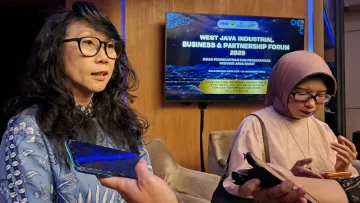
Efforts to strengthen West Java’s electric vehicle supply chain are beginning to bear fruit. Electric vehicle manufacturer BYD has formed a partnership with six prospective local suppliers under an agreement worth Rp38 billion.
The partnership was marked by the signing of a statement of intent at the 2026 West Java Industrial Business and Partnership Forum, held at Menara bank bjb in Bandung on Thursday, 26 November 2026.
Sri Moertiningroem, director of business empowerment at the Ministry of Investment and Downstreaming/BKPM, said the agreement followed a business-matching event held in Bekasi on 17 September 2026.
The event brought together BKPM, the Ministry of Industry and the West Java Industry and Trade Agency (Disperindag) to connect large companies with prospective suppliers from local businesses.
“Following this matchmaking, BYD and six prospective suppliers reached an agreement worth Rp38 billion, which was signed today,” Sri said.
She explained that the partnership also forms part of the obligation for large companies receiving government investment incentives to work with micro, small and medium-sized enterprises (MSMEs) and domestic businesses.
The incentives include tax holidays, tax allowances and masterlists. Through the policy, the government aims to ensure that investment benefits not only large companies but also creates business opportunities for domestic industry players.
Sri stressed that involving local suppliers is important to strengthening the industrial structure and increasing the use of domestic components in the electric vehicle ecosystem.
“Collaboration is important, and we must continue encouraging MSMEs to join industrial supply chains. That means not only MSMEs, but domestic businesses more broadly,” she said.
To ensure the partnerships are sustained, BKPM will monitor and evaluate them alongside the regional Investment and One-Stop Integrated Services Agency (DPMPTSP), Disperindag and relevant ministries and agencies.
Oversight will also be strengthened through the Online Single Submission Risk Based Approach (OSS-RBA) system. Large companies that have entered into partnerships are being encouraged to report their implementation through the Investment Activity Report (LKPM) every three months.
Sri acknowledged that efforts to bring MSMEs into industrial supply chains still face several challenges, including limited market access, product quality, workforce skills, production capacity and financing.
The government is therefore promoting capacity-building through training, vocational education and production assistance, as well as wider access to financing through national banks, state-owned banks under the Himbara association and regional banks, including Bank bjb.
She also said a dedicated task force was needed to help MSMEs overcome business obstacles, from licensing to market access and financing.
West Java Industry and Trade Agency head Nining Yuliastiani said the forum had opened up partnership opportunities not only in electric vehicles but also in the food, automotive and textile industries.
Local commodities including milk, quicklime and potatoes are also being considered for inclusion in industrial supply chains.
Nining said the approach was important for linking farmers supplying raw materials with processors and downstream industries in an integrated production ecosystem.
“This is tangible proof of our commitment when we say we must build local supply chains,” she said.
Nining said strengthening local supply chains was one of the West Java provincial government’s strategies for accelerating economic growth towards 8 per cent by 2029.
The province’s manufacturing sector, one of the main pillars of its economy, still needs to grow faster. According to figures cited by Nining, it grew by 4.98 per cent.
The transport equipment industry is one area of concern. Although it contributes about 18 per cent, its growth is said to be only around 2 per cent.
Nining said the industry’s reliance on imported components was one problem that needed to be addressed. Greater use of local raw materials and components could generate more value for industry in West Java.
“If components can be supplied locally rather than imported, this can increase growth in the relevant subsectors,” she said.
Alongside supply-chain development, the West Java provincial government is targeting improvements in productivity, workforce skills, investment quality and logistics links between industrial areas.
Nining cautioned that a high investment value does not necessarily translate into job creation. Investment must therefore strengthen the regional industrial structure and deliver economic benefits to the public.
The provincial government will also seek to connect industrial estates with the economic potential of regencies and cities, including areas in southern and eastern West Java.
The aim is for partnerships between large industries and local suppliers to develop beyond business agreements into integrated supply chains that improve industrial competitiveness and broaden the benefits of investment in West Java.
Source: jawawa.id (https://jawawa.id/newsitem/west-java-supplier-joins-rp38-billion-electric-vehicle-supply-chain-1795722621)
Originally published by inilahkoran.id (https://www.inilahkoran.id/pemasok-lokal-jabar-masuk-rantai-pasok-industri-kendaraan-listrik-senilai-rp38-miliar), translated from Indonesian