
West Java SMEs Adopt Digital Product Passports to Access European Markets
Global market demands for product transparency and traceability are driving Indonesian businesses to adapt to new standards set by Europe. One such method is the implementation of the Digital Product Passport (DPP), which allows all product information—from raw material origins to carbon footprints—to be traced digitally.
This technological implementation has begun with Java Spices, a spice producer from Cijeruk, Bogor, West Java. Through the INA Trading export platform, every product package is equipped with a PERURI RFID Blockchain sticker that stores information regarding organic cultivation processes, processing, and packaging.
Amiranto Adi Wiboc, CEO of Pundi and INA Trading, stated that European Union regulations will mandate the use of Digital Product Passports for products entering the region starting in 2030. Consequently, Indonesian entrepreneurs need to begin preparations immediately.
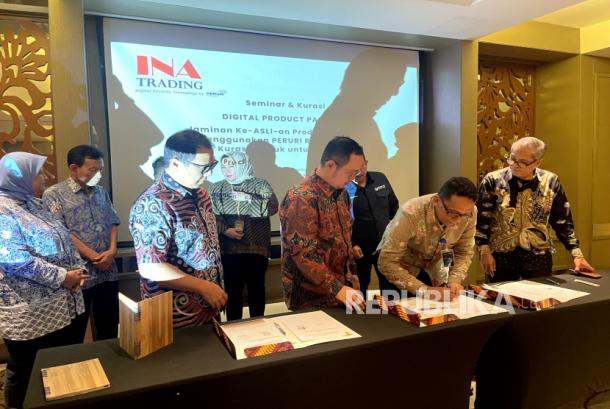
“European regulations for the implementation of RFID and blockchain will come into effect in 2030. The Digital Product Passport will eventually be mandatory for every product shipped to Europe. INA Trading serves to connect businesses with buyers worldwide, while simultaneously ensuring that marketed products have guarantees of authenticity through PERURI RFID Blockchain technology, which can be scanned using the INA Trading mobile application,” said Amiranto during the PERURI RFID Blockchain Seminar and Curation on Friday (26/06/2026).
Muchrizal, CEO of PERURI Smart Card, explained that this technology is also used to calculate carbon footprints throughout the production chain. Calculations are performed using Internet of Things (IoT) devices installed on organic lands, transport fleets, and production facilities.
“All the IoT devices we use are connected to the INA Trading and PERURI Digital Security platforms for the implementation of RFID and blockchain,” said Muchrizal.
During this West Java product curation event, Pundi/INA Trading established collaborations with Polaris and Java Spices/Archipelago to apply PERURI RFID Blockchain to spice products and bamboo crafts, such as chairs, tables, and home decorations, targeting markets in the Netherlands, Serbia, and several Eastern European countries.
These products are planned to be shipped to the Netherlands using containers to meet the requirements for End of Year Sales 2026 in the European market.
However, technological readiness must be balanced with marketing strategies tailored to the character of each target country. Marketing communications consultant Ginung Pratidina noted that businesses need to adjust packaging design, colour selection, and social media storytelling to ensure products are more easily accepted by European consumers.
Through the implementation of the Digital Product Passport, consumers will simply need to scan the RFID embedded in the product to obtain information regarding the origin of raw materials, artisan identity, production location, materials used, carbon footprint, certifications, and the authenticity status verified via blockchain technology.
In its implementation, PERURI Digital Security provides digital signature technology, smart contracts, and digital security systems to maintain product data integrity. Meanwhile, Pundi provides the blockchain infrastructure and digital platform that records the entire journey of the product transparently, making it more difficult to manipulate.