
West Java Revenue Agency Promotes Samsat Kiosk Innovation at National Dukcapil Meeting
The West Java Regional Revenue Agency (Bapenda Jabar) has introduced the use of demographic data to digitalise motor vehicle tax payment services. This innovation is realised through the Samsat Kiosk, which allows the public to pay vehicle tax without having to visit a Samsat office or be served directly by an officer.
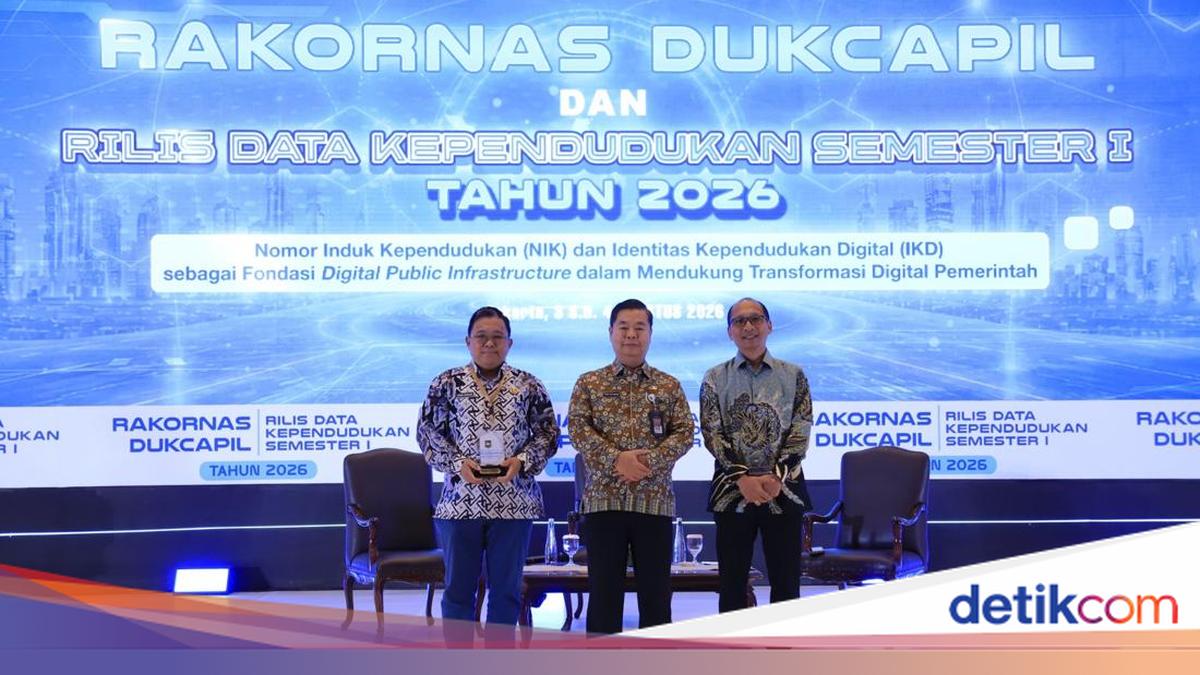
Dwi Agus Sulistyo, Head of the Revenue Information System Management Division at Bapenda Jabar, stated that utilising population data is part of the agency’s effort to increase locally-generated revenue (PAD), particularly from the motor vehicle tax sector. He made the remarks during the National Coordination Meeting (Rakornas) of Dukcapil and the Release of Semester I 2026 Population Data held at Hotel Bidakara, Jakarta. During the session, he explained the practical application of population data used by Bapenda Jabar to support regional tax services.
“Alhamdulillah, we were given the opportunity and honour to share our experience regarding the use of population data at the West Java Bapenda. We are very grateful to be able to integrate the use of population data in an effort to increase locally-generated revenue, especially for motor vehicle tax,” Dwi said during the ‘Sharing Session on Good Practices for Utilising NIK and IKD for Regional Public Services’ on Tuesday (4/8/2026).
Dwi explained that motor vehicle tax payments have traditionally involved the Samsat Development Team, which consists of three institutions: the police (West Java Regional Police) as the coordinator, the regional government through Bapenda, and PT Jasa Raharja. Each institution has its own authority in the vehicle tax service process. According to Dwi, the use of population data can be carried out without diminishing the authority of each institution. One of the benefits is expanding public access to tax payment services.
“We looked for an alternative where, without the presence of officers, the public could still pay their taxes. Because essentially, according to the authority of our police partners in registration and identification, the person paying the tax must be the owner and cannot be represented,” Dwi explained. To address this need, Bapenda Jabar utilises a population data-based system that can support the identification process of taxpayers. The technology used includes fingerprint reading via a card reader, face recognition, and Digital Population Identity (IKD). “So, even without an officer present, we can receive revenue from motor vehicle tax,” he said.
The innovation is realised through the Samsat Kiosk. According to Dwi, the existence of this device is a solution to the limited number of officers while simultaneously expanding service points for motor vehicle tax payments. “We substitute this with a device we call the Samsat Kiosk,” he stated. Currently, Bapenda Jabar has 175 Samsat Kiosk units placed in various community activity centres. Locations include shopping centres, government centres, Bank BJB office networks, and remote areas. Dwi mentioned that the placement of Samsat Kiosks in various locations aims to bring services closer to the community. In the future, the agency hopes to expand the number of devices further. “Ideally, we hope for one device per village. So that people find it easier to pay taxes, they don’t have to travel far to a limited number of Samsat offices, but can do it in their own neighbourhood,” he said.
The Samsat Kiosk offers various services, including annual vehicle tax payments, transfer of ownership, motor vehicle tax information, income tax (PPh), land and building tax (PBB), land and building acquisition duty (BPHTB), other regional taxes (PDL), and regional levies (RD).
On the other hand, regional tax management still faces the challenge of taxpayer databases that are not always up-to-date. This condition can hinder service effectiveness and potentially cause regional revenue leakage. Therefore, the integration of the population database is an important part of supporting the transformation of regional tax services. Valid population data can become a single source of truth to ensure the accuracy of taxpayer identities. This integration can also help improve bureaucratic efficiency and become a foundation for developing digital-based tax services. Bapenda Jabar itself is reportedly capable of receiving approximately 25,000 data hits per day to support this data utilisation process. The use of population data and the Samsat Kiosk is ultimately directed at creating easier and more accessible motor vehicle tax payment services, while supporting the optimisation of locally-generated revenue.
Meanwhile, the Director General of Dukcapil at the Ministry of Home Affairs, Teguh Setyabudi, appreciated the innovation carried out by Bapenda Jabar through the Samsat Kiosk. According to Teguh, technological developments mean public services need to continuously adapt to the public’s usage patterns of digital devices. He assessed that the current existence of the Samsat Kiosk is a positive step to bring services closer to the community. However, going forward, he believes the service needs to be more integrated with devices already used daily by the public, especially mobile phones. “We appreciate Bapenda West Java. We must anticipate the development of the Samsat Kiosk,” Teguh said. “In the past, Dukcapil had ADM, it still exists now, but it is starting to be abandoned because people can access services using their mobile phones,” he added. According to Teguh, a similar pattern could be applied to the Samsat Kiosk service in the coming years.