
West Java Regional Police Construct Boreholes to Anticipate Drought
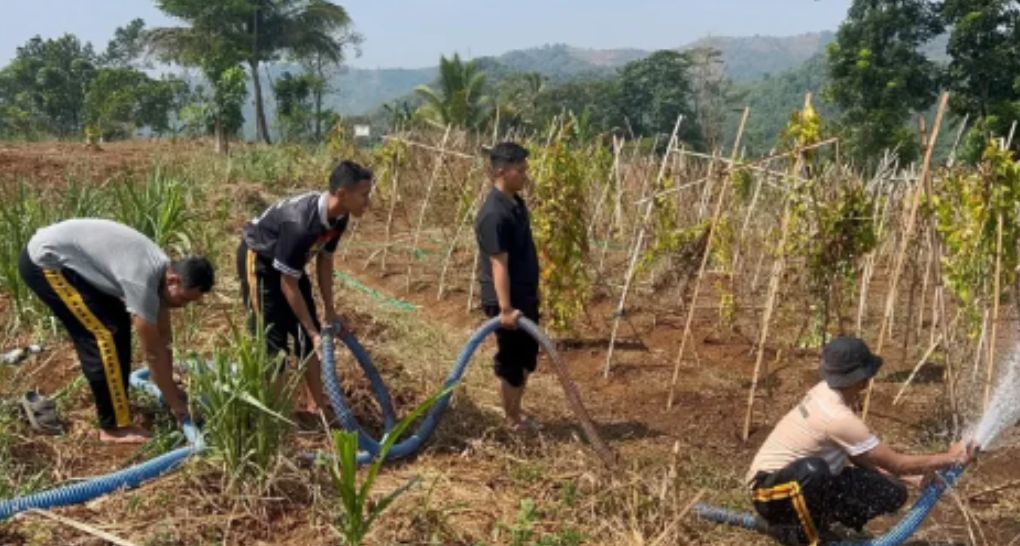
The West Java Regional Police (Polda Jabar), through its Human Resources Bureau, is strengthening its anticipatory measures against the peak of the dry season by constructing boreholes and distributing clean water to several farmlands owned by supervised farmer groups (poktan). This initiative is designed to prevent droughts that could potentially lead to crop failure, particularly for corn, which is a key component of the national food security programme.
As the dry season begins to reduce water availability in several areas, Polda Jabar is intensifying various mitigation steps to ensure agricultural productivity remains stable. In addition to the construction of boreholes, clean water distribution is being carried out regularly to farmlands requiring additional water supplies.
AKBP Condro Sasongko, Head of Career Development at the West Java Regional Police HR Bureau, stated that these steps are part of the force’s commitment to maintaining the sustainability of food security programmes implemented alongside supervised farmer groups. “These efforts are a form of mitigation by Polda Jabar to maintain the continuity of corn cultivation and minimise the impact of drought on food security programmes. The programme focuses not only on corn cultivation but also on purple sweet potato. In addition to fertilisation, both commodities require sufficient water availability to grow optimally until harvest. Prolonged drought due to the dry season or the El Niño phenomenon has the potential to reduce production yields or even cause crop failure,” he explained.
According to Condro, such conditions not only disadvantage farmers but could also hinder the achievement of food security targets. As an anticipatory measure, the police are providing assistance for borehole construction in several areas where supervised farmer groups are located. These boreholes are expected to serve as alternative water sources when irrigation levels or river flows decrease.
“We are providing borehole construction assistance to several farmer groups within the West Java Regional Police jurisdiction as an alternative water source to support agricultural irrigation needs. Besides building borelar, we are also deploying water tankers to distribute clean water to farmlands. The water is sourced from the Jatiluhur Reservoir before being distributed to lands requiring additional water supply during the dry season,” he added.
Condro noted that each farmland receives a supply of two water tankers daily to ensure plants do not suffer from drought stress. Furthermore, West Java Regional Police personnel are involved in monitoring irrigation channels and river flows to ensure water distribution is maximised for the farmers.
Based on data from Polda Jabar, between January and July 2026, corn and purple sweet potato have been planted across 18,000 hectares, reaching approximately 85.70 per cent of the 21,014-hectare target. Meanwhile, corn absorption by Bulog has reached 8,891 tonnes, or about 17.78 per cent of the 50,000-tonne target, while absorption by feed factories has reached 212,000 tonnes. Polda Jabar hopes these mitigation steps will maintain agricultural productivity and ensure food security targets are met.