
West Java Regional Legislative Commission III Appreciates KDM's Commitment to Optimising Taxes for Development
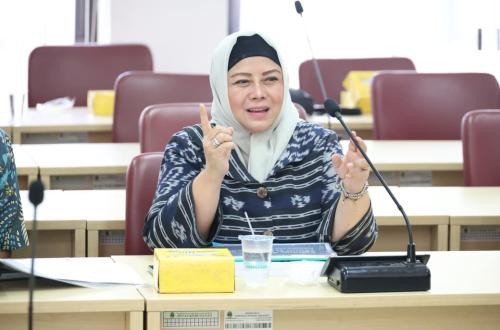
Tina Wiryawati, a member of Commission III of the West Java Regional Legislative Council (DPRD), has expressed appreciation for the commitment of West Java Governor Dedi Mulyadi (KDM) to optimising motor vehicle tax revenue to support development across various regions.
According to Tina, public compliance in paying vehicle taxes plays a vital role in the local government’s ability to finance development and public services. Therefore, public awareness must be continuously maintained and accompanied by transparency in budget utilisation.
“The taxes paid by the community ultimately return to the community through development and services. This is what we must continue to encourage, so that the public becomes increasingly aware that paying taxes is part of the mutual cooperation to build West Java,” Tina stated on Friday (5/9/2026).
She noted that several programmes presented by the Governor—ranging from the construction of road infrastructure, drainage, and street lighting (PJU) to pavements, as well as increasing the capacity of SMA and SMK schools—are essential needs that directly impact the community.
Tina also highlighted the government’s attention to the healthcare sector. In her view, efforts to ensure that the public continues to receive healthcare services, including for citizens not yet covered by BPJS, require supervision to ensure implementation is targeted and does not create new problems in the future.
“Healthcare services are a basic right of the community. The government must be present when citizens need assistance,” she said.
Furthermore, she appreciated the programme for connecting electricity to communities that have not yet enjoyed access to electricity. She hopes that this programme can be accelerated so that all residents of West Java can obtain access to this basic necessity.
On the other hand, Tina reminded the importance of organising irrigation channels and managing spatial planning. In her view, the existence of water channels is closely related to agricultural productivity as well as efforts to reduce flood risks.
She also supported the push for regency and municipal governments to improve regional governance to make it cleaner, more organised, and more comfortable.
Tina assessed that criticism from the public towards the government is an important part of the development process. Constructive criticism, she said, can serve as material for evaluation to ensure government policies are increasingly well-targeted.
“Development cannot be immediately perfect. What matters is the will to continuously improve deficiencies and listen to public input,” she concluded.