
West Java Regional Council Highlights Strengthening of BIJB and Bureaucratic Restructuring
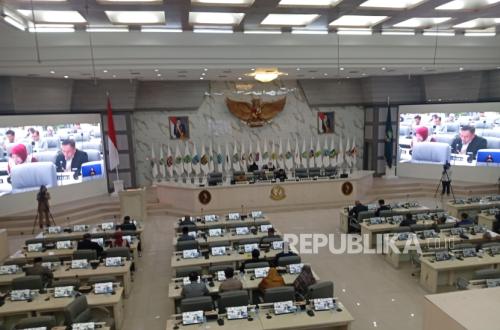
The West Java Regional Council held a plenary session on Monday (28/09/2026) to present the general views of various factions regarding two Draft Regional Regulations (Ranperda). These regulations pertain to the second amendment of West Java Regional Regulation Number 22 of 2013 regarding the establishment of the Regional Owned Enterprise (BUMD) managing the West Java International Airport (BIJB) and Kertajati Aerocity, as well as the formation and structure of regional apparatus.
The Deputy Chairman of the West Java DPRD, Iwan Suryawan, stated that the meeting was a follow-up to the plenary session on 11 September 2026, which featured the Governor’s introductory note on the two draft regulations. For the sake of efficiency, only the PAN Faction read its views aloud, while other factions submitted their perspectives directly to the council leadership.
The next stage will involve the West Java Provincial Government providing the Governor’s response to the factions’ views during a plenary session scheduled for 30 September 2026.
In the general view presented by the Deputy Chairman of the PAN Faction, Toto Suharto, several strategic notes were raised regarding both draft regulations. A primary concern involves the strengthening of PT BIJB and the development of the Kertajati Aerocity area. According to Toto, BIJB and Kertajati Aerocity are strategic assets for West Java; therefore, regulatory changes must be accompanied by improvements in governance, capitalisation, and business strategy.
In the Governor’s introductory note, the authorised capital of PT BIJB is proposed to increase from Rp2.5 trillion to Rp8 trillion. This increase is intended to accommodate plans for capital injection via land ownership through the inbreng mechanism, financial restructuring, and to create opportunities for strategic investors. Toto argued that the capital increase should not be viewed merely as an administrative adjustment.
“The amendment to the Regional Regulation must not stop at administrative aspects or capital adjustments. There must be a business reorientation and an improvement in the performance of the BUMD,” he stated.
PAN also requested that the West Java Provincial Government provide a measurable roadmap for the commercialisation of Kertajati Aerocity, including the diversification of non-aeronautical revenue streams. Such steps are deemed essential to ensure that the area’s development strengthens the financial performance of PT BIJB. Furthermore, ownership structures and the protection of regional assets remain a priority. The Provincial Government is urged to ensure that the entry of strategic partners does not diminish regional interests or compromise strategic control over BIJB.
Development in Kertajati, Toto added, must provide broader benefits to local communities, particularly in the Majalengka Regency and the Ciayumajakuning area. The involvement of local MSMEs, labour absorption, partnerships with regency and city-level BUMDs, and the integration of transport and logistics must be strengthened.
PAN also encouraged the implementation of good corporate governance through transparency, accountability, independence, responsibility, and fairness. The performance evaluation of directors and commissioners should utilise measurable indicators.
Regarding the Draft Regional Regulation on the Formation and Structure of Regional Apparatus, PAN emphasised the importance of bureaucratic restructuring based on actual needs and workload. Toto stated that the principle of ‘right-sizing’ should be applied to ensure the organisational structure remains efficient without compromising the quality of public services. Efficiency is also expected to reduce operational and personnel expenditures, thereby increasing the fiscal space within the Regional Budget (APBD) for education, health, basic infrastructure, and MSME empowerment.
Digitalisation through the Electronic-Based Government System (SPBE) must also be strengthened to ensure public services are more accessible and transparent. “The institutional transition process must not disrupt public services or strategic regional programmes. The placement of civil servants (ASN) must be conducted professionally based on competence, following the principle of ‘the right man on the right place’,” said Toto.
He concluded that the restructuring of regional apparatus must respond to the needs of West Java, ranging from strengthening research and innovation, disaster management, and food security to the development of the creative economy.