
West Java MES Prepares Sharia Economic Movement Based on Cooperatives and MSMEs
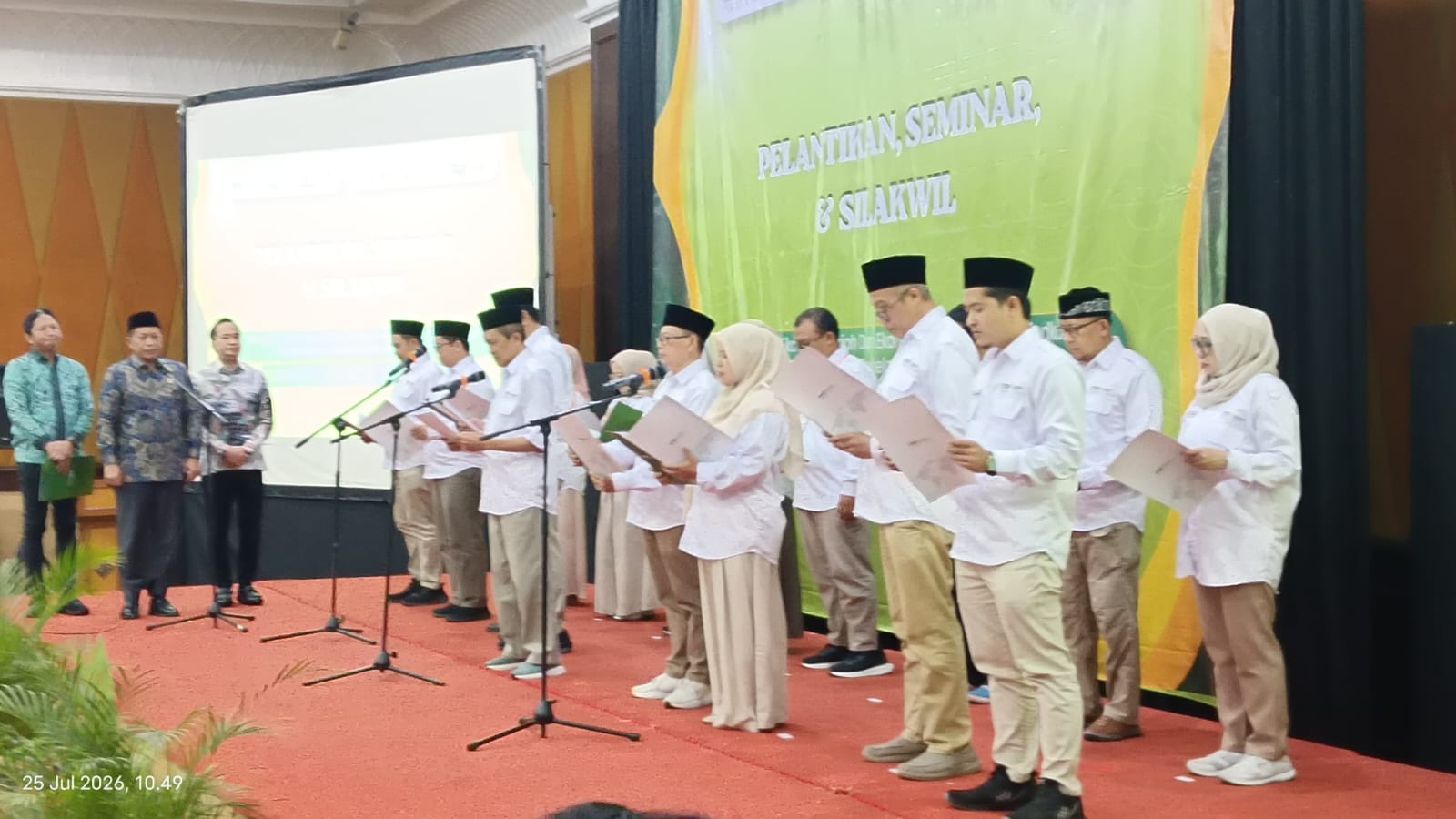
The West Java Sharia Economic Society (MES) continues to strengthen its ranks. That spirit was on display at the inauguration of its new management for the 2026–2029 term on Saturday (25/7) in Bandung.
The new officials were sworn in by the Daily Chairman of the MES Central Executive Board, who is also the Minister of Cooperatives, Ferry Juliantono.
The Minister asked MES West Java to change the organisation’s direction of movement. If the sharia economy has so far largely operated in the space of literacy and education, the new leadership has been asked to shift towards real implementation through the development of cooperatives, MSMEs, and sharia-based businesses.
MES West Java Chairman Harry Maksum expressed his readiness to embrace the directive from the chairman of the central board.
“The organisation is now assigned to be a driver of productive economics that directly touches communities. We have been directed by the Daily Chairman to focus purely on implementation — business implementation,” he said.
The daily chairman also asked MES West Java to establish cooperatives and other business entities, whilst simultaneously taking an inventory of Muslim entrepreneurs.
One of the programmes being prepared is the formation of mosque-based sharia cooperatives.
According to Harry, the government has opened the door to financing support for such cooperatives.
“The Minister hopes MES will go into business. He even wants mosque-based sharia cooperatives gathered together, to be financed by the Minister and the head of Danantara. One mosque could receive Rp1 billion,” he said.
SHARIA FINANCIAL SERVICES
According to him, the challenge for the sharia economy today is no longer a lack of public understanding, but rather the limited use of sharia financial services. The National Survey on Financial Literacy and Inclusion shows sharia financial literacy has reached around 43%, whilst the inclusion rate stands at only about 13%.
“This means there are already quite a lot of people who understand the sharia economy, but few use sharia financial instruments. Out of 100 people, only around 13 make use of them. So there is still a gap we need to close,” Harry stressed.
For that reason, MES West Java will champion a range of productive economic programmes, from strengthening sharia cooperatives and empowering MSMEs, to building economic infrastructure such as solar petrol stations and ice factories for fishermen.
“The essence of the programme is operational. MES is now being pushed to not merely talk about concepts, but to genuinely be present and run business activities that benefit the public,” he continued.
Meanwhile, the West Java Provincial Government has also urged the sharia economy to move into the real sector. H Sumasna, Regional Assistant for Economy and Development, representing the Governor of West Java, assessed that economic growth is not enough if it cannot reduce unemployment and poverty.
Although West Java’s economy grew 5.79% in the first quarter of 2026 — higher than the national figure — the open unemployment rate still stands at 6.64%, with the poverty rate at 6.78%.
The government has also highlighted the prevalence of high-interest lending practices, known as ‘Bank Emok’, which continue to ensnare communities.
“Our economic growth is high, but access to the benefits of that growth is not yet inclusive. There are sectors growing rapidly, but the benefits have not yet been felt evenly across society,” Sumasna explained.
CREATING NEW ENTERPRISES
Previously, Ferry Juliantono judged that the sharia economic movement had spent too long confined to the seminar room. In fact, he said, the measure of success for the sharia economy is the ability to create new enterprises and open up employment.
“The literacy is sufficient. Now is the time to perform directly in the real sector,” he declared.
He asked MES to map out potential Muslim business actors for development. The government is also preparing mosque-based cooperatives together with Baznas, the Indonesian Mosque Council, the Ministry of Religious Affairs, and Danantara, as centres of economic activity for the community.
For Ferry, cooperatives are the primary instrument for breaking people’s dependence on loan sharks and ‘Bank Emok’.
“Fighting Bank Emok with a haram fatwa alone is not enough. What is needed is to provide a real alternative for the public,” he said.
The government is also preparing the Red-and-White Village/Neighbourhood Cooperatives as financing distribution channels, including for people’s business credit (KUR), whilst simultaneously shortening the distribution chains of various strategic commodities.
“The Red-and-White Village Cooperatives become new state infrastructure to break distribution chains that are too long,” he explained.
He acknowledged that these measures would confront the interests of groups that have long enjoyed economic rent-seeking practices.
“My enemies are indeed growing in number. But because the President supports me, I have become emboldened,” he asserted.