
West Java Hajj Ministry Office Supports Poverty Alleviation Through Local Economic Empowerment
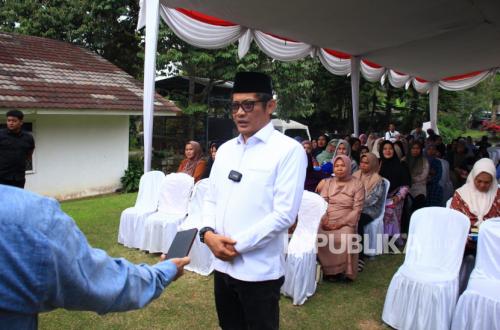
The West Java Regional Office of the Ministry of Hajj and Umrah (Kemenhaj) is fully supporting poverty alleviation efforts through the economic empowerment of local communities. Head of the West Java Kemenhaj Regional Office, Boy Hary Novian, stated that his office is ready to collaborate with all stakeholders to drive the hajj economic ecosystem so that its impact can be directly felt by the public. “We from the West Java Kemenhaj Regional Office will encourage hajj and umrah organisers such as travel agencies, PPIU, and KBIH to utilise and involve local community businesses,” Boy Hary said during a Hajj Preparation Socialisation event held by the Ministry of Hajj and Umrah with Member of Commission VIII of the House of Representatives, Muhamad Abdul Azis Sefudin, in Cianjur, West Java, on Saturday (18/7/2026). Boy assessed that the market potential of the hajj and umrah ecosystem is very large. In West Java, the number of umrah pilgrims can reach 400,000 to 600,000 people annually, in addition to around 30,000 regular hajj pilgrims. If this potential is managed domestically, the economic turnover is believed to significantly boost the welfare of local communities. “Therefore, Kemenhaj West Java urges pilgrims in the future to prioritise buying souvenirs in Indonesia. Additionally, the government now requires that consumption components for pilgrims in the holy land, such as rice and spices, must be supplied directly from Indonesia,” he said. Boy Hary explained that Kemenhaj West Java wants the benefits of hajj and umrah, which have not been significantly felt by the community so far, to also contribute to economic growth, particularly in West Java. “Considering that trillions of rupiah of pilgrims’ money has been spent in Saudi Arabia, even though products like prayer mats, prayer beads, and food supplies are sourced from other countries. We want the hajj economic ecosystem in our region to run consistently and benefit our community in the future,” he said.