
West Java Governor's Approval Rating Hits 95.4 Percent, but Awareness of Key Education Programmes Remains Low
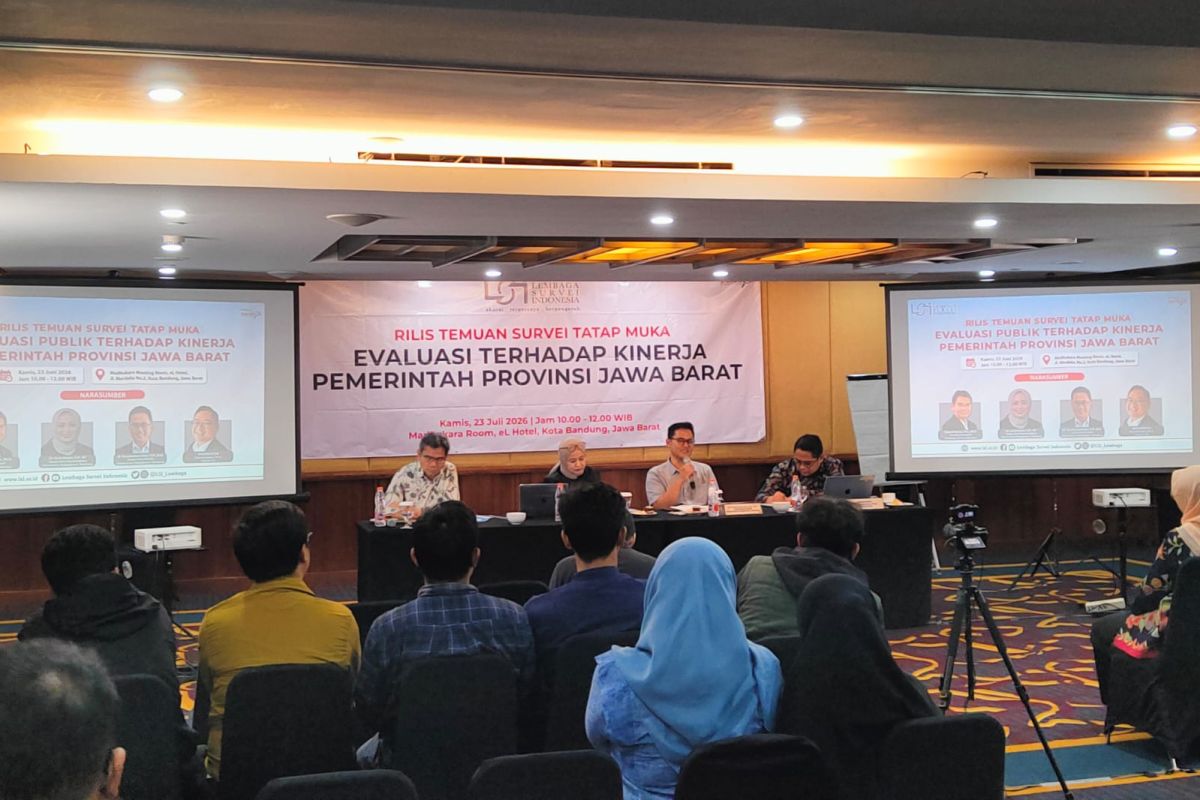
Bandung (ANTARA) - The Indonesian Survey Institute (LSI) has recorded a remarkable public satisfaction rating of 95.4 per cent for the performance of West Java Governor Dedi Mulyadi (KDM), even though public recognition of the region’s flagship programmes, such as those in education, remains below 50 per cent.
LSI Executive Director Djayadi Hanan set out the breakdown of the satisfaction figures, comprising 39.3 per cent of respondents who said they were very satisfied and 56.1 per cent who said they were fairly satisfied.
“Meanwhile, respondents who said they were dissatisfied stood at 3.3 per cent, while those who said they were not satisfied at all amounted to only 0.5 per cent. A further 0.8 per cent of respondents answered that they did not know or gave no response,” Djayadi said in Bandung on Thursday.
According to the release of the survey evaluating the performance of the West Java Provincial Government, the dominance of positive public perception is underpinned by high appreciation for infrastructure development and governance that is seen as responsive.
Djayadi concluded that the overall level of public dissatisfaction sits at a very marginal 3.8 per cent.
He said the high satisfaction rating for KDM’s leadership is driven by three main factors: positive assessments of the running of government (60.2 per cent rated it good), a perception of economic conditions as tending towards stable or moderate (44.3 per cent), and the performance of basic public services on the ground.
“The aspects with the highest appreciation are infrastructure development and basic services, whilst the economy remains the government’s main challenge, although more than half of respondents still expressed satisfaction with its performance,” Djayadi said.
He noted an interesting finding from the survey: LSI identified a public communication gap surrounding a series of strategic education programmes, such as the New Student Admissions System (SPMB), Cooperative Private Schools (SSK), and the Sekolah Manusia Unggul (Maung) programme, which are fully supported by most residents who know of them but are not yet widely recognised.
“However, the level of public awareness or recognition of these programmes is still relatively low, at below 50 per cent,” he said.
The LSI survey was conducted from 2 to 9 July 2026 across 27 regencies and cities throughout West Java, using a multistage random sampling method involving 800 respondents distributed proportionally.