
West Java Governor: Integrated, Equitable Public Transport is a Basic Need
West Java must be fair. Large cities may be developing, but villages must also feel the benefits of development. Basic infrastructure must reach all levels of society.
Bandung (ANTARA) — West Java Governor Dedi Mulyadi (KDM) affirmed that the availability of integrated, digitalised and equitable public transport has now become a basic need for metropolitan residents, following the official start of construction on the Bandung Basin Bus Rapid Transit (BRT) infrastructure project.
“This is a joyous moment for the people of Bandung Raya. We hope the construction proceeds safely, smoothly, without disruption, and delivers high-quality infrastructure,” Dedi said in a statement in Bandung on Wednesday.
Dedi noted that with the region’s large population and ongoing growth, demand for public transport is steadily rising.
The man familiarly known as KDM stressed that surging public transport passenger traffic must be matched with extra security, adequate sanitation facilities, proper pavements and street lighting to curb the potential for crime — not only in Bandung Raya but across the whole of West Java.
“West Java must be fair. Large cities may be developing, but villages must also feel the benefits of development. Basic infrastructure must reach all levels of society,” he said.
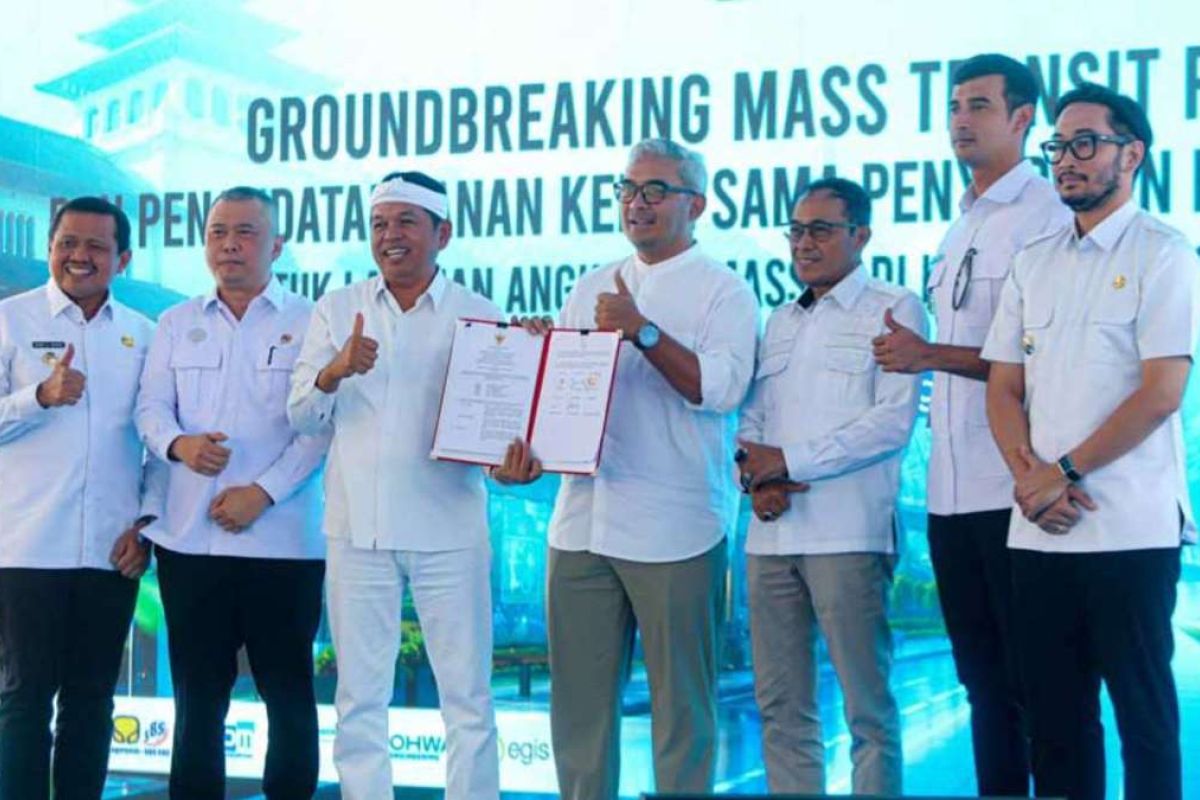
Construction of the Bandung Basin BRT, part of the road-based Indonesia Mass Transit Project (Mastran), was symbolically launched with a groundbreaking ceremony at Leuwipanjang Terminal in Bandung City on Wednesday (22/7), with the target of full operations by 2027.
The modern mass transit system, valued at Rp1.3 trillion in investment, is projected to be supported by 21 kilometres of dedicated lanes, 6 main depots, 753 bus stops, and the implementation of an Intelligent Transportation System (ITS).
Elsewhere, Minister of Transport Dudy Purwagandhi explained that reorganising mobility through the BRT is a long-term solution to reduce congestion, which erodes productivity and drives up logistics costs in the Bandung Basin area.
“Today’s groundbreaking is a historic milestone in delivering modern public transport. We want to provide public transport that is comfortable, safe, punctual, affordable and integrated, so that it becomes people’s primary mobility option,” Dudy said.
Director General of Land Transport at the Ministry of Transport Aan Suhanan detailed that the Mastran project is financed by the Indonesian government, the World Bank and the Agence Française de Développement (AFD), with the Bandung Basin BRT portion covering 719 off-corridor stops and 34 on-corridor stops.
The first phase of construction will focus on off-corridor stops, the Cicaheum Depot, the Leuwipanjang Depot and the main BRT route, followed by subsequent phases for iconic stops and depots in Cimenyan, Padalarang, Soreang and Majalaya.
“Going forward, the BRT system is targeted to have a maximum waiting time (headway) of 7 minutes during peak hours and 15 minutes outside peak hours. We are optimistic that all works can be completed on target,” Aan explained.