
West Java Governor Guarantees Free Private Schooling for the Poor After State School Admission Chaos
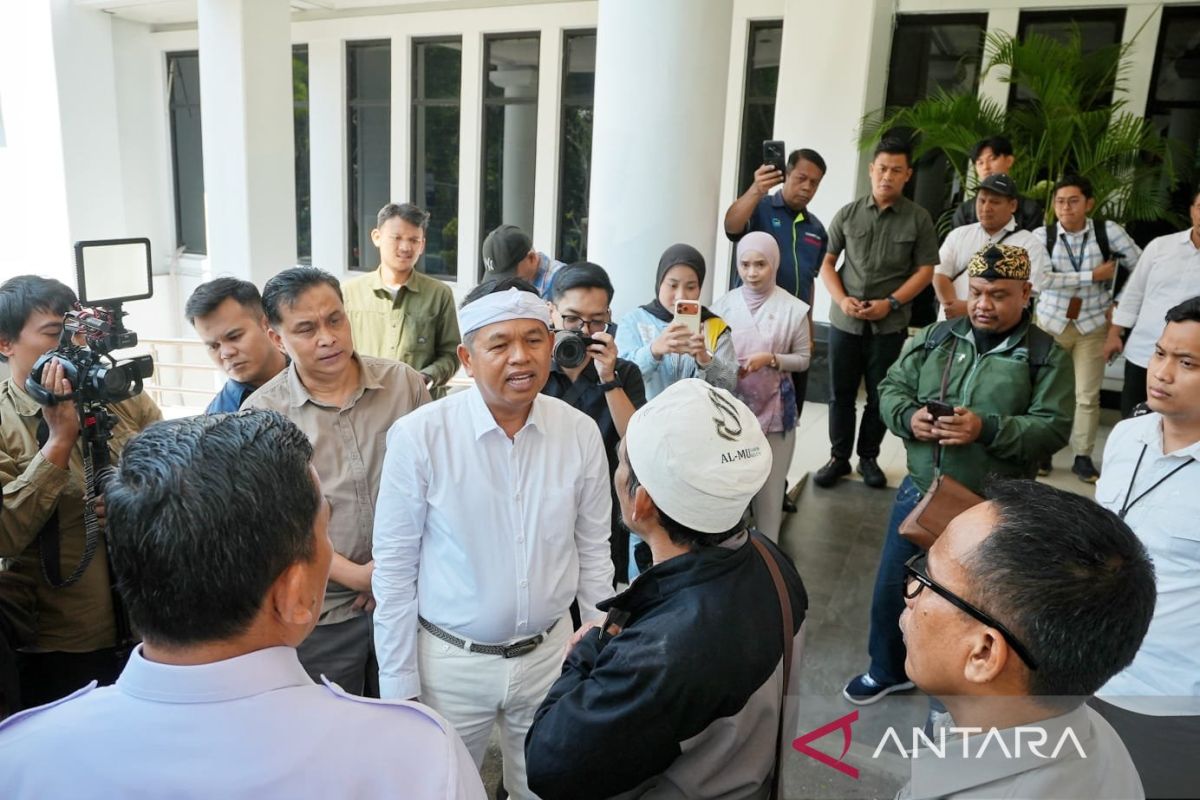
Bandung (ANTARA) - West Java Governor Dedi Mulyadi has reaffirmed that private schools will be guaranteed to be free, albeit on a limited basis, for economically disadvantaged residents following the recent unrest surrounding the Senior High School/Vocational High School (SMA/SMK) New Student Admission System (SPMB) in West Java.
The West Java Provincial Government guarantees financial support for affected residents—specifically those who failed to secure spots through the SPMB, particularly from vulnerable economic clusters—to ensure they can continue their education in the private sector. This serves as a concrete solution to the limited capacity of state SMA/SMK schools, said Dedi.
“For those who do not have the opportunity to be mapped into state schools, there are still private schools. For those whose parents are unable to afford it, the West Java Provincial Government guarantees free education costs for poor children in private schools,” said KDM, his familiar nickname, in a statement in Bandung on Friday.
Dedi emphasised that the anger expressed by parents whose children failed the New Student Admission System (SPMB) during the New Student Mapping (PCMB) phase for state SMA/SMK is not the fault of the citizens, but rather a reflection of the government’s failure to provide equitable educational facilities.
He made these remarks following a viral incident involving a parent protesting at the West Java Education Office (Disdik) due to their children being at risk of being displaced from state school quotas.
“Today, if many parents are angry because their children were not mapped into state schools, it is not the fault of the parents, but our fault as the state organisers,” Dedi stated.
According to Dedi, the local government has not yet been able to accommodate all prospective students into the government-owned education ecosystem.
“Because we cannot yet prepare state schools and state teachers for all the people. That is the mistake,” Dedi said.
Dedi revealed that the intense competition within the SPMB is exacerbated by applicants from outside the regional mapping who are also vying for certain schools. As a result, the positions of local prospective students are being displaced.
“Without mapping, their children face competition from new applicants and children who did not enter their previous target schools and subsequently apply to these schools. Consequently, the children’s rankings drop, leading parents to feel their children may not be mapped into state schools,” he said.
Regarding the protest at the West Java Education Office, Dedi revealed that the parent in question initially refused to provide their child’s identity or target school when officials attempted to assist.
“They said they would withdraw the data, but did not provide the data. But that is fine. The government must be willing to accept any emotion from its citizens. The important thing is that we want to provide the best service,” he said.
Responding to public pressure to return the admission system to a simpler parameter, such as the National Exam Score (NEM), Dedi admitted he was in agreement. However, he reminded that such regulations fall strictly under the domain of the central government.
“Provisions regarding graduation and entry into state schools are all regulated by the Ministry of Primary and Secondary Education. We only follow the provisions and align ourselves with what the ministry has established,” he said.
He even joked about what he would do if given the authority over the bureaucracy.
“If the authority were given to me, I would make it as simple as possible,” Doughty added.