
West Java Education Office Prepares 'Jabar Sakola' Programme to Reduce Dropout Rates
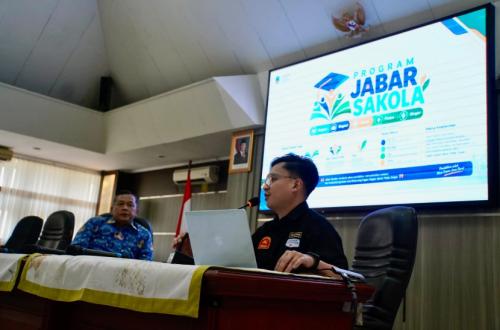
The West Java Provincial Education Office (Disdik) has begun socialising its latest educational breakthrough, known as the Jabar Sakola Programme (PJS). This programme is designed to expand educational access for the community and reduce dropout rates in West Java through a series of comprehensive educational assistance schemes.
The socialisation event was held at the Dewi Sartika Hall, West Java Education Office, Bandung, on Thursday (1/10/2026). The event was attended by all departments within the West Java Education Office and representatives from Regional Education Branch Offices (KCD) Regions I-XIII.
Mohammad Ibrahim, Head of the ICT Unit (UPTD Tikomdik) of the West Java Education Office, stated that the Jabar Sakola Programme is a transformation of previous educational scholarship programmes. To ensure that assistance is accurately targeted, the West Java Education Office has precisely matched recipient data with the Integrated Social Welfare Data (DTKS) to prevent duplication with central government assistance, such as PIP or PKH.
“Our hope is that through this opportunity, we can all understand and implement this Governor’s policy programme to the best of our ability. This ensures that educational assistance is truly felt by the students in need,” he said.
In line with this, the Head of the Senior Secondary Education Division (PSMA) of the West Java Education Office, Ai Nurhasan, emphasised the office’s commitment to maintaining the programme’s accuracy. He instructed all personnel across the 13 Regional Branch Offices to work hard in conducting factual field verifications.
“Colleagues in the branch offices will go directly into the field to verify data. This is to ensure that the assistance programme is distributed precisely to the residents of West Java who are truly entitled to receive it,” he asserted.
The implementation of the Jabar Sakola Programme policy is divided into four main assistance schemes prepared for students in SMA (Senior High School), SMK (Vocational High School), and SLB (Special Needs School) who are currently enrolled. The four schemes include:
PJS Personal: Funding assistance aimed at students from vulnerable families (decile 1) who do not receive PKH/PIP. This assistance focuses on meeting students’ personal needs to prevent the risk of dropping out, such as the purchase of uniforms, books, and daily transport costs.
PJS Operasional: Assistance to reduce the annual tuition fee (SPP) burden for 11th and 12th-grade students in private schools within the vulnerable categories (decile 1 and 2). Specifically for private SLB (Special Needs Schools), all students will receive this assistance regardless of economic decile criteria.
PJS Private School Partnership (SSK): Financial assistance covering the Educational Contribution Fund (DSP) as well as monthly tuition subsidies. This programme is intended for students attending private SMA/SMK schools that have established a Memorandum of Understanding (MoU) with the West Java Provincial Government since the New Student Admission System (SPMB) era.
PKS Industrial Partner: A full educational scholarship programme providing opportunities for selected students to attend vocational schools (SMK) in the Bekasi Industrial Partner area. Students will be fully funded for three years until graduation and prepared for integration into the workforce.
Through the introduction of the Jabar Sakola Programme, the West Java Provincial Government hopes that no more children will be forced to drop out of school due to financial constraints. The programme is also expected to achieve educational equality to create an exceptional generation for West Java.