
West Java Considers Reinstating Tuition Fees for Affluent High School Students
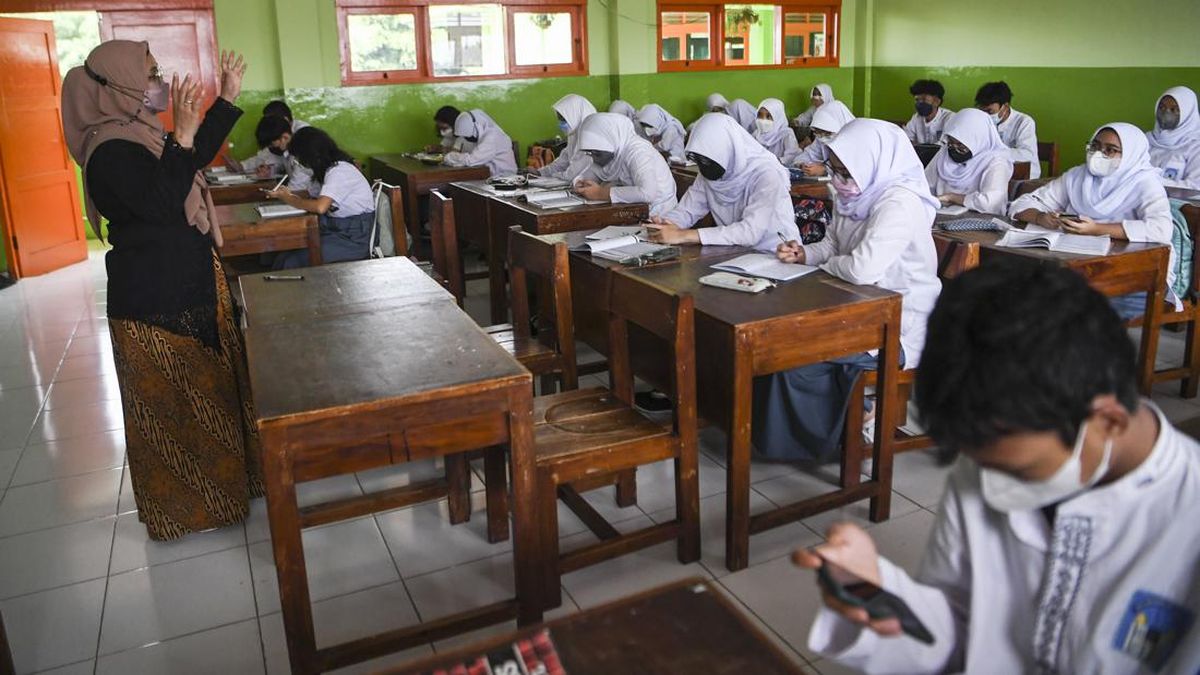
The Provincial Government of West Java and the West Java Regional People’s Representative Council (DPRD) have begun deliberating a proposal to reactivate the Education Development Contribution (SPP) for students from affluent families during a working meeting of the Special Committee for the Draft Regional Regulation on Education Implementation this week. The proposal emerged as a solution to cover shortfalls in school operational costs. If implemented, students will resume monthly payments.
Thus far, the emerging proposal is that the reactivation of SPP payments will not be imposed on all students, but only on those from affluent families or those in Desil 6 to Desil 10 categories. Meanwhile, students from poor and near-poor families in Desil 1 to Desil 5 will continue to receive free education.
The Head of the West Java Education Office, Purwanto, stressed that the proposal is still under discussion and has not yet become an official decision. “It is still under discussion. So, we will see what happens, what hopes emerge from these talks,” Purwanto said after a meeting at the West Java DPRD building on Tuesday (14/7), as quoted by DetikJabar. Purwanto explained that one reason for the proposed reactivation is that many state schools need additional funding sources to improve the quality of educational services.
“Yes, because firstly, an aspiration has emerged that these schools need sufficient budgetary support,” he said. Meanwhile, the Chair of Commission V of the West Java DPRD, Yomanius Untung, stated that the discussion on reactivating SPP for senior high schools (SMA) and vocational schools (SMK)—education levels managed by the provincial government—stems from the fact that the current budget received by schools is far from the ideal requirement for delivering quality education.
Yomanius said the estimated proper cost for a high school student is around Rp4.5 million per year. However, the government can currently only meet approximately 40 per cent of that need. He argued that reactivating SPP would open new funding avenues for schools to improve the quality of learning, from enhancing teacher competency and upgrading facilities and infrastructure to supporting students’ talent development. “If this reactivation proceeds, we are essentially helping the younger generation to receive better learning and knowledge. Because with reactivation, there will be an opportunity for funding to upgrade the quality of teachers, to upgrade teacher competency, and upgrading requires funds,” Yomanius said on Wednesday (15/7), as quoted by DetikJabar.
He explained that school budget requirements are not limited to classroom teaching and learning activities. Additional funds are also needed to repair educational facilities and provide broader opportunities for students to develop their potential through various non-academic activities. Furthermore, Yomanius said that if schools have more adequate budget support, students will have greater opportunities to excel at various levels of competition. “What is the ultimate goal? The ultimate goal is for children to have better quality than they do now. Especially if we look nationally, the IQ of our children, among other things, the quality of our high school graduates is equivalent to the quality of junior high school graduates in the Philippines,” Yomanius revealed.
“Secondly, we still face difficulties competing with other children to enter world-class universities. Not to mention world-class, we often lose out in competition for prestigious national universities,” continued the DPRD member elected from the West Java XI electoral district (Sumedang, Subang, and Majalengka Regencies).
Governor Dedi Mulyadi held a different view. KDM, as he is familiarly known, stated that now is not the time for schools to resume collecting SPP from the public. According to him, before discussing funding sources through the activation of SPP, all schools must first be able to optimally manage the School Operational Assistance (BOS) funds. “We must conduct an in-depth study. Later, if the governor activates SPP, the opinion will be different again, that the governor is not prioritising education,” KDM said on Wednesday, as quoted from DetikJabar.
KDM added that he has toured various high schools in West Java and found that the quality of school management is not solely determined by the size of the budget, but also by the school management’s ability to utilise BOS funds. “The BOS funds, I have visited every school. This school uses BOS funds, and the school is a mess. SMA 1 Depok uses BOS funds, and the school is tidy, and I asked the headmaster, ‘How can your school be tidy?’ ‘Well, we manage it well,’ he said.” Therefore, KDM stated that his current focus is to ensure all schools can manage BOS funds effectively before considering the re-implementation of SPP. If there are still shortfalls, particularly regarding educational facilities and infrastructure, KDM assured that the West Java Provincial Government will step in to assist through the provincial budget.